
Written by Millie Oliver
The 17th century was a period marked by religious, political and cultural upheaval and revolution. As with most periods in history, art often becomes a window into the atmosphere of the period in which it was created, and into the souls of the people who create it.
There is no period more striking or interesting in terms of its artwork than the Baroque period. Spanning from 1600 to 1700, this period marked a point in time where art took on a form it never had before. Baroque artworks had the potential to affect the beholder both spiritually as well as corporeally. Art in this period became less about what it represented or meant, but rather about what it did. It is this fact which made its style so fascinating and distinctive from many of its predecessors such as the Renaissance period. There are two potential etymological origins of the term ‘Baroque’, firstly from ‘barroco’ meaning an irregular or flawed pearl, pointing to the art style’s excess and overflowing boundaries. The second potential origin derives from the Latin word ‘baroco’ something obtuse, obscure, fanciful or useless.
One of the defining features of this era was its gratuitous violence, creating an uncanny sense of psychological immersion. The art seemingly breaks the fourth wall and involves the viewer. There are no Baroque artworks more encapsulating of this feature than Artemisia Gentileschi’s ‘Judith Slaying Holofernes’ from 1612-13. Gentileschi’s most famous artwork illustrates the revolutionary nature of the Baroque period and acts as a prime example of the social impact of paintings with this gruesome nature.
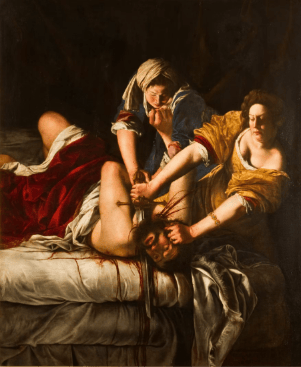
Artemisia Gentileschi grew up the sole woman in her house after the death of her mother in childbirth. She was raised by her father, Orazio Gentileschi, who himself was an acclaimed Baroque artist. From a young age, she showed a natural talent and appreciation for art, producing her first professional work at the age of 15. She was hired by many wealthy and noble families of the time and was notably the first woman to become a member of the Accademia di Arte del Disegno in Florence. Gentileschi is widely considered one of the most accomplished artists of the 17th century and her painting ‘Judith Slaying Holofernes’ stands as a testament to her talent.
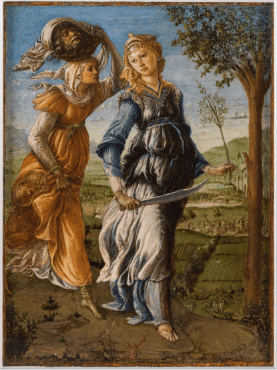
This painting is a dramatic reimagining of a New Testament Catholic story in which the Assyrian King Nebuchadnezzar sends his general Holofernes to besiege the Jewish city of Bethulia. Judith, a Jewish widow determined to protect her people, dons her finest dress and attempts to seduce Holofernes. After he becomes heavily intoxicated, she, with the help of her maidservant, decapitates him, saving their people. This was a very popular tale in the Middle Ages, with Judith being an incredibly popular figure throughout art history due to her virtuous disposition. In the Renaissance period, depictions of Judith often portray her as virginally beautiful, with Boticelli’s depiction showing her as a goddess dressed in richly draped garments.
In the late Renaissance, Judith became a more seductive and aggressive character often being portrayed as an elaborately adorned noblewoman instead of a virtuous saint or goddess figure.
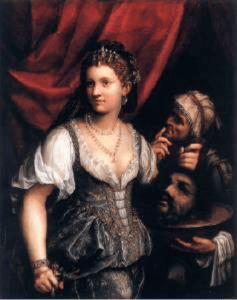
Moving into the Baroque period, Judith became an opportunity to indulge in gore; appearing more as a violent assassin rather than a femme fatale. The story’s popularity belongs to part of a broader narrative of virtue over vice in the religious psychology of the 17th century. The Catholic church at the time was embroiled in conflict with the Protestant movement and the threat of the Ottoman Turks, whose eastern origins facilitated the western alignment with the figure of Holofernes. Many Baroque artists depicted this scene; however, Gentileschi’s differs hugely, portraying Judith as strong and unrelenting, rather than distant.
Gentileschi’s treatment of the Judith and Holofernes narrative is part of a ‘broader assertion of agency’ on her part. It is no secret that many find this piece so captivating because of the parallels it holds to the artists own life. Her artistic achievements until recently were long overshadowed by the story of her rape at 18 years old, at the hands of her art tutor Agostino Tassi. She was tortured for years to give evidence during the subsequent trial in which the judge eventually ruled in her favour. This is a story of a young woman’s survival and courage, but also of her power and agency to take control of her destiny and reclaim her artistic freedom on her own terms in a time where such a phenomenon rarely occurred.
This artwork has all the hallmark features of a classic Baroque painting. The tenebrism creates a dark background contrasted by the figures in the foreground which become dramatically highlighted. The contrast of scale is significant: when the size of Holofernes’s fist was examined in comparison to the maidservant’s face, it took the two of them to subdue him which exposes the drastic force and exertion necessary to complete the task. Additionally, both the women’s arms are fully extended, which serves to emphasise how Holofernes’s legs are bent at the knees, and his arm at the elbow, evoking a sense of dismemberment throughout the rest of his body. What is most memorable about this piece however is the act of the beheading itself: blood spurts from his neck, spreading down the white bedsheets below him. As Holofernes’ head tilts towards the viewer, we become entranced by his helpless gaze.
In a period of such religious intensity and conservatism, it is surprising to see not only a woman have an independent artistic career, but one that was celebrated and recognised across Europe. Similarly, to see a figure such as Judith, a woman with the determination typically only prescribed to men in this period, be so fixated upon by artists and throughout different eras is unexpected. Judith was also celebrated for her vigour and unrelenting strength, rather than vilified, which presents itself as a caveat to the opinions we would typically associate early modern European society as having.
Artemisia’s work exemplifies just how revolutionary the Baroque period was in both the artwork produced and in its view of female artists. Gentileschi’s portrayal of Judith Slaying Holofernes not only struck a chord with 17th century viewers for its heroism and violence but still resonates with 21st century viewers who consider it an exemplary manifestation of 17th century female rage.
Bibliography
Frey, Angelica. “How Judith Beheading Holofernes Became an Art Historical Icon of Female Rage.” Artsy. https://www.artsy.net/article/artsy-editorial-judith-beheading-holofernes-art-historys-favorite-icon-female-rage. <Accessed 26th October 2026>
Nowak, Marissa. “The Power and Symbolism in ‘Judith Slaying Holofernes’.” Where Creativity Works (blog), July 28, 2025. https://wherecreativityworks.com/the-power-and-symbolism-in-judith-slaying-holofernes/. <Accessed 26th October 2026>
Olive, Kathleen. “A Closer Look: Episode 7 – Artemisia Gentileschi’s Judith Slaying Holofernes.” Limelight Arts Travel, November 11, 2022. https://www.limelight-arts-travel.com.au/a-closer-look/episode-7-gentileschi-judith-slaying-holofernes. <Accessed 26th October 2026>
Smarthistory. “Artemisia Gentileschi, Judith Slaying Holofernes.” https://smarthistory.org/gentileschi-judith-slaying-holofernes/ <Accessed 26th October 2026>

