
Written by Leda Rossmann
The Gin Craze was a period in early modern London, during which gin production and consumption led to an increase in drunkenness across people of all genders and social classes. Gin was far less expensive than wine, ale, and other spirits, and thus grew quickly in popularity, particularly among the working class. The British Parliament restricted brandy imports and encouraged domestic gin production, at least until the Gin Craze infected their labor force. Incomes were high; consumers had money to spend, and the government wanted that money to circulate in domestic markets. Grain prices were lower due to fruitful harvests, and gin could be distilled from the surplus of British corn. Additionally, ale prices were increasing due to rising taxes, while taxes on spirits were falling.
In 1688, William of Orange, avid gin enjoyer, came to the throne. In 1689, Parliament banned the importation of French wines and spirits. In 1690, the London Guild of Distillers’ monopoly was broken, and gin distillers popped up all over the city. Gin did not require a license to make or sell, so one could buy it in any type of shop. Additionally, gin is easy to make. It requires no fermenting or aging, meaning it can turn a fast profit compared to other grain-based alcohols.
Gin was far easier to access than clean water, especially in London’s poorer districts. It was also extraordinarily affordable. The average working-class Londoner made around 15 to 20 pence in one day and could get gin drunk for just three half pence. Binge drinking and public drunkenness became widespread in working-class communities, creating a perpetual association between gin and laborers. Those communities were labelled addicts, lazy, and improper.
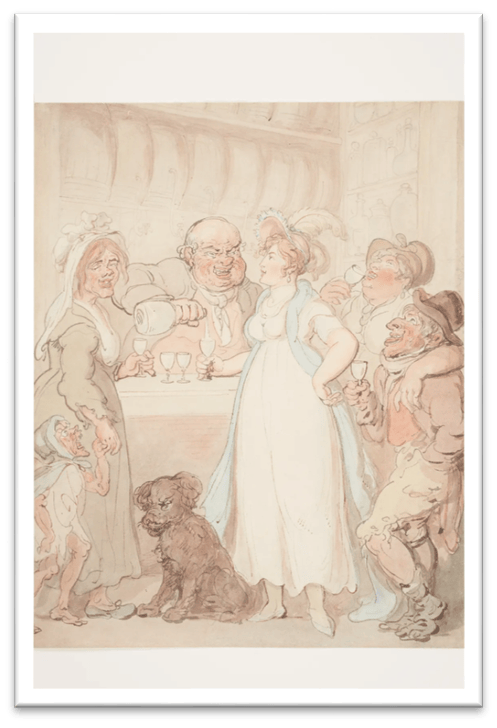
http://www.londonmuseum.org.uk/collections/london-stories/thomas-rowlandsons-satirical-london-drawings/
Gin, due to its commonality and availability, affected women as well. Gin was not sold in an alehouse fashion. There was minimal room to sit and be social while drinking; one could just pick up their gin and be on their way. Alehouses were also traditionally male; it would be frowned upon if a woman entered and tried to drink in an alehouse as men did. Additionally, gin was extremely easy to pick up from grocers or other street vendors after work or on errands. Due to its low cost, husbands, in control of the household’s expenditure, would not notice a few pence skimmed off the top. Women also pawned belongings and clothing for some secret spending money, or took secret jobs such as peddling, laundry, spinning, or prostitution. This sexual debauchery led to large amounts of broadsheets published on the effects of gin on women and families.
At the time, London’s population was booming, in part due to migration of single working women into the city from the countryside, increasing the density of the poorer districts and growing London’s industries with a larger labor force. Many of these women experienced a newfound freedom and good financial standing that they were able to spend at gin houses. The London government blamed gin for making debtors and addicts out of their laborers, ‘poisoning’ the nation and interrupting the country’s productivity.
Gin’s influence on women was commonly represented on broadsheets and other propaganda. When women turned to gin, they were understood to be depraved, heartless and corrupted, to have ruined their families. In the poem Strip Me Naked, or Royal Gin Forever, a mother, desperate to satisfy her gin cravings, pawns off any household items and clothes she can, tells her children that gin is better than her breastmilk, and generates such a hysteria that she collapses.
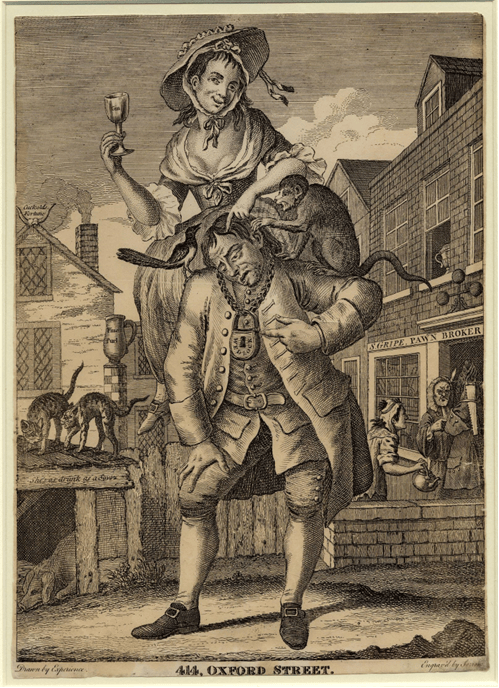
In a 1751 etching, published as a satire on marriage, a wife is carried by her husband, gaily drunk and holding her cup of gin. She, a monkey, and a magpie all sit on his shoulders. Her dress is lowcut, revealing her cleavage, and she points humorously at the padlock weighing on her husband’s neck labelled ‘wedlock.’ Monkeys usually represent human vices; thus, this one symbolizes the wife’s addiction to gin. The husband stands crouched, with a hand supporting himself resting on his knee, pointing at the same wedlock chain as his wife, only with a far more sorrowful look on his face. In the background, two cats hiss over a pig sty labelled “she’s as drunk as a sow.” Next to them is a jug of “fine purl,” an English alcohol also known as wormwood ale, but again, ale was expensive for working-class people and not socially acceptable for women to drink. On the right, a pawnbroker’s shop is stuffed with people trying to sell their household items, undoubtedly for money to purchase more gin.
The phrase “cuckold’s fortune” is on the roof of the building behind the couple. The wife’s gin addiction has led her to cheat on her husband, making her husband a cuckold. She has socially damned herself, as there is no returning from the label of a drunk, while her husband has failed in his masculinity, rendering him in deep shame as the laughingstock of the town. Additionally, women at the time were thought to be more lustful than men and led by their “wandering wombs” rather than rational thought. Or, at least, the blame could be placed there instead of on husbands’ failures or other societal factors.
The bird in the etching is labelled as a magpie, although I believe it is drawn to be either a magpie or a cuckoo bird due to the cuckoo’s connection to the etymology of “cuckhold.” Cuckoo birds lay their eggs in other birds’ nests, so the unsuspecting birds would hatch and raise, along with their own babies, cuckoo birds. Human men who do not know whether their children are theirs are thus labelled cuckolds. Magpies, on the other hand, represent bad luck, thievery, and death. Magpies mate for life, so seeing a single magpie is an omen symbolizing sorrow and misfortune. In the UK, it is common to greet a singular magpie with the phrase, “Good morning, Mr. Magpie, how is your lady wife today?” based on the seventeenth century nursery rhyme, ‘One for Sorrow.’ Our married cuck from the etching is dutifully bound to his cheating, gin-addict wife. His lady wife is his misfortune.
In medieval and early modern England, the story of a cuckold was played for laughs, as it is today. A cuck, as defined then, was a husband whose wife was unfaithful (not today’s fetishized meaning of someone who gets pleasure by watching their partner be unfaithful). In early modern London, though, the actual reality of being a cuckold was to be a failure of masculinity. It brought shame on the husband, who failed to live up to patriarchal expectations of his sex and his marriage. The etching, in the bottom corners, is labelled ‘Drawn from Experience, Engraved in Sorrow.’ Although the work is anonymous, working-class communities, families, and marriages throughout London were deeply affected by the Gin Craze. Cuckold husbands were common in these communities, enough for a multitude of broadsides, articles, and drawings to be published, laughing at the stereotype.
In a patriarchal society in which gender roles were strict, women gin addicts were abnormalities and cuckold husbands were a newfound humor. Gin led to other debauchery as well, as in one case where a maid named Jane Andrews went to a gin shop in the morning and left with two men and a woman. Together they drank at the home she worked at into the late afternoon before engaging in sexual intercourse. Another woman, Judith Defour, wound silk and was addicted to gin. She stripped her two-year-old child and sold the clothes for money to buy gin, drank all afternoon and during her shift before confessing that she had strangled her child and left them in a ditch. The literature of the time believed that gin led women to destroy their families, mainly by cheating on their husbands, rendering them cuckolds for the world to jeer at.
Bibliography
Abel, Ernest L. 2001. “The Gin Epidemic: Much Ado About What?” Alcohol and Alcoholism 36 (5): 401–5. Oxford Academic. https://doi.org/10.1093/alcalc/36.5.401.
den Hartog, Marlisa. 2019. “Horn-Bearers, Voodoo Dolls and Magic Cups: Discovering Adultery with Medieval Magic Tricks.” Leiden Medievalists Blog, Leiden University. https://www.leidenmedievalistsblog.nl/articles/medieval-magic-tricks-to-discover-adultery.
“Gin and the Gin Craze | Digitens.” 2019. Digitens.Org. 2019. https://www.digitens.org/en/notices/gin-and-gin-craze.html.
Moorhead, Joseph. 2022. “Cuckoldry in Early Modern England | Forum.” University of Melbourne, September 19. https://blogs.unimelb.edu.au/shaps-research/2022/09/19/cuckoldry-in-early-modern-england/.
“The Gin Craze: Ruin of 1700s London.” 2026. London Museum. 2026. https://www.londonmuseum.org.uk/collections/london-stories/gin-craze-ruin-1700s-london/.
White, Jonathan. 2003. “The ‘Slow but Sure Poyson’: The Representation of Gin and Its Drinkers, 1736–1751.” Journal of British Studies 42 (1): 35–64. JSTOR. https://doi.org/10.1086/342685.
Image Credits
https://www.britishmuseum.org/collection/object/P_1992-1003-23 © The Trustees of the British Museum.

