
Written by Felix Warner
Nietzsche’s ‘The Birth of Tragedy’ is an analysis of Attic Tragedy that insists on its enduring relevance to his theory of suffering stimulating the creation of beauty, as well as the inherent beauty of suffering itself.
Nietzsche commences ‘The Birth of Tragedy’ by establishing that art is “the highest task and the proper metaphysical activity of this life.” He deflects any scepticism with his call to “the earnest ones”, those who understand the fundamental importance of aesthetics and are willing to come forth and explore its meta physicality.
Apollo and Dionysos are then introduced as symbols to express the duality of human artistry. To these gods, “the two art deities of the Greeks”, Nietzsche assigns opposing states. The Apollonian state is one of dreams which are beautiful in appearance due to their order and form. Meanwhile the Dionysian state is unruly and wild, pertaining to drunkenness which can be represented by his followers, the satyrs. Satyrs were humorously and deliberately hideous, a disturbing goat and man amalgamation who embodied the vices of uncontrollable drunkenness and lust. Simon Goldhill discusses how satyr scenes such as these became “most common of all decorations on pots for symposiums”, which were filled with wine. This decoration forced men to confront a rather fragile sense of self, asking themselves, “Is this what we look like when we have too much of Dionysus’ wine?” The susceptibility of man losing control of his faculties was a source of terror to the Greeks, defined by Aristotle in his Nicomachean Ethics when he observes that the “brutish type […] is found chiefly among barbarians” but that it is also “the condition of men under the influence of passions”. The disorderly drunkenness of satyrs provides a warning of indulging in excessive drink and consequently losing oneself entirely in the Dionysian. Nietzsche agrees that the raw ecstasy of Dionysian rituals is too primitive and destructive to be practiced by civilised people. Therefore, whilst Dionysos is essential to the creation of art, his antithesis Apollo must be present to provide enough order and structure to make the art comprehensible to the human mind.
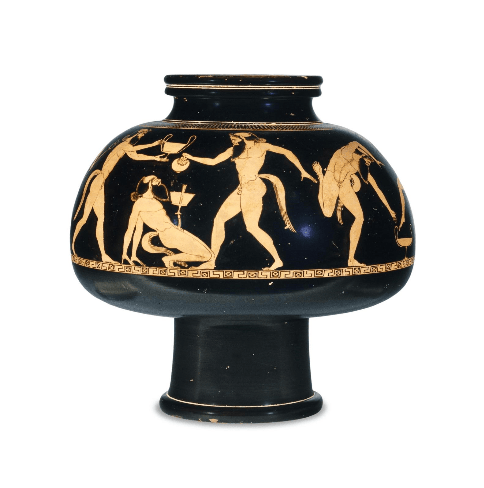
With this, Nietzsche begins to address the art form which he later states offers the perfect opportunity for the uniting of the Apollonian and Dionysian: music. The music produced individually under these art-deities are strikingly distinct from each other. Apollonian music has a clearly structured rhythm, whereas “[i]n the Dionysian dithyramb man is incited to the greatest exaltation of all his symbolic faculties” and from such music springs another art form: dance.
In this dancing, “man is no longer an artist, he has become a work of art”, thus proposing that this is a transformative action for man. However, embracing the Dionysian is a startling concept to the Apollonian Greeks and this is approached sensitively by Nietzsche, who proposes that there must be a compassionate yet firm dismantling of the “Apollonian culture […] stone by stone, till we behold the foundations on which it rests”.
Nietzsche believed it was the Archaic Greek lyric poet Archilochus that fully embraced the Dionysian, as in lyric poetry “language is strained to its utmost that it may imitate music”, and music is defined by Nietzsche as an inherently Dionysian medium. The influence of the Apollonian assists in the creation of the poem itself as “the inchoate, intangible reflection of the primordial pain in music, with its redemption in appearance, now produces a second mirroring as a specific symbol or example”. Nietzsche therefore explains that the individualistic aspect of a poem is an illusion that is reflected by the ‘mirror’ of Apollo and the lyricist is actually portraying comprehensive suffering that he has experienced through the Dionysian. It would be accurate to assert that Nietzsche perceived lyric poetry as a microcosm of the Primordial Unity, a sense of oneness with all existence.
Having considered this early convergence of the Apollonian and Dionysian, we begin to approach the pinnacle of artistic creation. From this lyric poetry evolved the tragic chorus which was the beginnings of the eventual development of tragedy as a genre. Thus, we return to the discussion of satyrs of whom the original Greek chorus was comprised of. When the audience was faced with these wild beings, who were in fact “the embodiment of [one’s] highest and intensest emotions” even as a performative representation, they were forced to confront an unravelling of Greek culture and accept the disturbing reality of nature. Nietzsche notes that “this is the most immediate effect of the Dionysian tragedy, that the state and society, and, in general, the gulfs between man and man, give way to an overwhelming feeling of unity leading back to the very heart of nature” recalling the aforementioned Primordial Unity. Indeed, as Walter Sokel reminds us, “the chorus has the last word and with it proclaims the consoling message of Dionysianism: Life goes on. Individuals come and go, rise and fall, but being as a whole is everlasting”.
Nietzsche continues in asserting that whilst “the Greek man of culture felt neutralised in the presence of the satyric chorus” as the appearance of the satyrs reminded man of his natural state, it was the music that entirely immersed man in the Dionysian frenzy which catalysed the neutralisation of civilisation “as lamplight by daylight”.
When tragedy progressed from just the chorus and incorporated other actors, the Apollonian was combined with the Dionysian as the actors become only appearances that are generated by the chorus to “display the visionary figure […] before the eyes of all”. The performance of Greek tragic actors surpassed ‘playing a role’; rather, it was a ‘mimesis’. ‘Mimesis’ referred to a poignant imitation which invited the audience “not merely to take the character enacted as the reality […] but to take the world and the situation of that character as the reality”. This “mimesis” was influenced by the Dionysian frenzy induced by the chorus so that “when the tragic hero appears on the stage, they do not behold in him, say, the unshapely masked man, but a visionary figure, born as it were of their own ecstasy”.
This appearance is by its very nature Apollonian; the audience is experiencing these events through the “dream-state” that defines Apollo’s influence on art and yet it is the Dionysian frenzy which makes the vision possible. Following this collision of the Apollonian and Dionysian the resulting vividness of these scenes provokes more than pity for the characters plight, rather a poignant empathic response as the suffering portrayed by tragedy becomes a stylized reflection of our genuine raw emotions. Hence when the audience observed the murder of the titular character in Aeschylus’ Agamemnon with his cry of “Alas! I am struck deep with a mortal blow”, they too were struck with the terror of a possible betrayal of their own oikos (household) or, upon witnessing Oedipus’ horrific realisation of committing patricide and incest in Sophocles’ Oedipus Tyrannus, the audience is filled with dread at the thought of transgressing in oblivion.
However, Nietzsche insists on the necessity of suffering as portrayed in tragedy, particularly analysing the transgression of Aeschylus’ Prometheus to highlight the parallels between him and Dionysos. The tragedy of Prometheus is the most striking example of “the profound Aeschylean yearning for justice” even when that justice is unlawful. Whilst the desire for justice affords the Apollonian to this myth, the willingness to break boundaries is profoundly Dionysian. Therefore, Nietzsche explains that Prometheus’ eternal suffering is intended to represent Dionysos “experiencing in himself the agonies of individuation” which he must suffer in the hope of drawing spectators back to the Primordial Unity. The conclusion of this point is “the best and highest that men can acquire they obtain by a crime”, asserting that in man’s search to attain the great and just, there will be suffering and it is crucial that it is embraced rather than avoided.
By the recognition of the necessity of this suffering, the resulting “fear and pity are supposed to be forced to an alleviating discharge” which recalls the discussion of catharsis in Aristotle’s Poetics defined as being “brought about by means of pity and fear, or through incidents arousing these emotions” and through the vicarious experience of tragedy, these emotions are purged and purified.
Therefore, to conclude, it is catharsis which provides a Dionysian medium for suffering to be aesthetically confirmed and united with, since the music of Dionysius can speak to all people, transcending language; yet it is the Apollonian artistic structure which theatre brings to this suffering that allows us to confront it safely without finding ourselves trapped in Dionysian frenzy. These states are explicitly opposing and seem destructive to each other, yet their interplay is essential to the attainment of the highest form of art, Greek tragedy. Tragedy gave us an outlet to embrace suffering as an unavoidable part of life and create emotive works of art which show humanity at our most natural and united. Thus, they inspired Nietzsche’s insistence of the beauty of suffering.
Bibliography
Aeschylus. (1926). Agamemnon. Translated by Smyth, Herbert Weir. Loeb Classical Library Volumes 145 & 146. Cambridge, MA. Harvard Universrity Press. Available at: https://www.theoi.com/Text/AeschylusAgamemnon.html [Accessed 23 Oct. 2026]
Aristotle. (1999). Nicomachean Ethics, W.D Ross, Batoche Books. Available at: https://socserv.socsci.mcmaster.ca/~econ/ugcm/3ll3/aristotle/Ethics.pdf [Accessed 20 Oct. 2026]
Fagan, P. (2018) Mimesis: Plato and Aristotle on the Political Power of Tragedy. Available at: https://www.academia.edu/38971073/Mimesis_Plato_and_Aristotle_on_the_Political_Power_of_Tragedy [Accessed 25 Oct. 2026]
Goldhill, S. (2004). Love, Sex and Tragedy: Why Classics Matters. The University of Chicago Press. Available at: https://archive.org/details/lovesextragedyho0000gold/page/n10/mode/1up [Accessed 21 Oct. 2026]
Nietzsche, F. (1909). The birth of tragedy; or, Hellenism and pessimism (W. A. Haussmann, Trans.; O. Levy, Ed.). George Allen & Unwin. Available at: https://www.gutenberg.org/files/51356/51356-h/51356-h.htm [Accessed 21 Oct. 2026]
Sokel, W. H. (2005). On the Dionysian in Nietzsche. New Literary History, 36(4), 501–520. Available at: http://www.jstor.org/stable/20057911 [Accessed 25 Oct. 2026]
Image Credits
The British Museum, https://www.britishmuseum.org/collection/image/34652001

