
Written by Nicole Ooi Yee Yin
26/10/2026
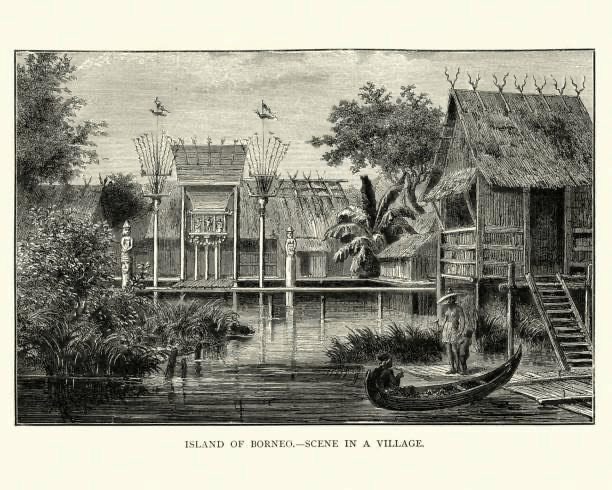
A few weeks ago, I picked up Into the Heart of Borneo because I decided I needed to learn more about the island I grew up on. In hindsight, it is somewhat silly to entrust this responsibility to an Englishman, but I still enjoyed the book. It is an exceedingly rich piece of travel narrative that captures a special moment in time and place, through the lens of a natural historian and amateur explorer, before the Bornean interiors were entirely swept by industrialization.
Reading through the book, I couldn’t help thinking how rare an experience this probably was for most Borneans back then and even more so now. O’Hanlon describes how butterflies flocked to them by the hundreds just to suck the sweat from their arms, the elusive but magnificent Trogonoptera brookiana (Rajah Brooke’s birdwing) among the kaleidoscope. From Latin names to incessant references to the Sarawak Museum Journal, the reader is reminded of Borneo’s colonial past at every turn. O’Hanlon is acutely aware of the tradition of Victorian naturalists, explorers, and the British military, as well as the history that precedes him and this land he is on. O’Hanlon ensures the reader also looks at the Borneo experience through the same lenses. One can make the case that this perpetuates colonial knowledge, but O’Hanlon balances it well with his self-deprecating humour and lively descriptions of the flora and fauna, people, and animals of the Bornean jungle. On encountering its infamous leeches, he quotes long passages from Smythies’ account of different species of Bornean leeches, supplying it with his own comedic insights. He proudly declares the success of chemical warfare—you can put off leeches by rubbing yourself with zinc powder.
While O’Hanlon does get disappointed when his Iban guide, Leon, looks too normal, Borneo and its people weren’t just exotic backdrops to his adventure. O’Hanlon and James Fenton are constantly teased for being unfit (and bald). The locals of Borneo are a lively bunch in his narrative. Most of them love to drink and dance and party, as people do. The policeman at Singapore airport was just as prejudiced as many Westerners may be. On hearing that they were venturing into the heart of Borneo:
“You go just to see rhinoceros?” the policeman said, appalled. “But they eat people in there! They’re cannibals! Blowpipes! Phut. Phut. You die. No noise. Very better than a gun.”
The Iban trio (Dana, Leon, and Inghai), guiding O’Hanlon and Fenton, receives the most attention throughout the book. O’Hanlon doesn’t dwell excessively on their culture and religion, for instance investigating where their belief of once also being ‘orang puteh’ (white people) came from, or the history of their conversion to Christianity (I wish he did). Rather, he centers on their quirks and personalities: wise and strong Dana, young and frisky Leon, good-natured and sleepy Ingy-Pingy (Inghai). O’Hanlon sometimes offers his two cents. Describing the elderly Kenyah woman who suffered from gangrene after stepping on a fish-spine, he takes a striking leap and relates it to the Niah caves Stone Age excavations, suggesting that life in the interior barely changed for millennia because of its dangers.
While O’Hanlon and Fenton explored the ancient interior of Borneo, it was at the same time rapidly deteriorating. The locals were well aware. Educated Edward and Siba are representative of the debate between development and conservation. Siba asks:
“How else will we pay for our people to be educated and have hospitals and live a decent life? I grant you—if we were Brunei and struck oil on the coast, we could leave the jungle alone and give every citizen a colour television set. But there’s precious little oil. There’s water and there’s wood.”
And the jungle doesn’t just grow back. From 1985 onwards, the pace of deforestation in Sarawak only accelerated. Dayak people first sent letters of appeal and petitions to state and regional authorities. When that proved futile, the Penan, Kayan, and Kelabit blockaded logging roads elsewhere in Sarawak that encroached on their land. Environmentalists worldwide supported the movement, but the Malaysian and Sarawak governments responded defensively. The media was censored, and the military, security forces, and police worked together to break down the blockades. Indigenous people were arrested, and the logging industry won the battle in the long run.
Siba’s comparison stuck with me, because I’ve lived in Brunei all my life. In the mouths of the people in the book, Brunei seemed isolated from the rest of Borneo. A wholly different colonial experience peeks through between the lines. While Brunei gained full independence in 1984, British forces stayed on and remain stationed there to this day. The SAS saw it as a training ground for jungle operations:
“What a pity,” said Malcolm, “that you can’t come to Brunei with us for a week. We could really sort you out and set you up over there.”
The oilfields had an allure for British men from other walks of life. Brunei now bans the public sale and consumption of alcohol, but my father remembers bars where Scottish men would take the edge off. For Southeast Asians, too, Brunei was a gold mine for jobs and money in oil. Dana’s son-in-law is described as returning on leave from Brunei’s oilfields. With no need for deforestation for money, Brunei’s greenery is relatively well-preserved, with almost fifty percent of its tiny landmass set aside as forest reserves or national parks.
Into the Heart of Borneo is a brilliantly humorous and rich description of journeying through the Bornean interior. It preserves a valuable snapshot of a Borneo still rich with unique flora and fauna, indigenous peoples experiencing transition at different stages, their beliefs and ways of life before it all changed. There is so much more to explore in this book—O’Hanlon’s bizarre nightmares, subtler power dynamics between O’Hanlon, Fenton and the locals—but maybe another time.
Bibliography
Davis, Wade. “Societies in Danger: Death of a People; Logging in the Penan Homeland.” Cultural Survival Quarterly, March 16, 2010. https://www.culturalsurvival.org/publications/cultural-survival-quarterly/societies-danger-death-people-logging-penan-homeland.
Hindson, Katy. “Interview with Redmond O’Hanlon.” Studies in Travel Writing 11, no. 2 (2007): 177–88. https://doi.org/10.1080/13645145.2007.9634827.
O’Hanlon, Redmond. Into the Heart of Borneo. London: Penguin Books, 2005.
Image Credits
Lancelot, Dieudonné. Island of Borneo – Scene in a Village. 19th century wood engraving. Public Domain.

