
Written by Oran Crane
26/10/2026
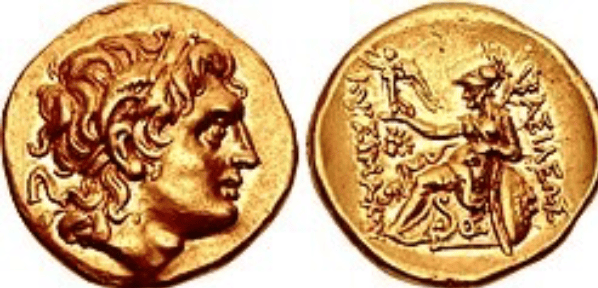
Following the death of Alexander the Great in 323 BCE, his lands were split between his generals. By 285 BCE there were three main factions: Ptolemy had established his domain in Egypt, Seleucus in what had been Persia and the Levantine coast, and Lysimachus controlled Thrace and Macedon. Despite amicable engagement and familial ties, power struggles raged both between the states, and within their courts.
The life of the eldest son of Ptolemy I Soter (d. 282 BCE), also named Ptolemy, was fraught with the machinations intrinsic within a Hellenistic court. He was given the epithet ‘Ceraunus’ (Thunderbolt), we are told by Pausanias, for his “recklessness” and the rash nature of his plotting and command (Paus. 10.19.7). This is a common trope throughout the ancient sources, yet this portrayal of him is perhaps flawed. This article will argue that although Ceraunus did make a catastrophic error that would lead to his death in battle, his career up until that point shows a more calculated and cunning figure that is perhaps representative of a notable and capable player of early-Hellenistic court politics.
Ceraunus, as the eldest son of Ptolemy I, was the assumed heir to the Egyptian throne throughout his childhood. After the birth of his half-brother (another Ptolemy), a power-struggle ensued between the siblings. It became clear that their father preferred the younger son and Ceraunus left Egypt in the mid-280s BCE. Appian theorises this was out of “fear”, but Ceraunus may have realised that the situation was untenable and left to pursue a different path (App. Syr. 62-63). Ceraunus evidently recognised the danger that the future Ptolemy II Philadelphus, his half-brother, posed to him. It would be unlikely that he would be allowed to live if he stayed, but he did not give up on the Egyptian throne for several years.
From Egypt, Ceraunus travelled north and joined the court of Lysimachus, who had pushed both Demetrius I Poliorcetes (with assistance) and Pyrrhus of Epirus out of Macedonia by 285 BCE (Just. Epit. 16.2-3). It is likely that Ceraunus aimed to try and gain some allies for a possible war against Egypt, to take what he believed was rightly his by force. Due to the familial tension that he encountered (Lysimachus was married to Ptolemy II’s sister Arsinoë, and his heir Agathocles was married to Ceraunus’ own sister Lysandra), Ceraunus’ prospects did not improve, especially with Lysimachus marrying his own daughter to Ptolemy II and Agathocles’ execution for alleged treachery. With Lysandra, Ceraunus again turned to another of Alexander’s generals: Seleucus I Nicator. He became a major player in the court of Seleucus as one of his “entourage” (App. Syr. 62). It was around this time that Seleucus attacked Lysimachus, who was killed at the Battle of Corupedium in 281 BCE. According to Memnon of Heraclea, after Seleucus had taken control of Lysimachus’ holdings in Asia and turned his sights on Europe, he promised Ceraunus that he could have control of Egypt once it came into his possession (Memnon, FGrH 434 8.2). Ceraunus’ repeated positioning alongside powerful players is evidence of his affinity for political adaptability. He had gone from being in significant danger in Egypt to being able to exert influence in the court of another significant leader of the age.
By late 281 BCE, Ptolemy I had been dead for over a year, and Ceraunus may have doubted the veracity of Seleucus’ promise. Whatever his reasoning, Ceraunus saw an opportunity and decided to act. While travelling to Europe with Seleucus, Ceraunus killed him, supposedly stabbing him in the back while he was making a sacrifice in Argos (App. Syr. 62-63, Just. Epit. 17.2, Memnon, FGrH 434 8.3). Having murdered Seleucus, Ceraunus headed to the city of Lysimachia, where he was crowned as King of Macedon. Through the assassination of his benefactor, he managed to become the ruler of one of the most powerful states in the Hellenistic world.
Nevertheless, Ceraunus still had challenges to his authority that required solutions. The son of Demetrius I Poliorcetes, Antigonus Gonatas, saw the possible fragility of the new regime in Macedon and attempted to invade Macedon with his fleet, but Ceraunus arrived hastily and defeated Antigonus with his own navy, helping to consolidate his rule of the country (Memnon, FGrH 434 8.4-6). Édouard Will argues that it was around this time that Ceraunus began to portray himself as the avenger of Lysimachus to justify his murder of Seleucus. This, in combination with his victory over Antigonus Gonatas, would have helped to solidify his image as a proper ruler and protector of Macedon and the Macedonian people.
Another issue remained for him to solve, that of his half-sister Arsinoë, the widow of Lysimachus. Arsinoë had three sons, who, following the death of her husband, she took with her to Cassandreia. Ptolemy Ceraunus knew that he would have to deal with her and her heirs to solidify his grip on the Kingdom of Macedon, so he sent an offer to her of marriage. Unsurprisingly, given the circumstances surrounding Ceraunus’ accession, Arsinoë did not consent to the marriage. It was only once he had promised her monogamy, the safety of her sons, and had sworn this to someone she trusted (supposedly in the Temple of Zeus), that she agreed (Just. Epit. 24.2). Ceraunus then travelled to Cassandreia to marry Arsinoë and greet her sons. The eldest was not present, but the younger two were met by the King, who promptly had them murdered in the arms of their mother (Just. Epit. 24.3). Arsinoë then fled to Samothrace. Elizabeth Carney theorises that Ceraunus had planned the marriage and deaths but decided to let Arsinoë live as to not further alienate himself from popular opinion. It would have been seen as necessary and smart for the heirs to be eliminated to remove any contention to his throne, despite the frequent brutality of his methods.
Ceraunus ruled for around a year and a half between 281 and 279 BCE. To stabilise his reign, he formed tenuous alliances with the surrounding Hellenistic kingdoms. Justin discusses the grievances he settled with Antiochus son of Seleucus, the deal he brokered with Pyrrhus of Epirus (which Justinian says included a marriage to Ceraunus’ daughter), and how he renounced his own claim to the throne of Egypt in order to placate Ptolemy II Philadelphus (Just. Epit. 24.1-2). This enabled him to reign with a degree of security. There is not a lot of material evidence from the reign of Ptolemy Ceraunus, but the Epinikos Decree has recently, in 2015, been re-attributed by Pierre Juhel to Ceraunus’ time on the throne of Macedon, which provides a brief insight into the inner workings of Ceraunus’ rule. The decree praises an official named Epinikos for his work whilst in charge of the city of Maroneia in Thrace. Even if the decree does not explicitly relate to any policies of Ceraunus, or his success as a ruler, it does provide insight into the functioning of the government under his reign.
Unfortunately for Ceraunus, his reign ended abruptly after an extreme military and political blunder. The Gauls had attacked his northern border under their leader, Bolgius. According to the ancient sources, Ceraunus rushed north without the full force of his numbers to face the invading Gallic army, even refusing help from the neighbouring Dardanians (Diod. Sic. 22.3, Paus. 1.16, Just. Epit. 24.4-5). Ceraunus died in the fighting, and his legacy has largely been that of being impulsive in nature.
In conclusion, Ptolemy Ceraunus may have been a brutal and self-serving figure of the Hellenistic world, but he was far from incompetent as he has been presented by many ancient sources. The mistake that ended his life was certainly folly, but his career up until that point was quite remarkable given the power struggles that he had to navigate throughout his life. Ceraunus successfully drew on his experience and political acumen to exploit his connections and become the ruler of Macedon. The Thunderbolt can be considered an example of the success and advancement possible within Hellenistic court politics if you possessed the cunning and cruelty necessary to achieve it.
Bibliography
Carney, E. (2013), Arsinoë of Egypt and Macedon: a Royal Life, New York.
Grainger, J. D. (2010), The Syrian Wars, Boston.
Hölbl, G. (2001), A History of the Ptolemaic Empire, London.
Holton, J. R. (2016), ‘Ptolemy Keraunos’, in R.S. Bagnall, K. Brodersen, C.B. Champion, A. Erskine and S.R. Huebner (eds), The Encyclopedia of Ancient History, Hoboken. https://doi-org.eux.idm.oclc.org/10.1002/9781444338386.wbeah30153
Jones, W. H. S. (1918), tr., Pausanias: Description of Greece, Volume I: Books 1-2, Cambridge, MA.
Jones, W. H. S. (1935), tr., Pausanias: Description of Greece, Volume IV: Books 8.22-10, Cambridge, MA.
Juhel, P. O. (2015), ‘Epigraphic evidence for Ptolemy Keraunos, King of Macedonia: The Epinikos Decree revisited’, Historia: Zeitschrift für alte Geschichte, Vol. 64 (1), 77-105.
Keaveney, A. and Madden, J. A. (2011), ‘Memnon (434)’, in I. Worthington (ed.), Jacoby Online. Brill’s New Jacoby, Part III, Leiden. https://doi org.eux.idm.oclc.org/10.1163/1873-5363_bnj_a434
McGing, B. (2019), tr., Appian: Roman History, Volume III, Cambridge, MA.
Mehl, A. (2006), ‘[2] P. Ceraunus – Ptolemaeus’, in Brill’s New Pauly Online, Leiden. https://doi-org.eux.idm.oclc.org/10.1163/1574-9347_bnp_e1012900
Walton, F. R. (1957), tr., Diodorus Siculus: Library of History, Volume XI: Fragments of Books 21-32, Cambridge, MA.
Will, É. (2008), ‘The formation of the Hellenistic Kingdoms’, in F. W. Walbank (ed.), The Cambridge Ancient History. Vol. 7. Part 1, Hellenistic World, Cambridge.
Yardley, J. C. (2024), tr., Justin: Epitome of Pompeius Trogus, Volume I: Books 1-20, Cambridge, MA.
Yardley, J. C. (2024), tr., Justin: Epitome of Pompeius Trogus Volume II: Books 21-44, Cambridge, MA.
Image Credits
Classical Numismatic Group, LLC. Macedon, Ptolemy Keraunos, AV Stater (Triton XIX, Lot 2037). Photograph. CNG Coins, http://www.cngcoins.com/Coin.aspx?CoinID=301205. Accessed 26 Oct. 2026.

