
Written by Eve Hudson
26/10/2026
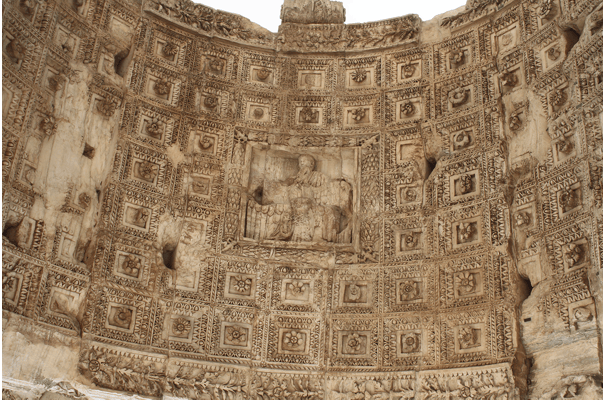
Deification of Roman emperors began with the death of Julius Caesar, who after being assassinated in 44 BC, was then subsequently deified by his successor Augustus to become Divius lulius in 42 BC. This began a precedent of deifying emperors posthumously, which ended with the deification of Alexander Severus in AD 238. A total of thirty-three emperors and members of the imperial family reached the status of divus or diva. This repeated deification of the emperor resulted in the formation of the Imperial cult, an overarching term used to describe the worship of the emperor.
In this essay, I argue that Romans and their emperors largely took deification and their own divinity seriously. Firstly, I will argue that a non-serious view of imperial deification is based on a modern perspective rather than contemporary. Secondly, I will discuss the exact status that an apotheosis provided to an emperor, and how this was different from the status of a normal deity. Next, I will analyse the relationship between politics and deification, concluding that deification was taken seriously both religiously and politically. Finally, I will discuss Seneca’s Apocolocyntosis, and contend that this satire does not doubt the religious process of apotheosis but rather the singular apotheosis of Claudius because of his lack of personal merit.
To properly conceptualise Roman attitudes towards emperor deification, the practice must be understood through a Roman perspective, rather than a modern one. While an emperor ascending to become divine may seem ludicrous from a modern perspective, the intersection of the human and the divine was a familiar concept to the Romans. Many prominent families in Rome claimed divine lineage, including the gens Iulia who claimed lineage from Venus. Additionally, mythology often included figures that were both divine and human, such as Hercules or the hero Castor. Even Romulus, the founder of Rome, was considered human but later deified. All of these provide clear examples of how the human and the divine were not totally distinct categories, and existing as both simultaneously was well within the framework of Roman religion.
The deification of important contemporary political figures predates Julius Caesar himself. Plutarch states that after the murder of the Gracchi brothers, their statuses were worshipped as if they were gods themselves. Even Cicero, who was so openly against Caesar’s self-representation as divine, privately deified his own daughter after her death. These instances of pre-imperial deification demonstrate the fluctuating relationship between the divine and the human in Roman religion at the time of Caesar, and deification’s partial acceptance by some in Rome. While Caesar’s deification was a unique and influential event in Roman history, deification of humans was not novel for Romans.
Hopkins in ‘Conquerors and Slaves’ (1978), argues for this simultaneous existence of the human and the immortal in Roman religion. Hopkins claims that the Roman population likely did not ‘bother with this demarcation’ of either human or God; those deified entered a new category in which they were ‘clearly both’. Hopkins’ assessment of the Roman attitudes towards this facet of religion are well supported by the larger Roman religious framework. While the validity of an emperor ascending to become divine sounds impossible when viewed through a modern monotheistic perspective, this is much more plausible within the flexible, polytheistic perspective of the Romans. The deification of Roman emperors fit neatly into the larger Roman religious tradition of continually adding, changing, and worshipping deities. Any assumption that Romans or emperors generally doubted deification centres a perspective that is incongruent with the contemporary features of Roman religion.
Another factor that must be considered is what religious status deified emperors actually had. Deified emperors and other members of the imperial family achieved the status of divus or diva, a distinct category from the gods themselves, who were referred to as deus or dea. This is especially relevant when considering the last words of Vespasian, as recorded by Suetonius. On his deathbed, Vespasian said Vae, puto deus fio, or ‘Woe’s me. Methinks I’m turning into a god’. Vespaisan’s usage of deus over divus in this account is particularly strange, given that an emperor would never ascend to become deus. Due to this strange word choice, it is unclear whether this aside was mocking the idea of apotheosis. While it may indicate a lack of seriousness in private at Vespasian’ s deification, external deification was not to be taken lightly. The private setting of this comment creates the implication that even if Vespasian believed deification was ridiculous, this was not an opinion to be publicly expressed.
This distinction between deified humans and gods can be further observed in the worship of these two respective groups. Sacrifice in different branches of the Imperial cult was typically made on behalf of the emperor, rather than directly to them, as would be done with a god. In fact, there is very little explicit evidence for emperors being worshiped and sacrificed to as a Roman god would be. This points to a Roman religious ideology that viewed the emperors’ lives, deaths, and deifications as a distinct category of worship. Worship to the extent of a god was often refused by emperors following the precedent of Augustus, especially in the Latin West where rulers were typically not treated as gods in local religion. Tiberius once wrote to the Senate, ‘to have my statue worshipped among the gods in every province would be presumptuous and arrogant’, emphasising how the emperor’s role in worship within the Imperial cult often changed from province to province. In reality, the practices were so diverse that there was no real, single Imperial cult. In the Jewish Revolt, for example, the first act of protest against Roman rule was to stop offering sacrifices on behalf of the emperor. To make this the first act against Roman imperialism underscores the massive political significance of Imperial worship in the provinces.
This interconnectedness between political power, self-representation, and deification across the empire prevented emperors and Romans from taking deification lightly. Roman religion and politics in general cannot be separated in the modern way these two cultural spheres typically are. Even if an individual did not believe the emperor was divine, the emperor’s undeniable political power drew from his status of divinity and closeness with the gods. The structure of Roman religion and politics was completely interconnected. Aside from the Vestal Virgins, every high-level religious position in Rome was occupied by the senatorial class. Being deified posthumously was only achievable via a formal vote of the Senate. Even the terms ‘augustus’ and ‘princeps’ that the emperor took on held both significant political and religious connotations. If an individual did not strictly believe in the divinity of the emperor, this divinity became infused with their own local traditions and thus interlinked with their own religious belief.
A major ancient source that appears to mock the process of deification is Apocolocyntosis by Lucius Annaeus Seneca. This work satirises the process of apotheosis that an emperor, in this case Claudius, undergoes to become deified. Rather than a skeptical account of the religious process of apotheosis, Apocolocyntosis is more aptly described as a critique of the character of Claudius himself. The work described Claudius’ last words as ‘Oh my, I think I just shat myself’, followed by the narrator commenting that he likely did as ‘he certainly shat on everything else’. Eventually in the satire, it was Augustus himself who moved to banish Claudius to Hades, with Augustus’ divinity being portrayed as legitimate as any of the other gods in the work. Under this closer examination, Apocolocyntosis is not critical of the process of apotheosis, but rather of the fact that a figure like Claudius would be worthy of apotheosis at all. It was a common trope among Roman writers that bad emperors believed they should be treated as a god even before their death and apotheosis. This attitude of Claudius was the target of Apocolocyntosis, not the process of apotheosis itself.
Imperial deification was largely taken seriously by both Roman emperors and Romans alike. This is not to say that every individual believed in deification beyond doubt, and private versus public accounts of deification take on a variety of attitudes. However, Roman religious and political structures did not allow for an externally skeptical view of deification. The potential for general skepticism around imperial deification becomes even less plausible when considering a Roman perspective, grounded in Roman religious norms and mythology. Once filtered through this perspective, accounts that appear to mock deification cannot reliably be labeled as satirising the process of apotheosis. Divine status was undoubtedly a part of the emperor’s power, and to take it lightly would render the emperor’s influence, via the Imperial cult, less significant. Ultimately, imperial deification was not simply a religious phenomenon; it was interconnected with imperial power across the provinces. Thus, Romans and their emperors largely took deification seriously as the structures of the empire itself ensured it.
Bibliography
Ancient Sources
Cicero. Letters to Atticus. Edited and translated by D. R. Shackleton Bailey. Loeb Classical Library 7. Harvard University Press, 1999.
Dio, Cassius. Roman History. Translated by Earnest Cary, Herbert B. Foster. Loeb Classical Library 32. Harvard University Press, 1914.
Josephus. The Jewish War. Translated by H. St. J. Thackeray. Loeb Classical Library 203. Harvard University Press, 1927.
Pliny the Younger. Panegyricus. Translated by Betty Radice. Loeb Classical Library 59. Harvard University Press, 1969.
Plutarch. Life of Romulus. Translated by Bernadotte Perrin. Loeb Classical Library 46. Harvard University Press, 1914.
Plutarch. Lives of Tiberius and Gaius Gracchus. Translated by Bernadotte Perrin. Loeb Classical Library 102. Harvard University Press, 1921.
Seneca. Apocolocyntosis, Edited and translated by Gareth Schmeling. Loeb Classical Library 15. Harvard University Press, 2020.
Suetonius. Life of Julius Caesar. Translated by J. C. Rolfe. Introduction by K. R. Bradley. Loeb Classical Library 31. Harvard University Press, 1914.
Suetonius, Life of Vespasian. Translated by J. C. Rolfe. Loeb Classical Library 38. Harvard University Press, 1914.
Tacitus. Annals. Translated by M. Hutton, W. Peterson. Revised by R. M. Ogilvie, E. H. Warmington, Michael Winterbottom. Loeb Classical Library 35. Harvard University Press, 1914.
Secondary Scholarship
Beard, M., North, J., Price, S. (1998) Religions of Rome Vol. 1, Cambridge. Chapter 7. Beard, M. (1995) Emperor of Rome: Ruling the Ancient Roman World, London.
Hopkins, K. (1978) Conquerors and Slaves, Cambridge. Chapter 5.
McIntyre, G. (2019) Imperial Cult, Boston.
Price, S. (1980) ‘Between man and god: sacrifice in the Roman imperial cult’, Journal of Roman Studies 70: 28-43.
Image Credits
Arch of Titus and the Colosseum, Rome” by Steven Zucker is licensed under CC BY-NC-SA 2.0. (https://courses.lumenlearning.com/suny-ncc-zeliart/chapter/early-empire-the- arch-of-tit us)

