
Written by Emma Morey
26/10/2026
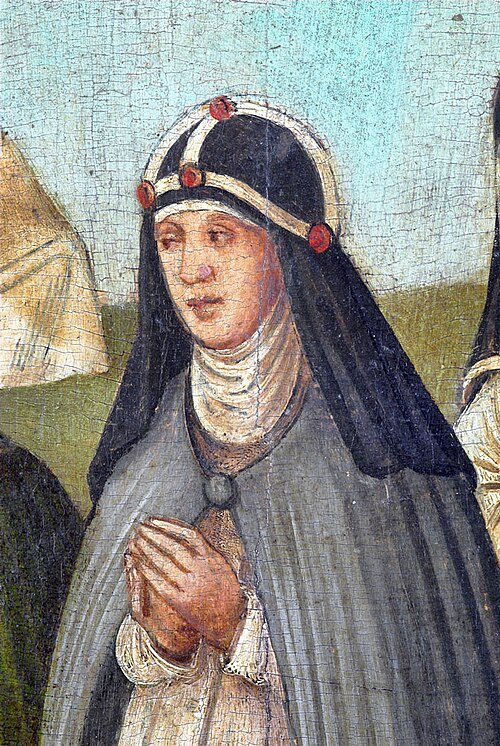
The Bridgettine order was born out of critique for corrupt institutions. St. Brigid of Sweden founded the order in 1346 as a source of purification for monastic houses facing considerable backlash. Opposing monasticism, which was becoming increasingly involved in the political world, she advocated a stricter lifestyle unencumbered by the temporal sphere, which, for women, entailed enclosure, or isolation within their convent from lay society; designed in a distinctive double-order structure wherein segregated groups of nuns and the priests tending to them lived within the same abbey walls. The Bridgettines were well-regarded throughout Europe for their commitment to their strict Rule. In basing her order off a critique of contemporary religious life, St. Brigid began a tradition of empowered resistance that became characteristic of successive generations of Bridgettine nuns.
Monasteries have often been presented in post-Reformation rhetoric as rife with laziness, greed, and corruption; not all, however, adhered to this trope. Exemplifying the ideal for laity to aspire to, those under holy orders crafted the definition for what a life devoted to one’s spirituality looked like. They served the less fortunate in hospitals, distributed alms to the poor, and provided the laity a source of prayers imbued with greater spiritual potency undepreciated by involvement in the material world. One of the strongest English convents on the eve of the Reformation was Syon Abbey, the only Bridgettine house in England, whose adherence to its Rule and centrality as an intellectual and religious hub resulted in its strong reputation throughout Christendom. Its patronage by wealthy laypeople, and its eventual role as a target began when Henry VIII broke from the Roman Catholic Church and began dissolving England’s monasteries.
Syon Abbey experienced serious dissent at the onset of the Dissolution of the Monasteries, splitting over agreement or refusal to swear the Oath of Supremacy recognising Henry VIII as the Supreme Head of the Church and severing connections with Rome. The Bridgettines were initially steadfast in their resistance until two of their priests, Richard Reynolds and Thomas Brownell, were martyred. These deaths sent shockwaves through the community and pushed John Fewterer, Confessor General and senior male authority under the abbess, to encourage submission to the Oath; his policy was unpopular and ultimately the majority remained loyal to their Rule. While deserving of considerable attention, Reynolds’ and Brownell’s deaths have loomed large in the story of the Bridgettines. The nuns left behind were overshadowed, despite their expulsion from the safe confines of Syon and subsequent fifty-year search across continental Europe, for a safe haven. They initiated a tradition of resistance followed by later generations of fleeing religion which remained uncompromised by the temporal pressures threatening to crush their resolve, resting instead on a shared intellectual and communal tradition to maintain religiosity in exile.
The basis of the Bridgettines’ survival, both literally and spiritually, rested in the maintenance of a community identity around which the nuns could rally, which Syon’s nuns preserved as they adapted their order’s characteristic style of devotion to fit their circumstances. The Bridgettine Rule credits its foundation to a prophetic vision experienced by St. Brigid, who, in “a state of rapture,” received instructions to establish the convent’s mother house. The Bridgettines’ spiritual practice was derived from this foundation; they prioritised introspective meditation and personalised emotional experiences to bring them closer to God, all within the safe confines of enclosure. They circulated manuscripts amongst themselves, documenting, as explained in the account of the Bridgettine lifestyle Mirror of Our Lady, experiences which “quicken[ed] and…stir[red] up affections of the soul.” Individualising and later circulating their experiences created a communal practice of devotion mirroring St. Brigid’s original vision that could be maintained within enclosure. Forced out of enclosure by exile, however, their form of worship was called into question. The nuns of Syon worked through worldly struggles to maintain this religiosity, and in so doing set themselves apart to the wider European Catholic community as pillars of strength, community, and resistance.
Through a forced migration plagued with struggles of penury, war, threats of violence and exposure to a hostile temporal world, Syon Abbey’s Bridgettine nuns relied on the hospitality of continental monasteries and sympathetic monarchs. They bounced from house to house for fifty years before establishing a permanent home in Lisbon, but throughout that time their actions—particularly their engagement in post-Reformation Catholic scholasticism—revealed the inner strength and devotion which made their order a beacon to Catholic Europe. Brandon Alakas’ study of A Looking Glass for the Religious, a translation of a popular devotional text attributed to the nuns of Syon, highlights the striking parallels to the Bridgettine experience in exile added to the existing text. Translating a text already steeped in a familiar sort of meditative prayer, the Bridgettines included emphases on perseverance through temporal hardship and the subordination of formal ceremonies and offices to personal piety and introspection; Alakas notes that these additions are highly suggestive of the adaptations the Bridgettines were forced to make during the course of their exile, prey to worldly adversity and deprived of consistent services and sanctuaries as they were. Not only in practicing their religiosity in a manner reminiscent to that which they were accustomed but in recording and circulating it in manuscripts like Looking Glass, Syon’s nuns demonstrated an unwavering perseverance and inner strength suitable to command the respect and inspiration of Catholics everywhere. Those interacting with the Syon nuns in their exile, particularly English Catholic laity who found themselves similarly pushed away from home and onto the continent, could observe how the nuns prevailed through substantial struggles to preserve their community and devotion, serving their role in society even while forced outside of it; they were the exemplification of what true, uncorrupted English monasticism could be.
Beyond maintaining and recording practices of private devotion, the exiled Bridgettines contributed further to post-Reformation Catholic scholarship in hagiographic traditions. The Life and Good End of Sister Marie recounted the story of Mary Champney, a sister of Syon who took orders in the period of their exile. In addition to praising an individual sister for her exemplary lifestyle, including an eventual return to England, it documents the nuns’ daily travails and continued devotion to their practice and community. Eulogising one of their sisters particularly for her ability to withstand the struggles placed upon the Syon Bridgettines, there emerged an idealised image of the true, faithful, God-loving woman, defined by her inner strength and unending devotion when faced with temporal challenge. Hagiographies like Mary Champney’s had been common in the preceding centuries and would continue to be as they were propagandised by the Catholic church to suggest their continued relevance and validity in the face of Protestant critique; the Life and Good End should be examined within this context, suggesting a similar use—propagandising an image of what the ideal female religious lifestyle was, in a distinctly Bridgettine style.
The Bridgettines’ intellectual engagement was both personal and public, encouraging the nuns to contemplate their spirituality in its newly adapted form as well as showing English Catholics that there were those, like the nuns of Syon, whose footsteps they should follow in preserving their religiosity. But their engagement in the Catholic cause was not limited to publication or their roles as distant spiritual figureheads; the nuns were, at times, active in evangelising and supporting the cause for a Catholic resurgence at home. Elizabeth Sander, a later recruit after the expulsion, returned to England to spread propaganda and collect sorely needed funds for the convent with some of her sisters. The nuns were arrested but managed to escape and return to the Bridgettines’ temporary outpost in Rouen. While Sander was the most well-known example, historians have asserted that the Bridgettines may have been engaged in missionary work in the continent, all in pursuit of an ultimate ambition of returning to England. The women of Syon never forgot their origins, even after permanent settlement in Lisbon with greater security, and throughout their history retained a fervent desire to return to their home to support their cause. Attempting to recruit English novices wherever possible while in Lisbon and maintaining connections through literature and patronage with English Catholics settled in Europe, the Bridgettines’ devotion to their mission was unwavering, culminating in their ultimate return in the nineteenth century.
Martyrs, understandably, took centre-stage as propagandised images of Catholic resistance to emergent Protestant regimes, rousing anger and collective determination in Catholic-minority communities to remain fervent. Women like the nuns of Syon Abbey, however, ought not to be neglected in fulfilling a similar role. Engaging in intellectual culture and maintaining an ultimate quest to return home and evangelise, the Bridgettines created a strong tradition that nuns of all orders would follow in their own expulsions to the continent. These women drafted a corpus of literature and formed networks of English Catholics across the continent, engaging in female monasticism differently to their forebearers in a manner effective in binding together their wider community; this tradition was forged out of a path first trodden by the exemplary nuns of Syon Abbey.
Bibliography
Alakas, Brandon, “Devotion in Exile: A Looking Glass for the Religious and the Preservation of the Birgittine Community of Syon Abbey,” Viator 50 no. 1 (2019), 289-315.
Bainbridge, Virginia, “Lives of the Brothers of Syon Abbey,” Medieval People: Social Bonds, Kinship, and Networks 37 (2022), 185-240.
Bowden, Caroline, “Surviving in Exile: Strategies and Supporters of the English Convents in Exile, c. 1600-1800,” in British and Irish Religious Orders in Europe, 1560-1800, ed. Begadon, Cormac and Kelly, James E. (Durham: Durham University Press, 2022), 83-100.
Collett, Barry, “Holy Expectations: The Female Monastic Vocation in the Diocese of Winchester on the Eve of Reformation,” in The Culture of English Medieval Monasticism, ed. Clark, James G. (Woodbridge: The Boydell Press, 2007), 147-165.
Makowski, Elizabeth, English Nuns and Law in the Middle Ages (Woodbridge: The Boydell Press, 2011).
St Bridget of Sweeden “The Rule of the Saviour,” trans. Searby, Dean in The Revelations of St Birgitta of Sweden: The Heavenly Emperor’s Book to Kings, The Rule, and Minor Works, ed. Morris, Bridget (Oxford: Oxford University Press, 2015), 123-147.
Walker, Claire, “Continuity and Isolation: The Bridgettines of Syon in the Sixteenth and Seventeenth Centuries,” in Syon Abbey and its Books: Reading, Writing and Religion c. 1400-1700, ed. Jones, E.A. and Walsham, Alexandra (Woodbridge: The Boydell Press, 2010), 155-176.
Image Credits
Portrait of Katerina Lemmel, St. Sebald Church, Nuremberg. Photo by Volker Schier via Wikimedia Commons

