
Written By Aliya Okamoto Abdullaeva
26/10/2026
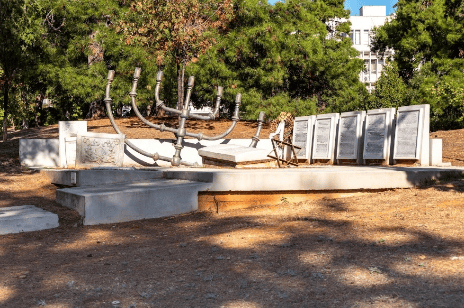
The Holocaust memorial site located in the Aristotle University of Thessaloniki, a constructed cemeterial micro-space composed of gravestones, a Sephardic tomb, and Jewish iconography (the menorah and the Star of David), is a confession to what and who was there before: the Old Jewish Cemetery of Thessaloniki. The memorial’s micro-spatiality is found in it being an impression of the Old Cemetery itself: two of the six gravestones are repatriated originals, the other four are fibre-concrete casts made from rescued stone. This impression, however, is not only a reconstruction of a would-be cemeterial scene at the Old Cemetery; it is also a reconstruction of its destruction. The scene is off-balanced; the slant with which the menorah and Star of David are positioned disrupt the tranquillity of the resting place. This introduces to the micro-space a temporal dimension irremovable from it: the Old Cemetery’s iconoclasm that began on 6 December 1942. On the five gravestones stood upright are inscriptions or, rather, epitaphs to the Old Cemetery and the victims of the Holocaust in Greece. Written in Greek, Hebrew, Spanish, French, and English, it addresses the (international) visitor: “You’re stepping on what is left of the largest necropolis […] a sacred place of remembrance with over 300,000 graves […].” By being a temporally contingent micro-space of ‘what is left’ of the Old Cemetery, the memorial site becomes both the Old Cemetery and its destruction; it would not exist if the Cemetery were not destroyed. As such, the before and after of the Cemetery’s visual landscape are layered on top of one another in the memorial site: the placement of the tomb and gravestones represent the Cemetery’s (dis-)organised layout, a historic and social space changing and growing to facilitate the relationship between the world of the living and the world of the dead, while the slanted icons reflect its ruin, with all semblance of the historic and social space being reduced to scattered stone and bone fragments.
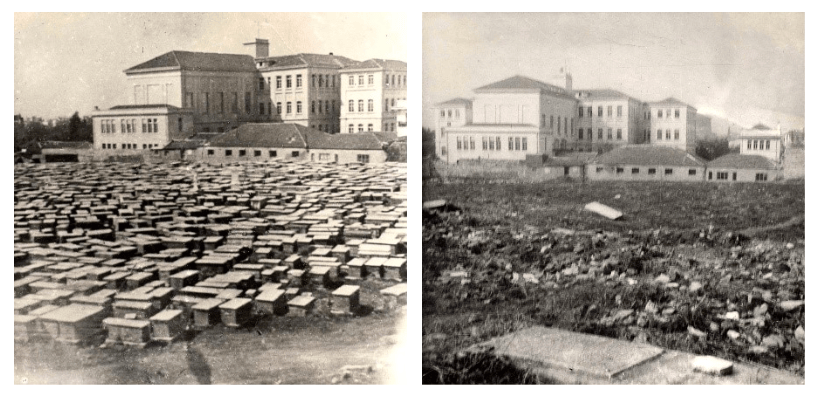
It is within this micro-spatial and material history that this Holocaust memorial site is conceptualised as a deathscape, i.e. a place given meaning and significance as a space associated with death and for the dead. Studying the memorial site as a deathscape, a spatio-temporal reflection is made on the relationship between Greek nationalism and Holocaust remembrance.
The iconoclasm of the Old Cemetery, what was a three hundred and fifty thousand square metre deathscape, was the conclusion to a struggle for space. This contest was a nationalist one: in 1912, Ottoman Salonika became Greek Thessaloniki, and as such, its social and spatial organisation had to ‘fit into the boundaries’ of a nation-state based on an exclusionary and homogeneously imagined community centred around a Hellenic and Orthodox Christian identity. When it became Greek, Thessaloniki’s social landscape was still Ottoman and Jewish; with the settlement of Sephardim expelled from Spain in 1492, Ottoman Salonika became known as ‘Little Jerusalem,’ an economic, political, and cultural centre for Jewish life. In 1910, Jews made up most of the population with sixty-five thousand people, while Greeks and Turks numbered thirty-five thousand and thirty thousand respectively. Beyond demographics, Thessaloniki’s multi-confessional character can be seen in its urban landscape via street names and community spaces; but in particular, it is seen in the spatial configuration of its cemeteries. Northwest to the Old Jewish Cemetery lies the Christian Evagelistria Cemetery, and southeast was a Turkish cemetery and a small cemetery of the Dönmeh, i.e. converts, or Sabbatians. As such, the “centuries-long physical imprint” of the Jewish community on the social and spatial organisation of Thessaloniki is seen via the centrality and integration of the Cemetery; it “narrated the city’s development”.
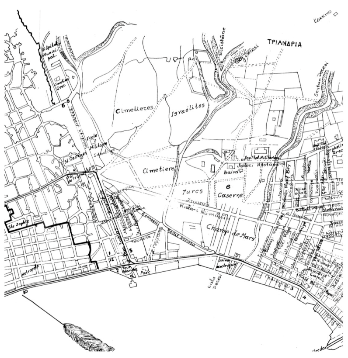
Taking into consideration Hesse and Lacqueur’s premise that “places of the dead represent the social imaginary of the living” then, the struggle for space emerges: the existence of the Jewish Cemetery in the urban centre of Thessaloniki is antithetical to the social imaginary of the Greek city in two ways. First, it spatially refuses the ‘(re-)Hellenization’ of Thessaloniki as illustrated above. Second, it is incompatible with Enlightenment ideas of urban space, wherein the world of the living and the world of the dead are to be spatially separated, and deathscapes are replaced with “something useful,” like a university. And so, with the establishment of the Aristotle University of Thessaloniki in 1926 on a small site of the Cemetery previously expropriated by the Ottomans, the struggle for space intensified.
It is in the Nazi Occupation of Thessaloniki in 1941, that, as contemporary Georgios Vafopolous wrote, “this unsolvable problem [the struggle for space] found its dramatic solution.” The exclusionary element of Greek nationalism became explicitly antisemitic in the presence of Nazi authority: when Jews en masse were “drafted for forced labour” local Greeks replaced them, and when Jewish properties were vacated, Greek ‘custodians’ and neighbours spoliated them. The Jewish community, once central to Thessaloniki’s topography, was made into a separate entity confined to ghettoes and subjected to dispossession. Finally, the nationalist or rather antisemitic struggle for space would be concluded on 6 December 1942, when the municipality employed five hundred workers to destroy the cemetery and gather its materials. Gravestone fragments would be used in the building of Thessaloniki’s churches, schools, and streets. This happened three months before ninety percent of Thessaloniki’s Jews were deported and exterminated in Auschwitz-Birkenau. As the epitaph on the memorial anachronistically states: “people were not enough. They wanted to kill the memory too […] Those buried here died for a second time.” But who does the memorial site mean when it says “they”?
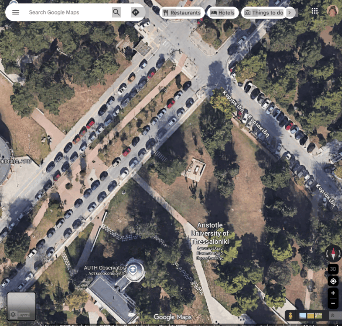
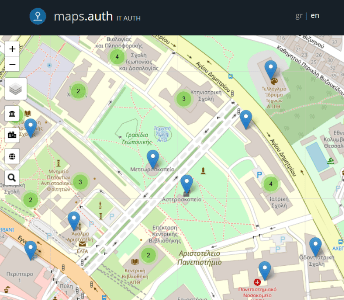
The university erected the memorial in 2014; and with it, the seventy-year spatial erasure of the millennia-old cemetery was recognised both in its spatial reduction and expansion. That is, the Old Cemetery, once central to Thessaloniki’s topography, is reduced to a memorial site as much as it is expanded into one after decades of silence post-destruction. However, although within the university campus, the memorial is a delimitated micro-space that is entered: white slabs function as stairs from the road onto the cemeterial scene, obscured by a grove of trees. The platform separates the memorial from the earth, with two short walls creating a closed-open space. As such, the visitor is expected to engage with the memorial not only visually but also corporally: there is a path for walking around the Sephardic tomb and there are no signs against touching the gravestones. This engagement is focused on the micro-space of the memorial site, and not the entire space of the Old Cemetery; that space is for the University. The delimitation of the memorial site from the University is not only seen on the physical campus, but also in the University’s virtual space. Nowhere on the University website is there mention of the Old Cemetery or the memorial site, despite its destruction being central to the development of the University itself. Only on the university’s interactive map is there a monument icon titled Jewish Cemetery Monument; but there are no interactive features related to the memorial site, and similar non-descript landmark icons (museum, theatre, castle) are found within and beyond the campus on the map.
In 2010, historian Apostolou wrote: “It remains beyond the realm of the imagination for a memorial to be erected that might refer to non-Jewish [i.e. Greek Christian] participation in the persecution of Greek Jews.” In 2025, a Polish tourist wrote, “In [Thessaloniki], it’s difficult to find not only traces of this tragedy, but also any mementoes of the [Jews of Thessaloniki]. You have to know what you’re looking for and where to look.” In Thessaloniki, remembrance and erasure of the Holocaust become one in the same: the memorial site exists, yet within the spatial matrix of the Greek nation-state, it is unwilling to undo its constant destruction as an erasure of local Greek participation in the Holocaust. As such, the memorial site both rejects and confirms Apostolou’s statement. The relationship between Greek nationalism, the Holocaust, and memory is found in all its complications within the memorial site as a deathscape.
As an Istanbulite, I walked through neighbouring Jewish, Christian, and Muslim deathscapes; they are spaces wherein the world of the living and the world of the dead still meet despite the exclusionary and homogenously imagined nationalist space of the Republic of Türkiye; memory lives on. Reflecting specifically on the Kimsesizler Mezarlığı (Cemetery of the Nobodies) in Istanbul, wherein the socially marginalised (the homeless, refugees, LGBTQ+ people) are buried anonymously, I am reminded of the iconoclasm of the Old Cemetery in Thessaloniki. Buried in anonymity, these bodies’ status as deceased ceases to be. This non-status, no longer dead because there is no space in which to realise the social role of the dead, cannot even be given to the bodies in the Old Cemetery; the antisemitism that prevailed within Greek nationalism dispossessed Thessaloniki’s Jews of any social role: it is now mostly the university’s space.
Bibliography
Apostolou, A. ‘Strategies of Evasion: Avoiding the Issue of Collaboration and Indifference during the Holocaust in Greece.’ In Collaboration with the Nazis. Edited by Roni Stauber. Routledge, 2011.
Aristotle University of Thessaloniki. ‘Brief History.’ Accessed February 10, 2026. https://www.auth.gr/en/history-en/.
Aristotle University of Thessaloniki. ‘AUTH Map.’ Accessed February 10, 2026. https://www.auth.gr/en/access-en/.
Central Macedonia Greece. ‘Monument of the Old Jewish Cemetery.’ Accessed February 10, 2026. https://visit-centralmacedonia.gr/en/what-to-do/64/culture/992/monument-of-the-old-jewish-cemetery.
Google Maps. ‘Aristotle University of Thessaloniki.’ Accessed February 10, 2026. https://www.google.com/maps/@40.630984,22.958994,208m/data=!3m1!1e3?entry=ttu&g_ep=EgoyMDI2MDIxMS4wIKXMDSoASAFQAw%3D%3D.
Hesse, C., Lacqueur, T. W. ‘Bodies Visible and Invisible: The Erasure of the Jewish Cemetery in the Life of Modern Thessaloniki.’ In The Holocaust in Greece. Edited by Giorgos Antoniou and A. Dirk Moses. Cambridge University Press, 2018.
Kornetis, K. ‘Expropriating the Space of the Other: Property Spoliations of Thessalonican Jews in the 1940s.’ In The Holocaust in Greece. Edited by Giorgos Antoniou and A. Dirk Moses. Cambridge University Press, 2018.
Maddrell, A., Sidaway, J. D., (eds). Deathscapes: Spaces for Death, Dying, Mourning and Remembrance. Ashgate Publishing Limited, 2010.
Obirek, S. ‘Polityka historyczna w wyadaniu greckim.’ Studio Opinii. February 17, 2025. https://studioopinii.pl/archiwa/244841.
Saltiel, L. ‘A City against Its Citizens? Thessaloniki and the Jews.’ In The Holocaust in Greece. Edited by Giorgos Antoniou and A. Dirk Moses. Cambridge University Press, 2018.
Saltiel, L. ‘Dehumanising the Dead: The Destruction of Thessaloniki’s Jewish Cemetery.’ In The Holocaust in Thessaloniki: Reactions to the Anti-Jewish Persecution, 1942-1943. Routledge, 2020.
Sautkin, A. A. ‘Cemetery Locus as a Mechanism of Socio-Cultural Identity.’ In Social Identities 22, no. 6 (2016): 661-677.
The Bezalel Narkiss Index of Jewish Art and Material Culture. ‘Holocaust Memorial at the site of the destroyed Old Jewish Cemetery on the grounds of Aristotle University, Thessaloniki, Greece, 2014.’ Accessed February 10, 2026. https://cja.huji.ac.il/hmm/browser.php?mode=set&id=46549.
The Jewish Community of Athens. ‘Greek university, built on ruins of Jewish cemetery, unveils memorial.’ Accessed February 10, 2026. https://athjcom.gr/en/2015/02/02/greek-university-built-ruins-jewish-cemetery-unveils-memorial/.
Yad Vashem Archives. Saloniki, Greece, The Jewish Cemetery, Postwar. 4620/1921. Thessaloniki, Macedonia, Greece. https://collections.yadvashem.org/en/photos/21677.
Yad Vashem Archives. Saloniki, Greece, The Jewish Cemetery, Postwar. 4620/1920. Thessaloniki, Macedonia, Greece. https://collections.yadvashem.org/en/photos/21035.
Zengin, A. ‘Turkish Cemeteries for the “Unknown”.’ Allegra Lab. May 2020. https://allegralaboratory.net/turkish-cemeteries-for-the-unknown-afterlives/.

