
Written By Ryan Henderson
19/10/2026
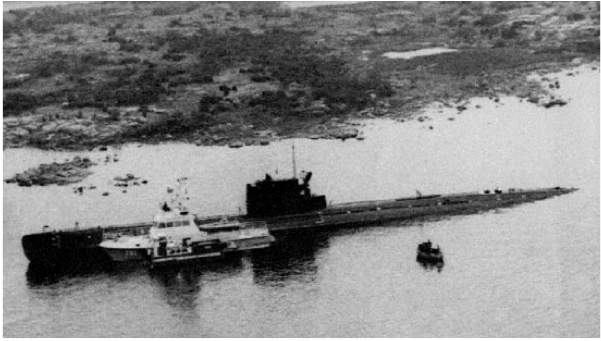
It is the early hours of 27th of October 1981 and the residents of Torhamn, a small, isolated fishing community on the southern coast of Sweden, are beginning to wake up. The locality is situated twenty kilometres from the naval base at Karlskrona, and was a popular location for birdwatching. When their boats took to the water that morning, they began to hear voices and shouts coming from the fog as a large, dark grey shape loomed into view. The residents of Torhamn were thrust into the middle of a dangerous Cold War confrontation, as the news of a beached Soviet submarine spread throughout the world.
From the end of the Second World War to the collapse of the Eastern Bloc, the Soviet Navy performed continuous exercises and surveillance operations above and below the surface of the Baltic Sea. This was a vital Cold War battleground, the Red Fleet’s role in any war against the West would be to seize the islands of the Danish Straits and, combined with amphibious landings and a ground invasion through Northern Germany, facilitate a breakout into the Atlantic, where submarines could savage NATO merchant shipping. This plan required the Soviet Navy to be top-of-the-line and ready to fight at a moment’s notice. As such, detailed maps had to be made of the sea floor’s topography (showing routes that submarines could use to traverse undetected) and the warfighting capacity of any potential adversaries had to be studied closely.
During the length of the Cold War, the Kingdom of Sweden upheld its policy of armed neutrality. It did not join the North Atlantic Treaty Organisation, for fear of Soviet economic or military retaliation; however, it still built up its military capabilities, capabilities that, by the 1980s, were among the best in Europe. Sweden had an advanced domestic military industry that allowed them to cement themselves as a prime regional power in the Nordics. Sweden believed that they could defend their shores without the need for NATO, but that would not deter Soviet submarines from operating close to their sea border.
In the event of a major war between NATO, and a naval confrontation in the Baltic, it was almost certain that Sweden would be drawn into the fight, most likely alongside the Western powers against the Warsaw Pact. To this end, Sweden remained under surveillance by Soviet Naval assets, submarines were used to evaluate Swedish coastal defences, sonar coverage and anti-submarine warfare (ASW) capabilities. During the 1980s, Swedish intelligence sources noted between seventeen and thirty-six subsurface operations in their territorial waters every year, most believed to have been Soviet in origin.
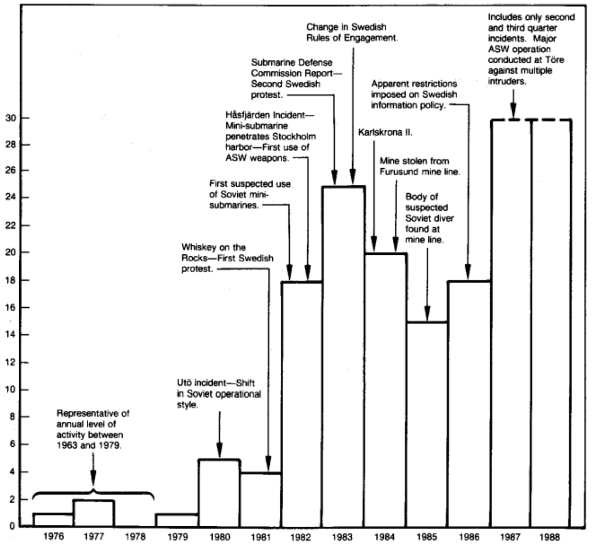
These incursions carried profound political risks, especially if the Swedish government or military decided to actively carry out operations to prevent them. The “submarine crisis” caused wide consternation within the Swedish military and public, it seemed inevitable that a direct confrontation would occur.
What the fishermen from Torhamn discovered was a Soviet Whiskey-Class diesel-electric attack submarine stranded upon a rocky bank, with its hull forced above the waterline and its engines unable to reverse itself back into the water. Quickly, Swedish Navy ships were dispatched to attempt communication with the crew and ascertain the circumstances by which they had beached their vessel. Initially, a single, unarmed, Swedish officer was allowed entry to the submarine, named the S-363, where he was met by Captain Second Rank Gushchin. Captain Guschin claimed that his submarine had struck an underwater rock, due to a navigational error caused by faulty equipment, and believed himself to be stranded some twenty kilometres off of the Polish north coast.
This statement was not accepted by the Swedes, who noted the skill required to penetrate so deep into the dangerous, and complex territorial waters. The Soviet Union officially stated that the boat had suffered from a navigational failure due to poor visibility during routine training, a story that, as heard in intercepted Soviet communications to the submarine’s crew, the submariners were encouraged to follow. In the years following the incident, Soviet officials would claim that the vessel had been returning from an exercise in the Baltic, and in celebration of its completion, the crew was treated to drinks and a party, a choice that resulted in the severe impairment of the navigator and other chief officers. Regardless, a later inspection of the submarine on the 3rd of November by Swedish experts concluded that both the navigational
systems were operating normally and the logbook had recorded the vessel’s journey along the south coast of Sweden.
The Swedish government issued a formal protest to the Soviets over the “flagrant violation” of their territorial waters and openly questioned the validity of Gushchin’s story. The note also detailed a concerning discovery: that the submarine was potentially carrying nuclear weapons. Following direction by Swedish Prime Minister Thorbjörn Fälldin, a specially modified Coast Guard vessel began to make radiation measurements across the hull of S-363; using gamma ray spectroscopy equipment the Swedes detected a significant amount of radioactive material inside the torpedo bays of the boat. The analysts determined that a ten-kilogram deposit of uranium-238 was present, and that the blast yield of a weapon utilising this amount of material
was comparable to the Little Boy bomb dropped on Hiroshima. Torpedoes fitted with a warhead of this size could be used to attack Swedish naval forces or coastal installations with significant effectiveness. Covert plans were prepared to seize the vessel by force and secure the torpedo room if the Soviets denied the existence of nuclear weapons aboard the boat.
The Soviet Union responded to the Swedish protests, giving assurances that the submarine had become lost due to navigational error, and that Swedish territory had not, in fact, been illegally breached and that S-363 should be treated as sovereign Soviet territory, with its possession transferred promptly back to their control. To the questions raised by the detection of radioactive material, they remarked chillingly that, “The Soviet submarine… carries, as do all other naval vessels at sea, the necessary weapons and ammunition”.
As political communications were ongoing, a sizeable Red Fleet was deployed to the Karlskrona area, comprising destroyers, frigates, submarine recovery ships, dedicated electronic warfare vessels and ships carrying missiles, which were also known to carry nuclear warheads. This posturing was openly ignored by Swedish authorities, as inspections of the vessel continued. Secretly, Swedish PM Fälldin gave the order to “Hold the border” and take action against further intrusion by any foreign vessels, coastal defence batteries and early warning stations were put on alert, as the Swedish Navy prepared to repel a potential Soviet operation to recover the submarine.
After a tense standoff, the Soviet government relented, and on the 6th of November, Swedish tugboats began the difficult operation of towing the Whiskey off of the rocks and out to sea, at the expense of the USSR, who offered a formal apology on behalf of the crew regarding the incident.
While a direct confrontation was averted, the incident was not the end of Sweden’s submarine troubles, by June of the next year and continuing for the rest of the decade, subsurface contacts began anew with increasing frequency. Stories of conning towers emerging in Swedish waters and tracks discovered on the sea floor, hinting to the existence of vessels that could submerge and drive slowly and silently under sonar detectors, continued to fuel speculation and calls for action against the Soviets.
The Whiskey on the rocks incident was a clear sign of the threat that Sweden and the Nordics faced in any war scenario, the failure of military deterrence against the capable and technologically advanced Soviet Union. The incident, and the relenting of the USSR to international pressure and accountability signifies the wound that events like the invasion of Afghanistan in 1979 had left on the USSR, as time marched further from the quiet stable years of Détente and closer to its eventual retreat from political strength and into collapse.
Bibliography
Będźmirowski, Jerzy, Miłosz Gac, and Jakub Kufel. “Baltic Sea during the Cold War: Polish-Soviet Maritime Cooperation.” Historia i Polityka. Wydawnictwo Naukowe Uniwersytetu, 2024.
Bengt Gustafsson, ‘The Swedish Submarine Issue,’ in The Journal of the Royal Swedish Academy of War Sciences. Volume 3, (Stockholm, 2010), 64-95.
McCormick, Gordon, Stranger than Fiction: Soviet Submarine Operations in Swedish Waters, (Santa Monica, CA: RAND Corporation, 1990)
Moore, Cameron. “The ‘Whiskey on the Rocks’ Incident.” In Maritime Operations Law in Practice, 1st ed., edited by David Letts and Rob McLaughlin, (Routledge, 2023), 136-48.
Nieuwint, Joris, ‘Whiskey on the Rocks – When Sweden Woke Up to Find a Russian Submarine Stuck on a Rock,’ in War History Online (2015) <https://www.warhistoryonline.com/war-articles/whiskey-on-the-rocks-when-sweden-woke-up-to-find-a-russian-submarine-stuck-on-a-rock.html> [accessed 01/10/2026]
Vogel, Kathleen Margaret, Nicole Janice Ball, and Milton Leitenberg. “The Case of the Stranded Sub (1982).” In Milton Leitenberg: Pioneering Work on Weapons of Mass Destruction, Wars and Arms Control, vol. 34, edited by Kathleen Margaret Vogel, Nicole Janice Ball, and Milton Leitenberg, (Switzerland: Springer, 2025), 313–18.
Image Credits
https://www.rand.org/content/dam/rand/pubs/reports/2007/R3776.pdf

