
Written By Harry Child
19/10/2026
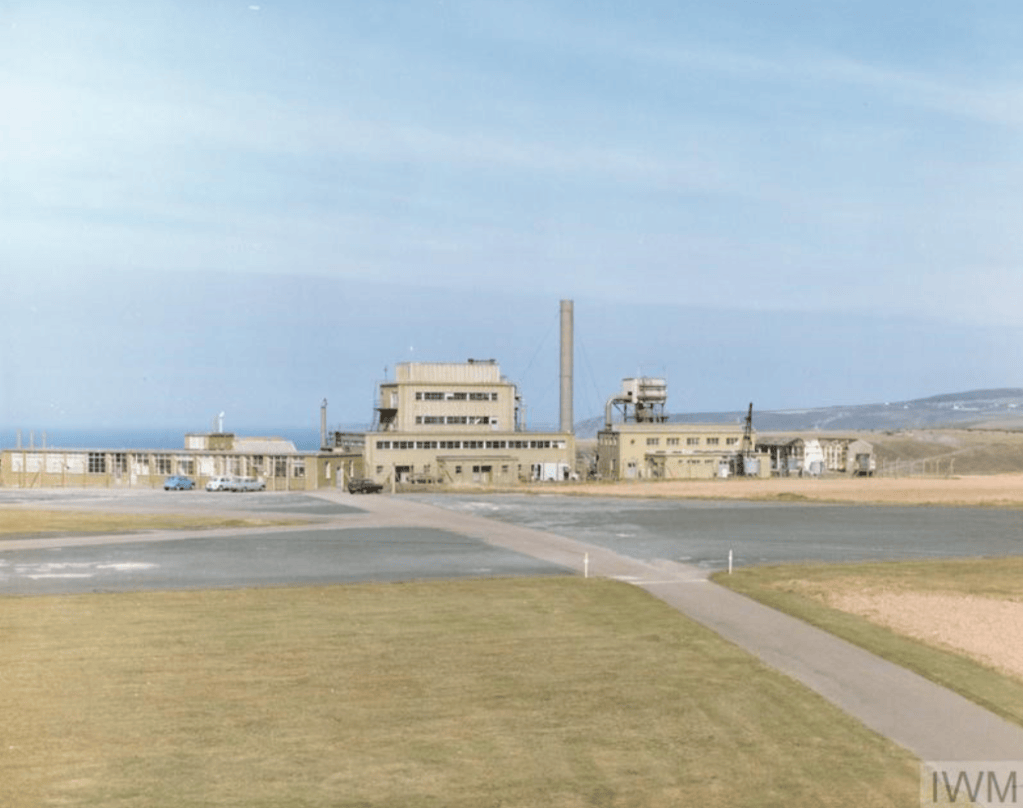
North Site, Nancekuke in the mid-1970s
Introduction
‘Gradually, over the years, little bits and pieces came out’: A week ago, during a conversation with my grandad, Denis Batty, I discovered that my great grandfather (my grandad’s father), a certain Claude Oliver Batty, had worked at Chemical Defence Establishment (CDE) Nancekuke, in Cornwall during the Cold War. Following this, I decided to interview my grandad to learn more about what he remembers of his dad’s involvement in the site. Over the course of thirty minutes, a lot of very interesting stories were revealed.
This article will not follow the conventional structure of an interview. Rather than following two sides of dialogue, this article will interweave the direct transcriptions from my interview with my grandad with documented information about CDE Nancekuke, to set Claude Oliver’s story within the wider known context of the site. All the in-text quotations are taken directly from the interview. The article will be broken into three sections, the first considering his early life: how he came to work at Nancekuke, before then considering his time working there, concluding with a section about Claude Oliver’s life away from work, how he relaxed when away from the highly tense job which required him to swear the Official Secrets Act.
Great Grandad’s Early Life
My grandad has often mentioned how his father, Claude Oliver Joseph Batty was born in 1908 in Henley on Thames in England. He was born into a family of businesses, his father, Claude Oscar Batty, ran multiple establishments in the area, including a bike shop, a cinema and a dance hall. But by the late 1920s, Claude Oscar saw that there were better opportunities in Cornwall and decided his family should relocate. This began with Claude Oliver who, at age 21, was sent down to Cornwall to set up business by his father; the rest of the family were then to follow.
Claude Oscar and his family opened a general store in St. Day, Redruth, in which they sold many things, even accumulators according to my grandad, which would be used by the locals in the area to run their radios. My grandad tells me that Claude Oliver drove the vans that delivered these from the shop in the early years. This firmly placed the family in Cornwall and put Claude Oliver in easy reach of CDE Nancekuke.
Following the war, where he had worked as a fireman, ‘he [Claude Oliver] was working at a factory called Heathcotes, near Redruth, in Cornwall, where we all lived and he was working there for some while and then the factory was sort of completed and he didn’t have a job, so he was looking for another job and found that they were going to open a big factory or complex at a place called Nancekuke’. My grandad also said Claude Oliver was working as an electrician at the time. Nancekuke was originally ‘an old airfield on top the hill near Portreath in Cornwall’. This it was – during the Second World War, in 1941, the site was turned into an RAF Fighter Sector Station and Overseas Dispatch Unit as part of RAF Portreath, and it remained this until May 1950. At this time, the Ministry of Supply took it over and began turning it into a Chemical Development Establishment to produce chemicals for use in warfare. Around this time, Claude Oliver ‘… went for an interview and basically he was offered a job as a patrolman for a while, and then once they got the thing up and running, they’d offer him the job to take him on as an electrician’.
Great Grandad’s time at CDE Nancekuke
‘… they had a big perimeter fence all the way around this place, this airfield, so he would work as a patrolman with dogs … Alsatians I think they were and he worked there for quite some time until such time as they got set up, the government set up this factory … experimental station I think it was called’.
The National Archives tell us that CDE Nancekuke started producing chemicals on a small scale in 1951, and they operated three sites. It was the North site in 1954 where they began producing the highly dangerous and volatile chemical agent known as Sarin; the Imperial War museums second this, saying it was set up as a test, to see if Britain could produce a lot of nerve agents to be used in chemical warfare. ‘So once they got it set up he then got offered the job as electrician and I think he was number two electrician to be taken on for the whole complex, so he worked for some time setting the place up and various bits and pieces … and then he became involved in more sophisticated equipment … which involved the stuff they were going to manufacture or were manufacturing at the site, which it transpires now was nerve gas’. My grandad did recall that his father did not work alone he had an ‘electrician’s mate’, essentially a person who helped him.
‘… he would go into the plant itself, the whole top-secret plant. Now the first thing was … going into the areas that he was going into, you had to change your clothes, you couldn’t wear your own clothes, so you changed your clothes and they washed their clothes and you’d carry on working from there. And then when he went into the real nerve area where they had all this specialised equipment and chemicals etcetera, he would have to go into put a suit on, a special suit, like a spaceman’s suit’. Now when asking my grandad if he ever remembers his father wearing this and if he didn’t how he knew about it, he replied that no he didn’t: ‘I didn’t see anything like that, it was only what he said he had to do’.
‘A lot of people were employed at Nancekuke’, said my grandad around three and a half minutes into the interview, four minutes later he returned to this point. ‘Many people in Cornwall, around the Redruth area, were employed there, so it was a place of good employment’. Interestingly my grandad went on to talk about the fact that there were a substantial number of workers who came from Lancashire at the site, and that his dad was friends with some of them – when I asked him what jobs they did, he responded that they did many jobs, including being electricians like his dad, but also being the chemists working in the plant. He says that these people were especially around when the factory was being set up, and were given accommodation around Redruth, he connected this with remembering council houses being built there at around that time.
‘I know that when he used to go on holiday, especially when he used to come up and see us, he used to say he had to say to the organisation where he was going for his holiday, so if there was a problem at the site then the police would find him and bring him back to the site so that he could go on there and sort what the problem was … they couldn’t have any ordinary electrician … there unless they knew what they were doing, unless they knew what the plant was about. He was one of the people that understood how the thing was all connected up’. My grandad went on to say that he never remembered an instance when his dad got called back to the site. He also recalled that his dad had a special permit which allowed him to get his car onto the site and that any cleared visitor to the site, ‘had to be escorted all of the time’.
My grandad described what he remembered of the site’s appearance: ‘you could see if you looked up towards Nancekuke … obviously some buildings, but the main thing was two stacks stuck up’, referring to the chimneys of the site.
‘I remember that once, when the group of people who wanted to ban the bomb … they set up camp at one of the gates and the idea was they wanted to get onto the site and … they weren’t allowed to go on the site … And I think in the end because of the type of stuff that they were manufacturing there, a group of troops were landed on the site and they were there secretly so if anyone did break the gates … they would have to shoot them…’. So, my grandad recalled that protests happened at the site.
Great Grandad Outside Nancekuke
‘He worked there for twenty-one years and retired when he was sixty-five. Some time maybe after he had retired, they started to disband the site … the reason they were making all of this gas was to do with the cold war, once things eased off … I think they began to disband the site and there were all sorts of rumours on what they were going to do with all this stuff that was being left up there … Some talk about them throwing it into the sea … as the sea was on the edge of Nancekuke’. The National Archives tells us that Sarin stopped being produced at the site in 1956 and it then began producing riot control agents like CS gas and things like training stimulants and charcoal cloth which could be used in protective suits worn by British forces. Then in 1976, it was decided that the site would be closed and all the remaining chemical agent at the site was either destroyed or moved to Porton Down. It was then shut down properly in 1980 and given back to the RAF in September of that year.
My grandad recalls how his dad would, in his spare time wire some of the houses for those who he was working with at Nancekuke, my grandad helping out at times with this: ‘they used to say, “Claude could you come and put a light up for me?”, so he would go to their house and put a light up for them and charge them for doing it … I didn’t like electrics, but I used to go and pull the wires through …’
‘He retired and that was it … he was involved in dancing, he used to go with your great grandma, they joined an old-time dancing club and in the end, they ran the old-time dancing club …’. When I asked my grandad if they were good dancers, he responded, ‘I don’t know about that, but they were interested in it, they had a meeting every week’. ‘They used to go to church’ as well, my grandad said.
‘Dad was trained as a violinist at a very early age … and he set up his own band … to play at dances, dances that were popular in the thirties and the forties … the band was called Rhythm Sheiks’. Music was clearly a big part of Claude Oliver’s life outside of work.
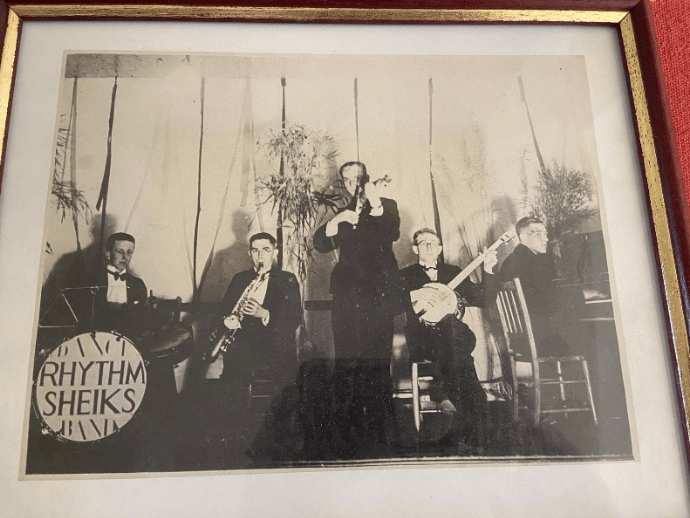
Claude Oliver Batty playing the violin (middle) in the Dancehall, performing with his band the ‘Rhythm Sheiks’
Then there came a slightly more intriguing pastime: ‘he had a greenhouse and he did cultivate cactuses … when he died, mum gave those, all the cactuses, to the Eden Project’. My grandad mentions that at this time, the Eden project had not yet started but had this garden centre where they were collecting the plants ready to go on display and that she got an invite to the Eden Project’s launch.
To end, my grandma chipped in at one point and told me that Claude was a very conscientious man and grandad seconded this, saying he was very loyal to the government. This illustrated to me that Claude Oliver was well suited to his role – the government must have known he was a safe pair of hands. The lack of specifics surrounding what his job involved perhaps proves this.
Bibliography
rious notes of information made from discussions with Denis Batty (Multiple dates; not publicly accessible).
Recorded Interview with Denis Batty lasting 30 minutes and 42 seconds, regarding Claude Oliver Batty’s involvement at CDE Nancekuke (09/10/2026; not publicly accessible).
The National Archives (TNA), ‘Nancekuke Remediation Project’, Defence: about defence, (archived, 2010), https://webarchive.nationalarchives.gov.uk/ukgwa/20101208174527/http://www.mod.uk:80/DefenceInternet/AboutDefence/WhatWeDo/DefenceEstateandEnvironment/Nancekuke/, last accessed: 11/10/2026.
Imperial War Museums (IWM), ‘Porton Down Chemical and Biological Defence Establishment’, HU 102387, https://www.iwm.org.uk/collections/item/object/205225590, last accessed: 11/10/2026.
Image Credits
Imperial War Museums, ‘Porton Down Chemical and Biological Defence Establishment 1917-2000’, HU 102387, taken by the Porton Down official photographer, accessible: https://www.iwm.org.uk/collections/item/object/205225590.
Claude Oliver Batty playing the violin (middle) in the Dancehall, performing with his band the ‘Rhythm Sheiks’, image reproduced courtesy of my grandparents: Denis and Christine Batty.

