
Written by: Edith Martell
03/03/2024
Like many other Classical scholars of my generation, I was flung into the field by my undying and unwavering love of one thing: Percy Jackson, son of Poseidon. His witty, brave monologue that spanned five books was, at twelve, an introduction into the world that would shape my life from there on out. I devoured the extended universe very happily, learning about Roman, Egyptian, and even Norse mythology — though none captivated me as those very first had. As I grew up and began working in the industry– digging, guiding, and even once being executed on the job — I became aware of the childlike simplicity these novels afford to the ancient world at large. It’s one thing to read about Percy’s adventures around modern-day America and quite another to get your hands dirty in the English soil.
Riordan excels at amusing, short storytelling. One of his defining characteristics as an author is his unparalleled skill in simplifying and often taming a story for his audience, but engaging them, nonetheless. It has been a while since I sat in the back of the car with orange-sticky fingers pouring over a copy of Percy Jackson and the Greek Monsters, but my love for the myths is no less profound. I blame Riordan, among others, for my insatiable need to write (just see my other two articles) and, at times, for my love for the ancient world. I did do a bit of growing up in between; well, it’s got me thinking. Which books bridged the gap between my past and, more immediately, my present? Despite this change, one thing is clear in my life: an unwavering and complete love of these stories.
Let’s start with the classics, shall we? I personally prefer the Odyssey to the Iliad, and the Aeneid more than either of those, but if millennium-old ancient poems aren’t really your cup of tea, I have a genre for you: retellings. I am sure you have all heard of Madeline Miller’s The Song of Achilles, and for a good reason. A fresh take on the years preceding the Trojan War, it follows the swift-footed Achilles and makes him a sympathetic, beautiful character. Narrated by his lover Patroclus, it’s a truly haunting eulogy to perhaps the best-known ancient hero. (And no, they weren’t cousins. Troy has been lying to you; I am sorry.) Ariadne and Electra –– both by Jennifer Saint — are other incredible retellings. And if after you’ve tackled them, you wish to take on the other ancients, I recommend Anne Carson’s translation work on the plays Electra and Antigone. I’ve performed them twice with two different groups of friends; it’s not rotten work. Not if it’s Carson. I recommend doing the voices — you’d be historically accurate.
Of course, if you’re looking for quick mythical explorations and an astute view of their many forms, read Natalie Haynes. Do yourself a favour and buy a book of hers — my copy of Pandora’s Jar is almost missing its cover. Though I’ve personally had a vendetta against her ever since she told me that she hated Percy Jackson (I’m joking Natalie, you were exceptionally lovely and exceptionally funny, I’m just blinded by nostalgia). Haynes is another author who dabbles in retellings: her novel centring on the story of Medusa, Stone Blind, was only topped by her lecture on it. I can recommend a Wikipedia rabbit hole on Gorgoneion as a close substitute. She’s as funny as she is on paper, and as tangential. Her pop-culture references are unmatched, and she makes even the most convoluted origins understandable. She’s a feminist but doesn’t shy away from the original context; she’s educated but not pretentious: Her Children of Jocasta is yet another woman first, stunningly written work. I am a fan.
Margret Atwood’s Penelopiad is yet another feminist retelling. You may recognise the title: it’s no mistake. A play on the Iliad, it tells the story of Odysseus’ wife, Penelope, during her twenty-year wait for his return. She’s as stunningly loyal, and as frighteningly cunning as she is in the original. If you’re into badass women turning men’s household incompetence against them with devastating results, give this a go. Penelope is one of my favourite mythological characters for a reason: her and Odysseus’ relationship is something I aspire to. Make no mistake, Homer knew what he was doing when Odysseus’ only reaction to Penelope cheating all 108 of her suitors out of their gold was that’s my wife! And I’m not even exaggerating.
On a much less fictional, much more Roman note — Mary Beard’s SPQR is one to read. In it, her description of Roman life and Rome’s convoluted thousand-year history is on display with no-holds-barred. Beard refuses to shy away from the gritty, often omitted side of things, and her writing is, of course, excellent. It even has pictures! Richard Hingley’s Conquering the Ocean is another fascinating non-fiction work, exploring the politics behind the Roman obsession with Britain. Spoiler alert: they thought this rainy island was something like the home of the gods, and their dominance over it was therefore dominion over land and sea. A pretty big claim for an empire which never even reached Australia.
I’ll end with one last suggestion: read the originals. Much like with TV adaptations, there’s nothing better than the inspiration, and so, as the title suggests, I’ll be talking Cicero. And Sappho but give me a minute. I think Cicero’s a funny guy, and I’m asking you to hear me out. First of all, please do pronounce his name correctly: with a hard ‘c’, it should sound a little like Kick-Airo. Then go on to read his Letters. A powerful public speaker — as evidenced in The Catilinarian orations-– he’s just as well-spoken whilst talking to his friends. They reveal a truly unique window into the psyche of an incredibly interesting, cynical and emotional man. They go something of a long way to humanising a legend — albeit one who was killed for calling Mark Antony gay a little too publicly. (But if this sounds like your worst nightmare, Robert Harris’ Cicero trilogy is always surprisingly accurate.) Sappho. Ah, Sappho- from Lesbos of the lesbians, writer of homosexual erotica and bizarre shorts about farmer’s daughters. Being one, that is a farmer’s daughter, I can vouch for her work. If you’re an unschooled voyager into the classics, you may still have heard of her. She’s been in the news recently, and not for rising King Arthur style. One of her recently discovered works is in dispute, but despite that, she remains indisputably excellent. She’s one of the few to mention herself by name within her works, and one of the few you can read in an afternoon. We have very little of her left — the Penguin Classics anthology fits in my jeans’ pocket — but her words are just as significant now as they must have been then, all those millennia ago.
I hope this inspires you to get reading, even a little bit. And, if none of those seem appealing, I can also recommend the Usborne’s Look Inside a Roman Town– it’s interactive and I remember loving it at age four.
Bibliography
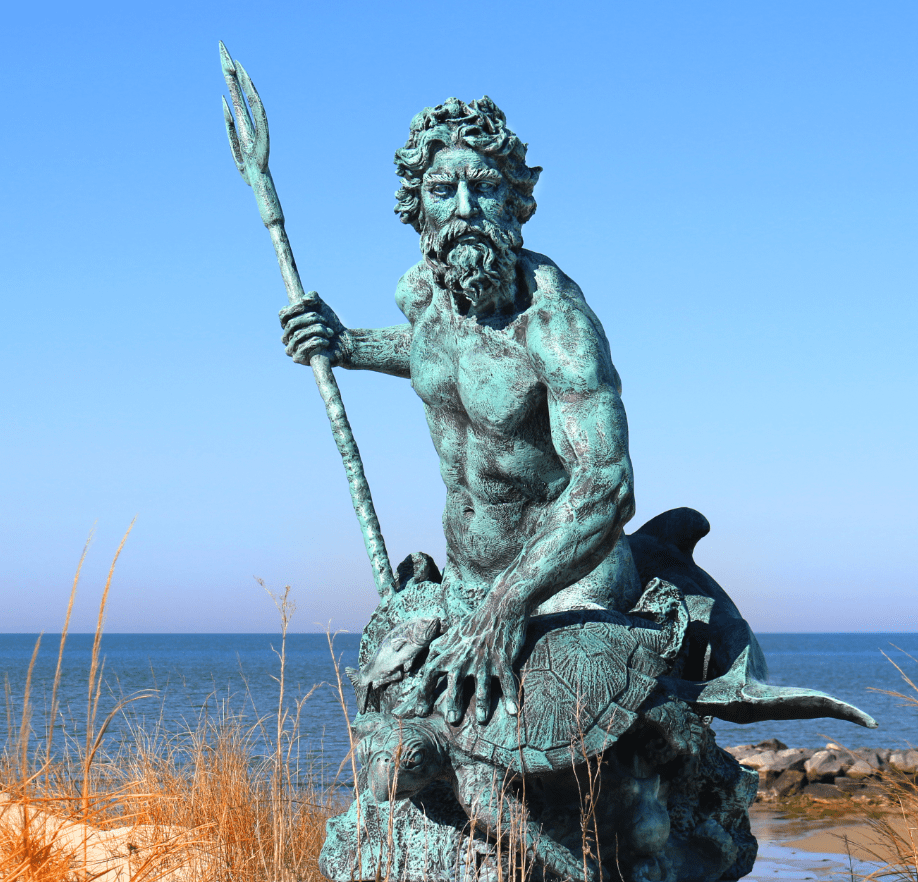
Featured Image Credit: Greek mythology Art Bronze Life Size Poseidon Sculpture [online]. Available at: https://www.aongking.com/aksculptures/greek-mythpology-art-bronze-life-size-poseidon-sculpture/ (Accessed 3rd March 2024).

