
Written by Yacine N’Dao
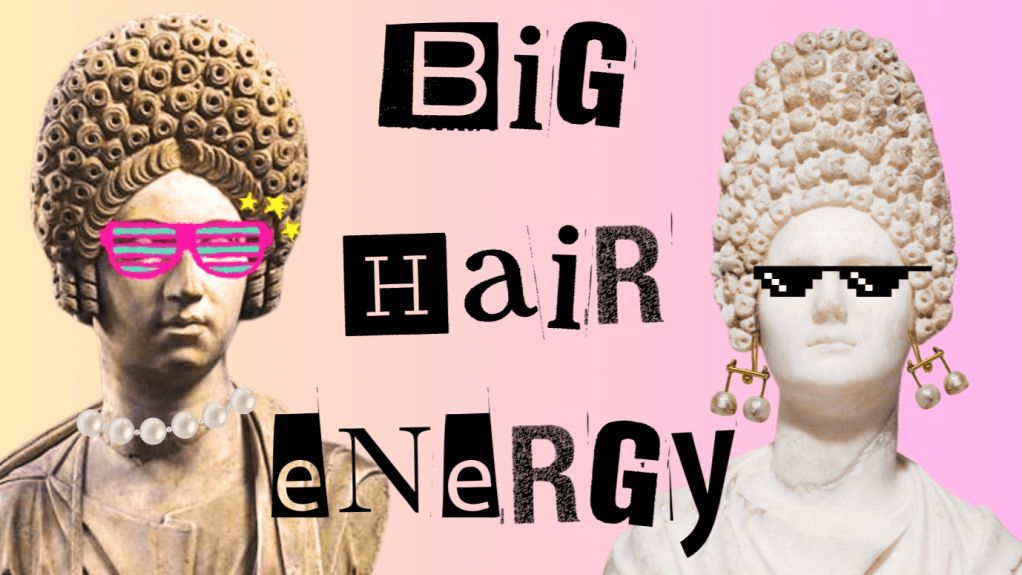
Under Flavian rule, a distinct hairstyle gained extreme popularity among the female population, stretching across all social strata within the Roman Empire. The era defining style is characterised by the meticulous arrangement of curled hair mounted towards the front section of the head, with the remaining section twirled and assembled into a bun or long braided locks at the back of the head. Regardless of the finish, the important element of this coiffure lies in the fashioning of the front, notable for its unique recognisable shape. The replication of this specific style can be interpreted as an effective way of communicating information about the wearer as intended by the wearer.
The advent of a new ruling imperial family in AD 69 and the stability it brought about prompted a shift in society. New members joined the political ranks; senatorial families not issued from the traditional ruling order were established. The elite class expanded, wealth was created, a prosperous middle class of citizens emerged. Stability after the civil war stimulated economic growth. Wealth often leads to independence. Slaves bought their liberty and benefited from this wave of social mobility. Changes in the Law, such as sine manu marriages, and no longer having a feminised paternal name had discreetly played a part in bolstering the self-esteem and autonomy of women whether married, divorced or widowed. The influx of new money seems to have inspired the wealthy women dwelling in the capital and their hairdressers to create visually imposing Flavian mounds, busy assemblage of curls more intricate and voluminous towards the later part of the first century, as recorded by critical male observers of the time, such as Juvenal and Martial. These highly disapproving judgements describe in exaggerated terms real women and their coiffure. Juvenal decries the vanity and deceit that these independent and audacious women dare display. Of the Flavian hairstyle he describes “so numerous are the tiers and storeys piled one upon another on her head!” Indeed, his comments reinforce the notion that this specific style was worn in Rome by young women and by older matrons.
A vertical mass of curls allowed a woman to physically take up space and distinguish herself from her peers. Due to their constrained role, lack of opportunity, and right to participate actively in society (with a few exceptions), women managed to make a statement beyond their limited choice of clothing. Experimental archaeology has demonstrated how this look can be achieved using only the tools available at the time. Consequently, those women wearing the coiffure in real life required a fitting lifestyle. A comfortable situation with access to slaves, a skilled ornatrix, resources to spend on curling irons, wigs, hair pieces, mirrors and combs, needles and pins, balms, oils, and waxes, as well as the leisure time to devote to this long and sometimes painful process that having one’s hair done daily would have been. The Roman concept of cultus is central to the core feminine values of the Roman Empire. Cultus embodies a woman’s commitment to maintaining control over her appearance through grooming, personal hygiene, clothing, hairstyle and jewelry. Combined, these carefully curated and calculated actions served as an outward sign of wealth or success and functioned as a direct reflection on her husband, family and household.
Part of Roman culture was to attach meaning to visuals. The case here is no different but for the singularity of being applicable specifically to women, who developed a tangible timely form and code of communication. In addition to expressing empowerment, wealth, status, and respectability, the choice of hairstyle acted as a uniform to unite women through the shared sense of belonging to the Roman Empire and the values it represented. Roman male and female portraiture, though distinct in their treatments, shared as source of inspiration the emperor and his family, who set the standard and created a form of Zeitgesicht, or template of Roman facial features, among private portraiture. The dissemination of the imperial family’s image shaped public perceptions and was used as a propaganda tool to maintain control throughout the empire. The images of imperial women would have reached far across the provinces and tethered them to Rome, functioning as aesthetic and behavioural role models that simultaneously served to export elite fashions from the capital. Their likenesses stamped on coins did, as numismatic evidence attests, circulate widely.
This mirroring practice had been observed with Livia, the influential first empress, who featured prominently in Augustan iconography. Livia’s public image projected the ideal feminine qualities and virtues valued by the Romans: loyalty, fertility and piety. Women wishing to demonstrate their support to the emperor and his wife from the various hairstyles she opted for during her lifetime. The last Julio-Claudian empress, Claudia, favoured a restrained modest coiffure communicating imperial ideals; easily copied, her hairstyle was emulated by women wishing to project a similarly devout and exemplary image. The dominant female role models circulating during the following Flavian period were those of Domitia Longina, wife of the last Flavian emperor Domitian and Julia “Titi” Flavia, his niece. Their style preference for this nest of curls served as inspiration. The Flavian look, unlike previous imperial styles, presented greater opportunities for creativity and was subsequently replicated widely by the upper- and middle-class women in the city of Rome and emulated with liberties by other women of various social and cultural backgrounds.
Through their choice of hairstyle in representation, the women of Rome, from those part of the imperial inner circle, widows and divorcees to wealthy merchant’s wives, expressed their financial and social worth. The belief that social class is a dividing element in artworks, upheld by Bandinelli, so that upper- and lower-class artworks are visibly distinguishable because they observe separate visual languages is moot in this case. Gender trumps class when it comes to this hairdo. Part of the mass appeal can be explained by the lack of overt class distinction its image afforded. Nevertheless, through its various interpretations, whilst maintaining a similar structural shape, each version is distinct. The results are unique and personal to the female subject. Through a combination of the sculptor’s skill, the number of curls making up the width and height of the mound, the finished effect produces an individual statement about the subject. The active decision made of commissioning a portrait sculpture with this hairstyle is certainly symbolic of a desire to belong to the Empire, a permanent way to seal one’s romanitas, or sense of Roman ideals. It was an act to signal her knowledge of the activities unfolding within the capital, her dutiful participation in society by the adoption and adherence to Roman feminine values, and her commitment to abiding and following Roman rule. In essence, it is a strong demonstration of membership to the empire. This overt display would be especially important to persons of foreign origin living in Rome, a subject living in the provinces and freedwomen carving out a life with their newly found standing.
Remembrance after death in Roman culture was a serious affair. In funerary sculpture, the choice of hairstyle portrayed was intentional. Hair styling is about control, control over one’s body and image. Applied to sculptural evidence, to be represented in Roman dress and style aligns the subject with Rome. The Flavian hive captured the imagination and favour of women even in the farthest corners of the empire. These women, despite their own ethnic traditions, so far from the capital, were keen to follow trends and this specific hairstyle resonated with them. Be it in search of a connection to elite women and a connection to metropolitan Rome, when deciding to be represented with this style, they confidently wished to highlight their romanitas. The use of the hairstyle was not limited to the leisured ranks of women. The non-elite women of the empire are likewise relevant. Freedwomen of the late first century and into the first part of the second century also wished to project an image of respectability. They achieved this by styling their hair in this way on funerary portraits. The hairstyle has more of an aspirational quality in most cases as it was unlikely that the freedwoman could afford to create the style on herself without a retinue of assistants. However, this was not impossible since certain freedmen and women did grow incredibly wealthy. On the one hand, the intention of the freedwoman, similar to other non-elite women, was to evoke the higher class of ladies by adopting their iconography. On the other hand, the purpose was to be associated with the respectability, domestic strengths of a matrona, the very embodiment of female virtue. The responsibilities of a matrona included the rearing of children and the management of all domestic aspects of the household; in other words, her responsibilities equated to a full-time job. This, in addition to the pressure of looking good in public, as a direct reflection on her husband, projecting the image of a matrona was desirable.
The creative freedom and versatility allowed in its execution – whilst still retaining the hairstyle’s core identifiable structure – resonated with the female psyche. Although the historical, political and social context of the Flavian period certainly enabled this development, the metropolitan fashion of the Flavian coiffure, for an exceptional moment lasting well into the early second century, retaining its popularity under Trajanic rule, evolved beyond just a trend and display of loyalty to the emperor and his kin. Replicated in portrait sculpture by elite, non-elite, foreign and freedwomen, young and old across the territory, this definitive hairstyle acquired common meaning and functioned as a conduit conveying the identity messages these women attributed to it. The iconic Flavian mode of hairstyle becomes synonymous with a temporary visual language. Via the application of this common and assimilated language through tangible sculptural representation, Flavian women made themselves visible beyond their social condition of domestication and subordination. The highlighted meanings represent a credible female reality within the rigid social norms dictated unto them. Blurring the lines of distinction between social classes, the gendered Flavian hairstyle acts as a collective outlet for women – united in their yearning for individual recognition and an even stronger need to belong – and bestowing them with postmortem agency.
Bibliography
Alexandridis, A. (2020), ‘Portraiture of Flavian Imperial Women’, in E. D. and S. Müller (eds). The Routledge Companion to Women and Monarchy in the Ancient Mediterranean World, London, 423-438.
Bartman, E. (2001), ‘Hair and the Artifice of Roman Female Adornment’, American Journal of Archaeology 105, 1–25.
D’Ambra, E. (2012), ‘Mode and Model in the Flavian Female Portrait’, American Journal of Archaeology 117, 511-25.
Fejfer, J. (2008), Roman Portraits in Context, Berlin-New York.
Harlow. M. (2022) A Cultural History of Hair in Antiquity. London: Bloomsbury Publishing.
Hemelrijk, E. (2016). ‘Women’s Daily Life in the Roman West’, in S. L. Budin and J. M. Turfa (eds), Women in Antiquity, London, 895-904.
Kampen, N. B. (1994), ‘Material Girl: Feminist Confrontations with Roman Art’, Arethusa 27, 111-137.
Kleiner, D. E. E. (1994), Roman Sculpture, New Haven.
Mattingly, D. (2004), ‘Being Roman: Expressing identity in a provincial setting’, Journal of Roman Archaeology 17, 5-25.
Olson, K. (2008), Dress and the Roman Woman: self-presentation and society, London.
Peterson, L.H. (2015),’ “Arte Plebea” and Non-elite Roman Art’, in Borg, B. (ed.), A Companion to Roman Art, London, 214-230.
Pomeroy, S. B. (2015) Goddesses, whores, wives and slaves : women in classical antiquity. London: The Bodley Head.
Stephens, J. (2008), ‘Ancient Roman hairdressing: on (hair)pins and needles’, Journal of Roman Archaeology 21, 110–132.
Van Abbema, L. K. (2016), ‘Women in Flavian Rome’, in A. Zissos (ed.), A Companion to the Flavian Age of Imperial Rome, London, 297-312.
Wood, S. (2016). ‘Public Images of the Flavian Dynasty: Sculpture and Coinage’, in A. Zissos (ed.), A Companion to the Flavian Age of Imperial Rome, London, 129-147.

