
Written by Nancy Britten
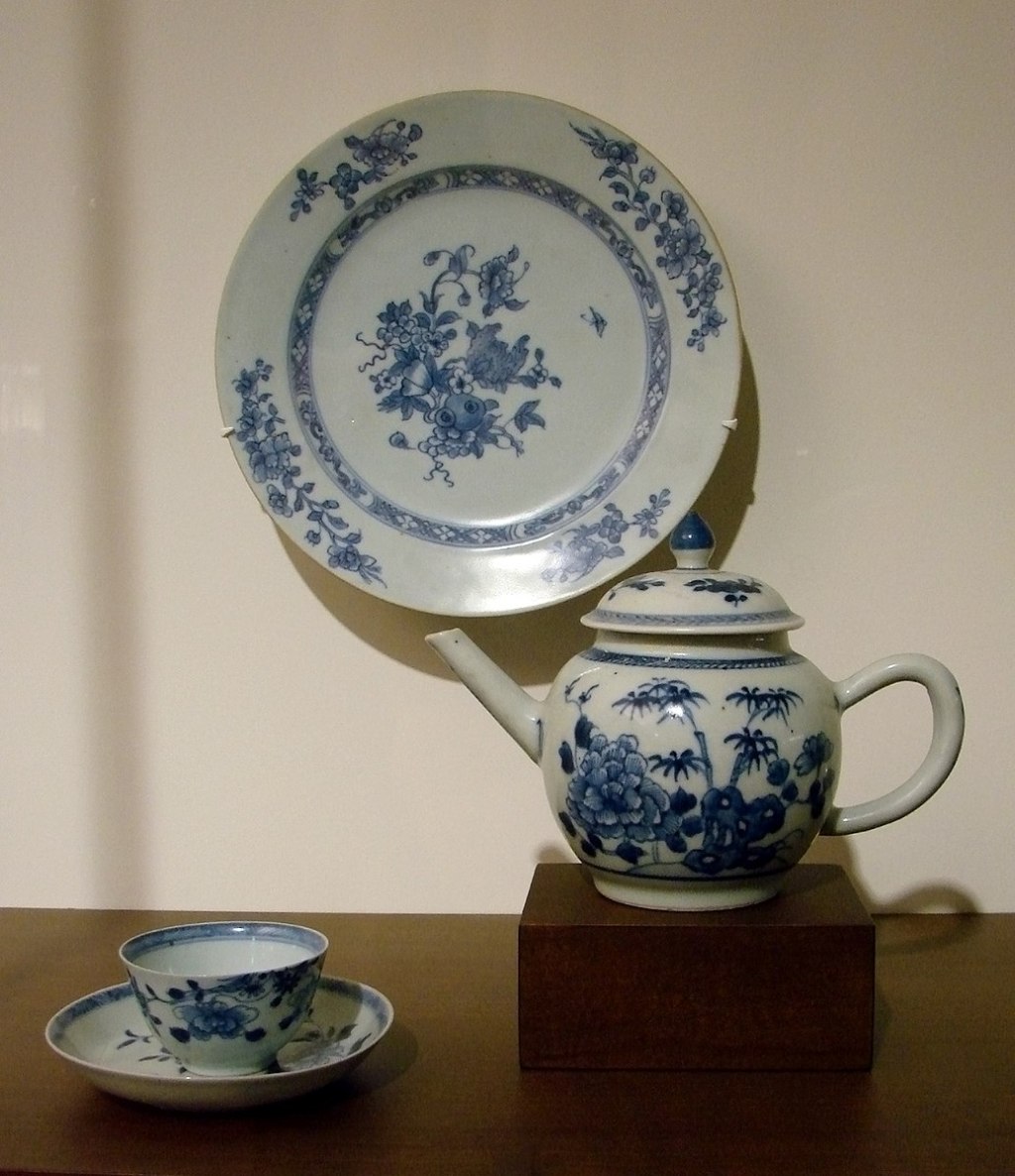
From tea and porcelain to silks and calicoes, early modern Europe was a theatre for developing social, cultural, and personal identities through exotic consumption. While the import of exotic goods was not a new phenomenon in this period, the establishment of the Dutch, British, French and Swedish East India trading companies created a context ripe for the flourishing of consumer demand and an acceleration of bulk trade throughout the eighteenth century.
So far, the general parameters of historical debate have been dominated by elite conspicuous consumption whereby it is intimately linked to social status and prestige. However, by focusing on the non-elite as well as women, it demonstrates that relationships of consumption are less deterministic and more fluid than historians, like Thorstein Veblen, on the “leisured class” have argued. This essay is neither a rejection nor a total dismissal of the conspicuous consumption argument. With greater scope, I would explore more thoroughly the compelling evidence and examples in support of conspicuous consumption coexisting with the arguments I present.
Instead, I wish to use studies of material culture to offer two alternative motivations and explanations for the consumption of exotic goods. Firstly, that in elite circles, consumption was just as much about knowledge sharing and collecting than it was an ostentatious display of power and status. Secondly, for people of low socioeconomic status and women, who have often been scapegoated as vacuous consumers of goods, consumption was a tool of empowerment and agency rather than an attempt to emulate their social superiors and transcend class boundaries. In this way, consumption was more diffuse and was accessible by all social classes as a source of power and agency.
Although historians such as Pierre Bourdieu and Peter Burke have claimed that exotic consumption was limited to elite consumerism, this was not always conspicuous and was alternatively a mechanism for the transmission of knowledge. In line with Bourdieu’s claim, exotic goods were often consumed by elites on the basis of their symbolic nature or sign value of bourgeois taste, however, exactly what was being symbolised requires some debate. This theory can be effectively demonstrated through the development of Western European country houses from the seventeenth century onwards which played host to assemblages of exotic and precious objects. While Chinese porcelain adorned the urban palaces of Italian nobles, English country estates like Ham House underwent an Asian-inspired renovation in the 1670s, showcasing items like Javanese or Tonkinese lacquer tables alongside traditional European silver-gilt furniture. This emphasized the elite’s fascination with chinoiserie and exotic furnishings.
Although Burke claims that the public display of these goods in living spaces suggests they functioned conspicuously as symbolic associations with power and status, more recently, Emile de Bruijn’s literature studies—using illustrated books on China written by European travellers—argues convincingly that such objects instead symbolised an appreciation for Chinese cultural and philosophical knowledge. Perceptions of China were largely shaped by accounts of Jesuit missionaries in their illustrated literary works such as William Alexander’s 1805 The Costume of China, which included references to China’s virtuosity, legitimacy of government, and preservation of ancient customs. Hence, these objects became objects of admiration among European elites and intellectuals, symbolizing continuity and stability in the rapidly changing early modern world. This fostered a fascination and preference for chinoiserie, as the illustrations and motifs found in these texts were reproduced on porcelain Delft glazed earthenware, offering consumers a glimpse into the cultured Asian societies they longed to explore. The concept of knowledge as a driving force for consumption resonates with Enlightenment thinkers of the era, who revered Ming and Qing China as models of morality and virtue for Europe, and thus began to adopt Chinese symbols through their consumption of goods. Therefore, existing alongside conspicuous consumption among elites was a deep desire for the transmission of knowledge and cultural ideas communicated through exotic goods.
A further example of how elite consumption was not limited to conspicuous and superficial purchasing was through engaging in collecting and curating. The increasing popularity of the Wunderkammer, Kunstkammer or ‘cabinets of curiosities’ throughout the seventeenth century, demonstrates that wealth and social status alone cannot offer a valid explanation for such collections. The systematisation and classification of knowledge as well as fascination and cultural curiosity were more alternative stimulants for curating exotic goods. A significant example of an early modern Wunderkammer is that of the 5th Duke of Bragança, Tedosio I, who amassed extensive collections of exotica with an inventory list of over 650 folios, including precious stones from Asia and a flask covered in mother of pearl from the Gulf of Gujurat in Northwest India. Rather than simply being a symbol of his imperial power and connections to empire, the inclusion in the inventory of many objects relating to the acquisition of knowledge such as twenty Mappa Mundi, cartographic nautical charts, and exotic objects of natural history such as coconuts, suggest a more complex motivation. Here, his interest in empire, cartography and geography embodied a scientific curiosity.
Kevin le Doudic claims the desire to collect was limited to wealthy elites’ self-interest and a need to differentiate themselves from other social groups, yet Daniela Bleichmar and Peter Mancall undermine this by claiming collecting took place on various social levels and was available to a wide public audience and expressed broader ideas about the wider world. Collectors increasingly came to view their cabinets as vessels of education and investigation rather than conspicuous and aesthetic displays.
Although historians previously claimed non-elite consumers were merely imitating elite tastes, they had their own motivations for consuming exotic goods, exercising their own agency and purchasing power within the market. Due to the highly elastic supply of low-cost labour and manufacturing in Asia, goods from the East were increasingly supplied to European markets in affordable and large quantities and became widespread across the social landscape. For example, in 1750, Bohea, the cheapest tea variety constituted two-thirds of total tea consumption and by 1730, almost 60% of all households owned equipment for making tea according to inventory studies. This highlights that exotic consumption wasn’t limited to elite classes and that people of low socioeconomic status were afforded greater agency as economic actors through their consumption choices.
Despite this, Veblen criticized the flow of exotic goods and practices down the social as a corrupting force, claiming people of low socioeconomic status attempted to elevate themselves by blurring the boundaries of the hierarchical class order through elite emulation. On the contrary, in these cases, emulation is more of an intention than a motivation. Instead, non-elites made conscious choices to purchase goods for their own sake fitting their practical needs and tastes. This is illustrated through the consumption of Indian textiles by all backgrounds, which dominated 80.6% of English East India Company Asian exports between 1738 and 1740. Although these calicoes and printed cottons remained a distinctive sign of aristocratic tastes in dressing gowns and dresses, for people of low socioeconomic status, the fabrics found a more practical use for beds, screens, curtains and drapes. This demonstrates that non-elite consumers were motivated by practicality, cost, and comfort, not imagining themselves as social equals. Instead of passively emulating elite tastes, the non-elite population became powerful economic actors who purchased with purpose and in accordance with their own needs.
So far, historians have tended to understand status in terms of class, but status was largely gendered, which is demonstrated through the lens of women who purchased not conspicuously but as a form of empowerment. The demeaning early modern stereotype of the female consumer paints her as obsessed with luxury, surface decoration and expense. This is perpetuated by Veblen’s portrait of the “leisured lady consumer”, who, motivated by aesthetics and prestige, purchased, and displayed wares afforded by her husband’s earnings. However, this stereotype is outdated, assuming women as passive consumers of pretty things. Instead, due to women’s duties increasingly involving the management of household resources in the early modern age, female patterns of consuming exotic goods became a statement of identity, empowerment, and economic agency.
This is illustrated in Beth Kowaleski’s literature studies, considering gendered discussions of tea and porcelain as a trope for women’s ideological struggle within the domestic economy. For example, in Joseph Addison’s 1714 fictional piece The Lover, porcelain is used as a metaphor for broader debates around female control and acquisition of goods. The wife’s ability to evade her husband’s economic control is highlighted as the narrator describes, “an old petticoat metamorphosed into a punch-bowl, and a pair of breaches into a teapot”. Here, the wife trades their old clothes for exotic goods, whereby the juxtaposition between items of female vanity “breaches” and “petticoats”, with the functional “teapot” and “punchbowl” suggests these items are a reflection of her self-identify, emphasising her inversion of economic norms and empowerment through her own purchasing choices.
Outside of fiction the diaries and personal manuscripts of Elizabeth Shackleton, an eighteenth-century Lancashire gentlewoman, offer convincing evidence that women’s control of exotic household goods was a conscious and economically considered investment rather than passive and conspicuous. The systematic and precise nature of her records across nineteen years in the form of tally charts, and book-keeping, such as “a new mahogany table […] it cost only £5:5s packing 3s6d in all £5:8:6” illustrates that to Shackleton the purchasing of economic goods required administrative competency and material knowledge. Therefore, women’s consumption was detached from displays of social status and prestige and instead, empowered them as informed economic actors.
Although it is tempting to view consumption as a conspicuous display of social status, the broader implications of this discussion reminds us that individuals lie at the core of consumption and that varying personal desires, motivations, and tastes must be taken into account. Instead of assuming exotic goods as symbols of social prestige limited to elites, a closer investigation of contemporary literature, inventories and diary entries reveals that knowledge sharing, cultural appreciation and most importantly empowerment and economic agency across the social spectrum were also key stimulants for their purchase. Rather than collectivising the consumer behaviour of entire social groups, it is more useful to study the micro-historical stories of objects and their owners in any further discussions on social status and exotic goods.
Bibliography
Berg, Maxine. Luxury and Pleasure in Eighteenth Century Britain. Oxford: Oxford University Press, 2005.
Bleichmar, Daniela and Peter C. Mancall, Collecting Across Cultures: Material Exchanges in the Early Modern Atlantic World. Pennsylvania: University of Pennsylvania Press, 2013.
Bourdieu, Pierre. A Social Critique of the Judgement of Taste. London: Taylor & Francis Group, 2010.
Brown, Stewart J. China, Social Ethics and the European Enlightenment’, in Ecumenism and Independency in World Christianity, edited by Alexander Chow and Emma Wild-Wood, 243-261. Leiden: Brill, 2020.
Burke, Peter. ‘Res et verba: conspicuous consumption in the early modern world’, Consumption and the World of Goods, edited by John Brewer and Roy Porter, 148-162. London: Routledge, 2013.
Campbell, Colin. ‘Understanding traditional and modern patterns of consumption in eighteenth-century England’, in Consumption and the World of Goods, edited by John Brewer and Roy Porter, 40-58. London: Routledge, 2013.
Charpy, Manuel. ‘How Things Shape Us: Material Culture and Identity in the Industrial Age’, in Writing Material Culture History, edited by Giorgio Riello, 199-221. London: Bloomsbury Publishing, 2014.
Coquery, Natacha. ‘Selling India and China in Eighteenth-Century Paris’, in Goods from the East, 1600-1800, edited by Maxine Berg, Felicia Gottmann, Hanna Hodacs and Chris Nierstrasz, 229-243. London: Palgrave Macmillan, 2013.
De Bruijn, Emile. ‘Virtual travel and virtuous objects: chinoiserie and the country house’, in Travel and the British country house: cultures, critiques and consumption in the long eighteenth century, edited by John Stobart, 63-85. Manchester: Manchester University Press, 2017.
De Vries, Jan. ‘Understanding Eurasian Trade in the Era of the Trading Companies’, in Goods from the East, 1600-1800, edited by Maxine Berg, Felicia Gottmann, Hanna Hodacs and Chris Nierstrasz, 7-39. London: Palgrave Macmillan, 2013.
Du Monilet, Claude. “Cabinet de la bibliotechue Sainte Genevieve (Du Molinet).” Curiositas: Les cabinets de curiositiés en Europe. Paris: L’université de Poitiers, 1692. Accessed April 2023. https://curiositas.org/cabinet/curios283 .
Gerritsen, Anne and Giorgio Riello. The Global Lives of Things: The Material Culture of Connections in the Early Modern World. London: Routledge, 2016.
Kowalski-Wallace, Beth. Women, China, and Consumer Culture in Eighteenth-Century England,’ Eighteenth-century studies30, no.2 (1995): 153-167.
Berg, Maxine. Luxury and Pleasure in Eighteenth Century Britain. Oxford: Oxford University Press, 2005.
Le Doudic, Kévin. ‘Exotic Goods? Far-Eastern Commodities for the French Market in India in the Eighteenth Century’, in Goods from the East, 1600-1800, edited by Maxine Berg, Felicia Gottmann, Hanna Hodacs and Chris Nierstrasz, 216-228. London: Palgrave Macmillan, 2013.
McCants, Anne. ‘Exotic Goods, Popular Consumption, and the Standard of Living: Thinking about Globalization in the Early Modern World.’ Journal of World History. 18, no. 4 (2007): 433–62.
Rippe, Emma. ‘A Curious Cabinet at the Bibliothèque Sainte Genevieve.’,Ph.D.diss. Southern Methodist University, 2011.
Senos, Nuno. ‘The empire in the duke’s palace: Global material culture in sixteenth-century Portugal’, in The Global Lives of Things: The Material Culture of Connections in the Early Modern World, edited by Anne Gerritsen, Giorgio Riello, 128-145. London: Routledge, 2016.
Shammas, Carole. Changes in English and Anglo-American consumption from 1550 to 1800’, in Consumption and the World of Goods, edited by John Brewer and Roy Porter, 177-205. London: Routledge, 2013.
Stobart, John. Travel and the British country house: cultures, critiques and consumption in the long eighteenth century. Manchester: Manchester University Press, 2017.
Vickery, Amanda. ‘Women and the word of goods: a Lancashire consumer and her possessions, 1751-81’, in Consumption and the World of Goods, edited by John Brewer and Roy Porter, 274-305. London: Routledge, 2013.
Wills Jr, John E. ‘European consumption and Asian production in the seventeenth and eighteenth centuries’, in Consumption and the World of Goods, edited by John Brewer and Roy Porter, 133-147. London: Routledge, 2013.
Featured Image Credit: Vassil, Porcelaine Chinoise Destinée à l’exportation Vers l’Europe et Retrouvée Dans La Cargaison d’une Épave; 18ème Siècle. Musée Guimet, Paris., November 27, 2007, November 27, 2007, Own work, https://commons.wikimedia.org/wiki/File:Porcelaine_chinoise_Guimet_281112.jpg.


