
Written by Gilbert Edwards
Emperor Marcus Aurelius (r.161-180AD) was raised in the upper-echelons of Roman society, and subsequently received an elite’s education in many arts, but primarily in rhetoric and literature. It is worth noting this education would have been conducted in Latin as well as Greek. Adopted by the senator Antoninus (at the request of the Emperor Hadrian, who had no heir to succeed him), he was – at first – an unlikely candidate for the imperial throne, whose biological father had died while Marcus was still a child. But when Antoninus died (c.161AD), Aurelius was left sole successor to command Rome’s expansive empire.
As a man who controlled most of Europe and North Africa by the end of his rule, holding immense power and patronage, he could have easily led a life of moral (and physical) indulgence or debauchery akin to that of Nero’s or Gaius Caesar’s (Caligula) for his own profit or satisfaction. Instead, however, Aurelius was known, amongst other things, for his diligence and scrupulosity over imperial documents, maintaining stable and cordial relations with the Senate – a key factor in ensuring a secure rule – protecting Rome’s interests by crushing the Parthian threat in 162AD, and the bloody onslaught of the Marcomannic Wars (c.166-180AD).
Greek was the language of the intellectual; in Rome, Greek was a sign of one’s status but also intelligence; Aurelius would have been introduced to the Greek philosophers who shaped ancient thought during his studies – such as Aristotle and Plato. As such, Stoicism (the primacy of rationality across all aspects of one’s life) of the Greeks founded by the Greek philosopher Zeno was replaced with the Romanised form of the philosophy: instead of being abstract and conceptual, Roman Stoicism became a form of lifestyle, borne out in how one lived one’s life.
Aurelius’ Meditations – although this is unlikely to have been its original title – are essentially, at heart, a set of maxims and philosophical theses to help Marcus with quotidian life. The obscure references to unknown people (who were presumably only known to the emperor himself), the probability that his work had no original title nor intended for publication all support this assumption.
Upon reading the first book of Aurelius’ Meditations, ‘Debts and Lessons’, one of the first impressions is of remarkable humility. Overall, it conveys a deep sense of moral obligation to one’s neighbour, but also self-sacrifice. Certainly, Stoicism is overwhelmingly prevalent in his work, with an emphasis on forbearing the trials and tribulations of life as best one can, but to ensure one is continually generous and charitable to one’s neighbour. He explains that one should be kind to one another, whatever the cost to your honour or the projection of your self-image.
The book begins with reference to his family and what he has learnt from each of them. In many respects, the first entry says it all: “Character and self-control”. Ultimately, Aurelius is striving to live life rationally, and to understand better how he can live a moral life. Indeed, a persistent thread through the first book is the centrality Aurelius puts on diligence and compassion.
To turn to the first, Aurelius is keen to ensure that he gains as many intellectual and moral lessons he can from life. Indeed, his diligence is primarily focused on the logos (the Stoic concept of “universal order”), but also appears to encompass all aspects of his life, whether that be in his studies (“to read attentively”), or in character building (“independence and unvarying reliability”). Interestingly, Aurelius’ thoughts are entirely centred around the assets and good qualities of others, rather than mentioning his own successes or failings; ‘Debts and Lessons’ certainly gives us, as readers, a picture of the emperor as an observant, self-effacing man, who strives to maximise what he gets from life.
Turning to the second, compassion is also central to the first book. The brevity of “Kindness” (the first lesson he notes down under “Sextus”) is very telling; self-sacrifice, arguably, is central to the first book. Certainly, he aims “to show intuitive sympathy for friends, and tolerance to amateurs and sloppy thinkers,” but also to serve “truth and justice” while placing one’s family and friends before oneself, and to be ever thankful to the gods for one’s blessings in one’s life. Indeed, this final point is expanded upon for the longest in the final entry of the first book.
This self-sacrifice seems somewhat incongruous with the archetypes of later (and previous) emperors; Augustus worked to ensure he held supreme power by declaring himself princeps (‘chief’); Nero, Caligula and even Aurelius’ own son, Commodus, worked for their own satisfaction and pleasure. In contrast, Aurelius focuses on “help[ing] others”, being “eager to share” and “Generosity, charity, honesty.”
Ultimately, then, ‘Debts and Lessons’ provided not only a useful set of maxims by which Marcus Aurelius aimed to live his life, but also provide us, in the modern world, with a self-sacrificing, self-effacing model by which we might strive to live. In many ways, therefore, Marcus Aurelius prefigured our modern concept of ‘stepping into another person’s shoes’.
Bibliography
Hays, Gregory. (2003), tr., Marcus Aurelius: Meditations, New York and Toronto.
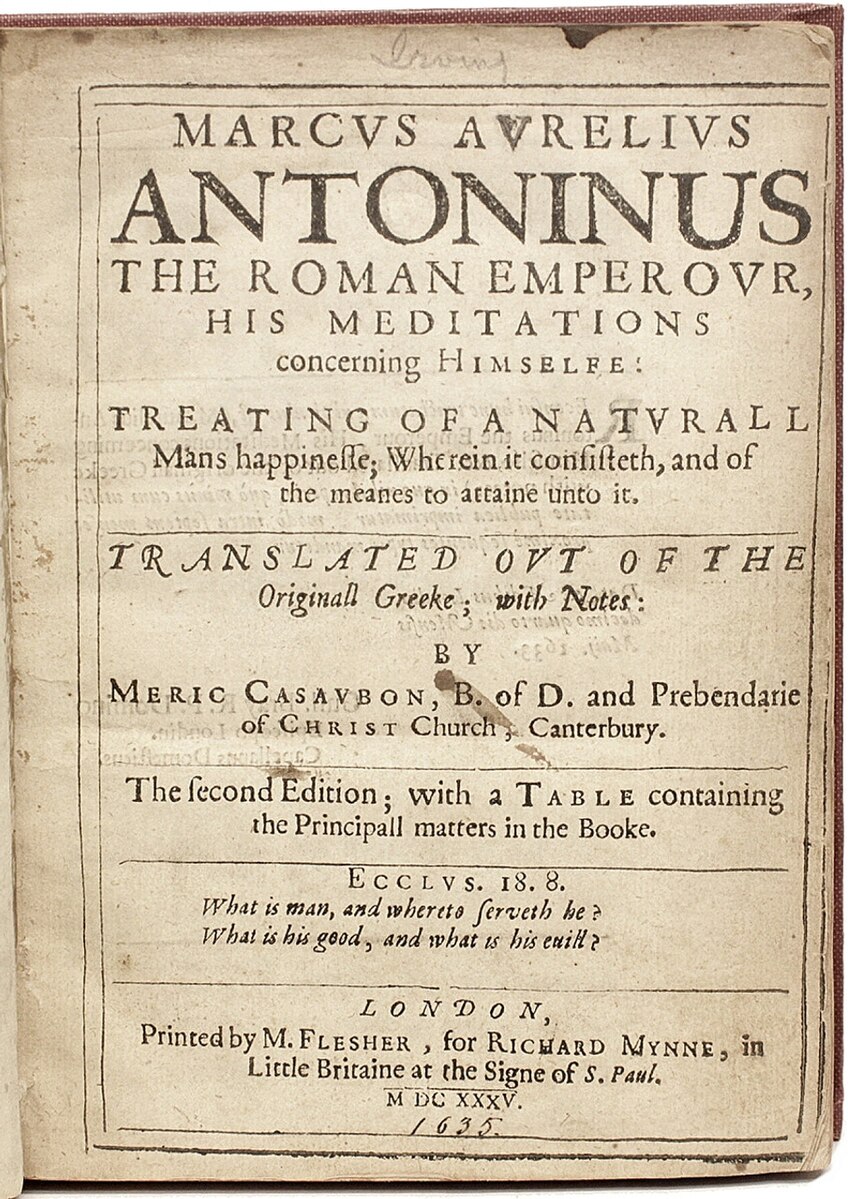
Featured Image Credit: Meric Casaubon, English: Marcus Aurelius, Meditations, English Translation by Meric Casaubon, Second Edition, 1635, 1635, 1635, https://dndgalleries.com/marcus-aurelius-antoninus-the-roman-emperour-his-meditations-concerning-himselfe-second-edition-1635/, https://commons.wikimedia.org/wiki/File:Marcus_Aurelius_Meditations_English_edition.jpg.


