
Written by Roya Kenny
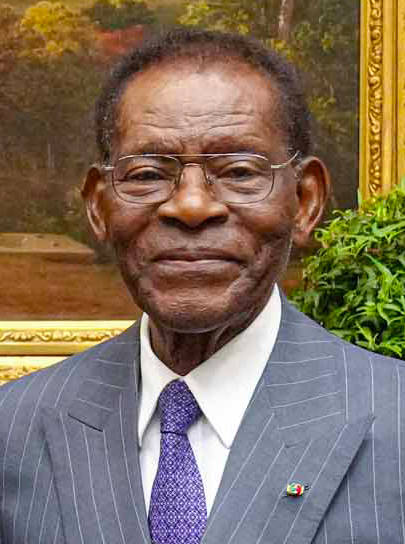
Teodoro Obiang Nguema Mbasogo has ruled Equatorial Guinea since 3 August 1979, after a successful coup against his uncle, the violent and erratic dictator Francis Macías Nguema. He is one of the longest-serving national leaders in the world, with a uniquely low incidence of threats to his leadership. As Human Rights Watch reports, Obiang’s rule, like his predecessor’s, is characterised by a “culture of fear,” with high levels of repression. Equatorial Guinea under Obiang is a profoundly divided society, with a small political and economic elite engaging in high levels of corruption and enjoying public funds to the detriment of the remaining majority of Equatoguineans. His rule has spanned almost half a century of large-scale change, especially regarding the nation’s economy. This article investigates Obiang’s regime chronologically in conjunction with a literature review on factors regarding the relative ‘success’ of his form of a personalist dictatorship.
Out of the economic, political, and social collapse under Macías, Obiang promised a turnaround of the country. While improvements in the refilling of ministries, the expansion of education and healthcare seemed a favourable change. It is also critical to recognise the corresponding lack of expansion of liberties and freedoms in civil society; in the early 1980s, the nation continued to operate under a weak economy, mostly propped up by economic aid and assistance from international organisations and other nations. In the political sphere at this time, from 1979 to 1986, there was no party rule, with Obiang in an uncontested role of power and a distinct lack of balancing institutions. Reliance on outside support to bolster the economy meant relative acquiescence to international pressure. Thus, in 1986, Obiang formed his own party, the Partido Democrático de Guinea Ecuatorial (PDGE). This began an approximate five-year period of single-party rule, during which the international community continued to push for the reintroduction of multipartyism. In the early 1990s, the PDGE approved a new constitution, and political pluralism was reestablished. A series of agreements also included a general amnesty to be granted to political exiles. However, as Ana Lúcia Sá and Edalina Rodrigues Sanches write, restrictive electoral laws barred these political opponents from participation in national politics. Elections that followed this shift in governmental makeup were largely “cosmetic,” with most parties, according to Sá and Sanches, either almost fully aligned with the PDGE, highly fragmented, or banned from legal operation.
These political shifts, which benefited the nation’s international image with little real effect on democratic freedoms, also coincided with the discovery of offshore oil reserves in the Gulf of Guinea. This discovery made the nation surge to prominence on the international stage, becoming, as Geoffrey Jensen terms it, the “Kuwait of Africa.” According to the International Monetary Fund, the country’s GDP increased 5,272 per cent between 1992 and 2008, estimating the GDP at $18.5 billion in 2008. US oil companies in particular drove investment in the country; companies include Chevron Corporation, ExxonMobil, Marathon, and Hess. Equatorial Guinea thus climbed to become one of the largest hubs of US investment in Africa. During this period of profound economic growth, it is clear the increased wealth was distributed incredibly narrowly, as a 2012 report from the African Development Bank estimated that 75 per cent of the population lived on less than $2 per day. This deepened level of inequality, as Sá and Sanches write, has allowed for the counteraction of opposition in the regime, the rewarding of collaborations, and the ability to leverage its international associates and recognition. Unsurprisingly, in an interview with Human Rights Watch, opposition figure Plácido Micó stated that oil has been able “to strengthen the dictatorship” because the new wealth generated lowered the pressure to bend to international demands to improve its severe human rights record.
Obiang has seen the country through a long period of change, facing threats to opposition as any longstanding leader, however, these threats are relatively low and point to a more successful survival than that of other authoritarian states in similar economic positions. Several factors point to this “success” in solidifying the Obiang regime. According to Sá and Sanches, these include: (1) co-optation through the use of strategic appointments and patronage; (2) the creation of restrictive institutional and electoral rules alongside “informal rules” (as demonstrated previously in the discussion on the ban of exiled opponents from national politics); (3) use of repression; (4) international links and projection. The third point focuses on the use of repression, a trademark underpinning of dictatorships as a whole, and while it is key to discuss, it is a “backbone” in which other mechanisms are used in an attempt to maintain control. In the case of Obiang in Equatorial Guinea, the neutralising of possible opposition is a key mechanism, achieved through appointments to favourable positions and the flow of corrupt money, further bolstering influence and connections for both the elites appointed and Obiang himself. As Austin S. Matthews and Sá write, Obiang, in his strategy for appointments to office, has opted for a method of “co-regionality.” This is characterised by a move away from the utilisation of junta military members as part of his elites and a shift toward support from loyalists from his native region of Wele-Nzas. This is evidenced by the fact that, since independence, the country’s politics have been led solely by the Esangui, a clan of the Fang ethnic group, which makes up 80 per cent of the population.
Further, the manipulation of the democratic institutions put in place in the late 1980s and early 1990s in acquiescence to international pressure bolsters the regime’s legitimacy both internally and externally and provides further avenues for elite patronage. The country has the trappings of a democracy, including a constitution, multiparty elections, a partisan legislature, and political parties, all of which lend legitimacy to the government without functioning as true actors in maintaining democracy. Obiang has not had an election thus far in which he has received any result under 95 per cent of the vote; as Matthews and Sá write, the institution of elections in the first place signals a supposed voice for the people, while the consistent domination of the vote by Obiang displays a strength in his apparent support. Further, democratic-facing institutions allow for the co-optation of opposition by incorporating these individuals into structures created by, and directly benefiting, the authoritarian leader himself. The more grounded Obiang’s PDGE party is in these institutions, the more it can expand its goals to create a cohesive elite and repressed opposition. A further benefit of a dysfunctional but existent set of democratic institutions is a thinly veiled pretext for diplomatic engagement with the international community, from nations to corporations.
Oil discovery and subsequent profitable production had further changed Equatorial Guinea’s relations on the international level. The financial gain that the nation, specifically its elite, benefitted from collapsed the former model of international aid under conditional agreements regarding the expansion of human rights frameworks that had characterised the economy of the 1980s. While there is still international pressure to address human rights abuses, Sá writes that the possibility of sanctions in response to human rights abuses, corruption, and fraudulent elections is low, meaning little motivation for real change to be enacted. Further, the collaboration with democracies, not just other authoritarian regimes, displays the pull of oil investment. This suggests that international pressures are more akin to tokenism, while the same democratic governments then cooperate with Equatorial Guinea, prioritising the financial gains created by oil.
To conclude, Obiang’s uncharacteristically long rule in Equatorial Guinea is characterised by both common and unique historical changes and authoritarian mechanisms. What requires further discussion is the country’s pathway from its peak oil production, which ended by the mid-2010s, and what this means for the power balances in the nation. If oil was so vital in maintaining Obiang’s regime, it begs the question of how the regime will attempt to adapt and if true internal opposition could be a possibility as oil production and thus its financial leverage wanes.
Bibliography
Sá, Ana Lúcia, and Edalina Rodrigues Sanches. 2021. “The Politics of Autocratic Survival in Equatorial Guinea: Co-Optation, Restrictive Institutional Rules, Repression, and International Projection.” African Affairs 120(478): 78–102. Available at: https://doi.org/10.1093/afraf/adaa030
Human Rights Watch. 2009. “Well Oiled – Oil and Human Rights in Equatorial Guinea.”
Kenyon, Paul. 2018. Dictatorland: The Men Who Stole Africa. London: Head of Zeus.
Matthews, Austin S., and Ana Lúcia Sá. 2024. “Elite Strategy in Resilient Authoritarianism: Equatorial Guinea, 1979–2023.” Democratization 31(8): 1823–43. Available at: https://doi.org/10.1080/13510347.2024.2343105.
Jensen, Geoffrey. 2019. “Tyranny, Communism, and U.S. Policy in Equatorial Guinea, 1968–1979.” Diplomatic History 43(4), Oxford. Available at: https://doi.org/10.1093/dh/dhz020
Image Credit
https://commons.wikimedia.org/wiki/File:2026_Teodoro_Obiang_(cropped).jpg


