
Written by Mia Hutchins
The Great Molasses Flood of 1919 was an industrial disaster in Boston caused by the collapse of a tank holding 2.3 million gallons of molasses (3.5 Olympic-sized swimming pools). The collapse caused waves 15-40 feet high and 150 feet wide, traveling at 35mph. It destroyed several buildings and killed 21 people, injuring 150. The disaster illustrated how such a thick, viscous liquid can still move with lethal speed.
Purity Distilling Company had created enormous molasses tanks in order to store and ship molasses to Copps Hill Wharf in Boston, where it was used for industrial alcohol. Local residents were aware that the tank was leaking and when they reported it, Purity Distilling simply painted the tank a dark brown in order to disguise the gooey molasses seeping out. The tank itself was 50 feet tall and 90 feet wide and made of thin steel. Molasses is about 1.4 times denser than water and because of how large the tank was, the pressure exerted on its walls was very high. Once the steel tank gave way, all the stored energy was released at once. This means that in the flood, molasses (a non-Newtonian fluid) would have moved like a gravity current. A gravity current is a flow in a gravitational field driven by a density difference within a fluid, such as in mudslides and landslides. In addition to the poor tank design and structure, the weather on the day also helped the fast spread of molasses. As temperatures started to drop, the roads were cooled. The molasses became more viscous as it came into contact with the cold streets, making it more difficult for people to swim out of. People who were already trapped under fallen buildings then became stuck in molasses and subsequently drowned.
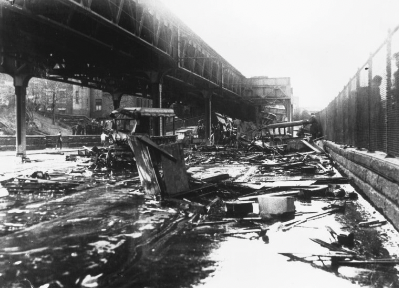
The ruin after the flood 1919, Boston Fire Department Archives.
The aftermath of the flood involved weeks of cleanup, and the sweet smell of molasses lingered for decades. In total, 125 lawsuits were filed against U.S. Industrial Alcohol (USIA) for inadequate safety practices. The lawsuits disagreed on the cause of the disaster. The USIA suggested that this was the result of anarchist sabotage rather than structural design. However, eventually, the design was put to blame for the carnage. The Great Molasses Flood changed structural engineering as we know it and helped introduce building safety regulations which we still enforce today.
Bibliography
Betancourt, Sarah. 2019. “The Great Boston Molasses Flood: Why the Strange Disaster Matters Today.” The Guardian. The Guardian. 13 January. https://www.theguardian.com/us-news/2019/jan/13/the-great-boston-molasses-flood-why-it-matters-modern-regulation
Sohn, Emily. 2019. “Why the Great Molasses Flood Was so Deadly.” History. 15 January. https://www.history.com/articles/great-molasses-flood-science.
Tikkanen, Amy. 2019. “Great Molasses Flood | Definition, Fatalities, & Facts.” In Encyclopædia Britannica. https://www.britannica.com/topic/Great-Molasses-Flood.
Wu, Michelle. 2019. “100 Years Ago Today: Molasses Crashes Through Boston’s North End.” Boston.Gov. Archives and Records Management. 14 January. https://www.boston.gov/news/100-years-ago-today-molasses-crashes-through-bostons-north-end.
Image Credit
The ruin after the flood 1919, Boston Fire Department Archives The Great Boston Molasses Flood of 1919 killed 21 after 2 million gallon tank erupted

