
Written by Anoek Cuming
Ninety years on, the 1936 version of Inside Europe by American journalist John Gunther is as titillating as it is an impressive snapshot of mid-1930s political Europe. The book progresses through European countries with a particular focus on international situations as related to Hitler’s Germany. Gunther provides overviews of what he determined were the most “important political, religious, nationalist, as well as economic factors” influencing various national politics. The interplays of Fascism, Communism, and Nationalism are demystified through explorations of the political actors that perpetuated these ideas. The majority of the information was compiled from Gunther’s own experience of travelling, in addition to consulting oral sources, contemporary books on politics, and thousands of newspapers, magazines, and pamphlets.
This review uses the 1936 sixth edition published in March. This last March edition, which contained a new preface, was finished the day before Hitler’s occupation of the Rhineland. As such, subsequent editions of Inside Europe take a decisively more serious tone and hundreds of textual revisions and tens of thousands more words (this is explained in the 1940 War Edition, the thirty-third edition). Later revised editions of the book are interesting for pertinent reflections on previous political developments influencing contemporary events in the obvious lead up to or during the Second World War. However, as the outbreak of war in Europe and the European Theatre more generally continues to be one of the most popular periods in History, this 1936 edition is fascinating because of the uncertainty of continuing peace in Europe.
The book surveys the fragile politics across the continent. The first chapters begin with the rise of Nazism and the challenge it poses to international order. It then moves on to describe the political battle between socialism and fascism in France. Briefly covered are the violent politics of Spain. Regarding Italy, particular attention is paid to the repercussions of Mussolini’s war in Abyssinia. Gunther then gives an overview of divisions within British politics. This is followed by a detailed explanation of the instability of Austrian politics. Next covered are the politics of the geopolitically important states of Central Europe, the Balkans, and Turkey. One of the most significant chapters explains the weakness of the League of Nations and explicates the factors that are most likely to contribute to war and peace. Finally, the book concludes with Stalin’s transformative policies as well as the importance of the Soviet Union in relation to Germany.
There is a weight to reading about what Gunther supposes are the significant implications of 1930s politics. Anticipatory tension builds as Gunther outlines the precarious factors determining the potential for peace or war. In these instances it is easy to imagine the anxiety for the future felt by those living through that time. At the same time, it is a poignant experience being a modern reader with the benefit of hindsight and knowledge of the horrors to come. This is felt, for example, when Gunther makes note of rearmament, writing “millions of armed men cannot sit around with billions of dollars’ worth of guns and ammunition and just twiddle their thumbs – indefinitely.” Gunther’s suppositions of potential future developments are interesting for what he gets right as much as for what he gets wrong. He writes “Fascism, momentarily powerful, may be the convulsive last agonies of the capitalist order; in which case Fascism will have been merely the prelude of communism.”
Gunther explicitly outlines “that the accidents of personality play a great role in history.” Indeed, the book can be characterised as documenting the phenomenon of strongman politics and generally distinct personalities that prominently defined the political landscape from the 1930s. Woven throughout character examinations are examples of Freudian psychoanalysis by Viennese psychiatrist Dr. Wilhelm Stekel, highly amusing to the modern reader. On Hitler, he writes, “Young Adolf detested his father and loved his mother… He had an Oedipus complex as big as a house.” While Mussolini’s actions stem from his youth when “His father was sent to prison by the local police; now Mussolini sends father substitutes to prison.” Indeed, popular support for dictators is explained as the Great War leading to the disillusionment of traditional modes of parental, legal, and religious authority, as “The Hitlers and Mussolinis were essentially father-substitutes.” While this type of psychoanalysis is now seen as academically improper, from a historical standpoint it is emblematic of a particular cultural moment.
As shown with quotes regarding Hitler and Mussolini, Gunther’s writing is at times incredibly tongue-in-cheek. This makes Inside Europe an immensely enjoyable read. For example, Gunther ridicules the leader of the British Union of Fascists, Oswald Mosely; saying he “brings little fresh salt to the Fascist pie,” and “what he talks is mostly nonsense.” When detailing France’s frequent change of cabinets, Gunther explains that “France’s ability to shed a government, like a lizard its skin, is of great advantage at certain critical moments in foreign affairs. Whenever things get really hot for Marianne at an international conference, the government can conveniently fall.” Gunther’s selective humour regarding the politics of Europe speaks to his sharp grasp of ideologies and events. His witty descriptions keep the reader engaged while some of his more cutting remarks reflect Gunther’s anti-Fascist and anti-Imperialist stance.
Inside Europe is both detailed and comprehensive, all while remaining accessible. As such, it is unsurprising that the book was popularly received and became the first book of the Inside series; Gunther would go on to write subsequent political travelogues. It remains a worthwhile read for anyone interested in the European interwar period, the Second World War, and the precedents of post-war politics.
Bibliography
Gunther, John. Inside Europe. New York: Harper & Brothers, 1936
Gunther, John. Inside Asia. New York: Harper & Brothers, 1939
Image Credit
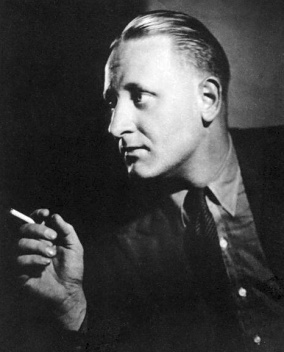
John Gunther, Wikipedia https://en.wikipedia.org/wiki/File:John_Gunther.jpg#filelinks


