
Written by Harry Child
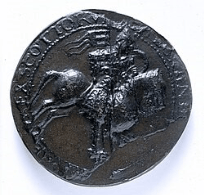
The seal of Alexander I, King of Scots from around 1112.
A fascinating aspect of history is the ability of material culture to communicate an important message about the characters and time period in which it was created. The seal of Alexander I of Scotland (r.1107-1124), is one such item. Namely, it presents the Normanisation of the Scottish monarchy. ‘Normanisation’ refers to the creation of a culture based around the new Norman lords of England. Whilst it would be a stretch too far to argue the seal represents the Normanisation of Scotland as a whole, it can be used to say, at least in the character of Alexander I, Scotland had a Normanised or at least semi-Normanised monarchy. That is what this article will argue in the following two sections. We will start by investigating Alexander’s seal itself, what we can visually see in it, and comparing it to other depictions contemporary of the time to see how Alexander chooses to represent himself. Secondly, we will consider the seal of Alexander’s elder brother, King Edgar (r.1097-1107), and how his representation contrasts with Alexander’s, with the ultimate goal of considering to what extent Edgar can be referred to as a Normanised monarch.
Visualising King Alexander I’s Seal
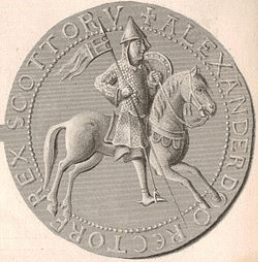
Figure 1: Steel engraving of the seal of Alexander I from the 19th century. This will enable us to better see the details of the seal.
To begin, through Alexander’s dress in the seal, he fundamentally presents himself as an archetypical Norman knight. Alexander is clearly wearing the hauberk, which comes to his knees and is split in the middle so he can straddle his horse. This hauberk also includes a coif-de-mailles, which covers his head and neck. This was an essential piece of armour for a Norman knight. But these parallels run deeper, as he is also depicted wearing the conical helm with a nasal (nose covering). Again, this was the typical helm for Norman knights, especially at the time of the conquest, something that becomes apparent if we compare the seal to figure 2.
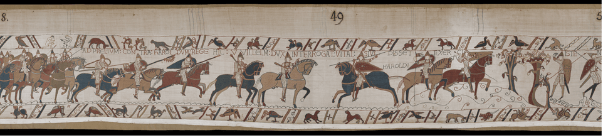
Figure 2: Scene from the Bayeux Tapestry showing Norman knights on Horseback.
Let us now consider what surrounds Alexander in the seal. Most prominent is the appearance of a horse, an animal closely associated with the Normans, who often used them in war. If we compare this feature to figures 3 and 4, we can see that this equestrian presentation was a frequently used image of the early Norman kings of England, namely William I and his son William Rufus. These parallels run deeper as we see Alexander holding a spear with a flag along with a shield, the same as in the depictions of the two William’s. The spear and kite-shaped shield were staple arms of a Norman knight at the time; these kite-shaped shields, in the words of Kelly and Schwabe, would ‘curve to the body’.
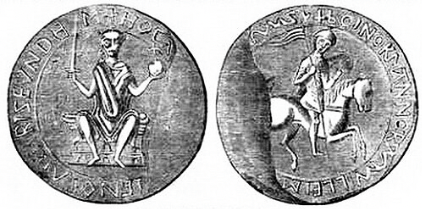
Figure 3: First Equestrian seal of King William I of England, c.1067.
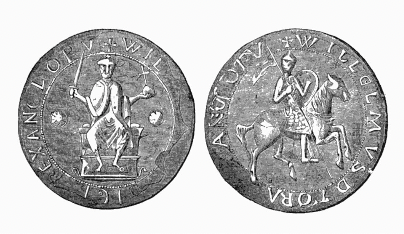
Figure 4: Great Seal of King William Rufus (1087-1100)
What we can establish is that Alexander, through his seal, is seemingly imitating Norman styles. This begs the question as to what prompted this imitation. Alasdair Ross has provided some information that may help. Ross highlights that Alexander was closely connected to the court of Henry I of England, the third Norman king and younger son of William I. Henry was in fact Alexander’s father-in-law. We are told that in the early 1110s, Alexander married Sybil who was the illegitimate daughter of Henry, so there were genuine familial ties between the Scottish and the English court during his reign. But this connection stretched beyond family, as in 1114 Alexander helped Henry in his campaign into Wales and was presented as a vassal to the English king around this time. This meant there was a certain recognition of being in some way subordinate to the Norman monarchy of England, and at the very least involved in their affairs, making sense potentially of the Norman motifs on Alexander’s seal. The connection with England during Alexander’s reign even stretches into religion, as Alexander was the king who brought the Augustinian monastic order to Scotland, bringing canons to populate the subsequent new monastic houses directly from England. One was even established at Scone, the ancient coronation site of Scottish monarchs. We must wonder if the decision to form a house at such an important royal site was informed by a desire to identify himself in some way with the order, and potentially therefore, to make an even deeper connection with England.
From this array of points, we can principally conclude that Alexander I chose to be depicted in distinctly Norman fashion in his great seal, styling himself in a similar fashion to his near-contemporary Norman rulers in England. The reasons behind this decision may well sit with his many links, personal, political and religious, with England, and as such his significant involvement in Norman culture.
Visualising King Edgar’s seal
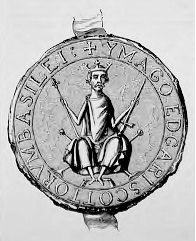
Figure 5: Marking of the seal of King Edgar of Scotland, by William Anderson, dated 1862.
The reason we may suggest a connection with the Norman kings of England began in Edgar’s reign, as following Malcolm III’s death in 1093 and the subsequent coup of Malcolm’s brother Donald later that year, which I have spoken about in a previous work (see bibliography), Edgar, the eldest of Malcolm’s surviving children by Margaret of Wessex fled with some of his brothers to the court of William Rufus. Here William Rufus provided support to Edgar, principally in the years following 1094, to help him claim the Scottish throne.
So let us turn to Edgar’s seal and how it weighs up when compared both to his Norman counterpart’s and Alexander’s. The surviving seal of Edgar is not an equestrian image, but rather an image of the king sat, almost enthroned. This does mimic the style of figures 3 and 4, with both William I and William Rufus sat in much the same style, so there seems to be an underlying stylistic basing of Edgar’s seal on those of the Norman kings. But there are some differences. For a start, Edgar is, like the two Williams, carrying items in both hands, but they are slightly different from those in the hands of the Williams. Whereas both the Conqueror and Rufus use their right and dominant hand to hold their sword, in their left holding the orb, Edgar is seen holding what seems to be a religious sceptre in his right, and his sword in his left. What’s more, Edgar isn’t conventionally gripping the sword, ready for action, as his counterparts are, but is holding it by the blade. This is some very interesting imagery. One idea that might help explain this comes from Magnusson, who argues that Edgar tried to be a peacekeeper during his reign. Magnusson cites the example of how he did not contest the Norwegians’ invasion of the Western Isles, instead just allowing them to do so. Perhaps this peacekeeping nature, something potentially visualised in this aspect of the seal, may derive from the four years of turmoil that preceded his reign: the bitter fighting for the Scottish throne that ended in significant bloodshed for the royal house. Trying to create an environment of peace could have been a way to counterbalance these events and provide some semblance of order to the kingdom.
Now for the more striking difference, that of facial hair. If we inspect Edgar’s seal, we can see that he sports a prominent moustache. If we compare this to figures 1, 3 and 4, neither Alexander, the Conqueror, or Rufus wear any facial hair. Scholars including Musgrove, Bartlett and Licence have commented on the idea that the Normans were clean shaven, utilising depictions from the Bayeux tapestry (see figure 2) among other sources to make their claims. They have often drawn a comparison with the Saxons in this, highlighting how they would often sport moustaches (see figure 6). So, Edgar is on the one hand presenting himself as stylistically somewhat Norman, but on the other wearing the facial hair of a Saxon. We may be able to explain this by considering who he was connected to. We know that when William Rufus sent an army to Scotland in 1097 in order to help Edgar reclaim his throne, this army was led by Edgar, but he was helped in this by Edgar Atheling, the last Anglo-Saxon claimant to the English throne, who at this stage was under Norman influence. It may be plausible, therefore, to suggest that Edgar King of Scots was influenced by his fellow army leader and the other Saxons he was connected to, and he wanted to represent this link visibly through his seal. We can go a step further, though. Edgar was related to Atheling—he was his maternal uncle—so it might be a plausibility that Edgar was utilising this familial link in his seal, presenting himself as a member of the old ruling Anglo-Saxon house, and thus of great monarchical pedigree, descended from former kings, bolstering his significance. Whatever the case, we can see that Edgar’s seal is a conglomeration of different styles which do not place him in either the completely Norman sphere, nor in a distinctly Anglo-Saxon or even Scottish one.
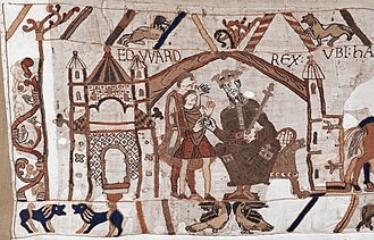
Figure 6: Scene from the Bayeux Tapestry depicting King Edward the Confessor and Harold Godwinson.
To conclude, it seems apt to return to the topic of facial hair. The fact that Alexander lacks the moustache his brother so proudly dons completes his portrayal: Alexander is presenting to us a vision of a Scottish king who is thoroughly embedded in a Norman culture, even if the manifestation of this in his Scottish reign is yet to be completely understood.
Bibliography
Bartlett, Robert. ‘The Bayeux Tapestry’, BBC: A History of the World, (2010), retrieved from: https://www.bbc.co.uk/blogs/ahistoryoftheworld/2010/08/the-bayeux-tapestry.shtml, accessed: 15 Nov 2026.
Child, Harry. ‘Scotland, 1093-1097: An Aptly Tumultuous End to Eleventh-Century Scotland’, Retrospect Journal, (2025), retrieved from: https://retrospectjournal.com/2025/04/13/scotland-1093-1097-an-aptly-tumultuous-end-to-eleventh-century-scotland/, accessed: 15 Nov 2026.
Kelly, Francis M. & Schwabe, Randolph. A Short History of Costume and Armour, (David & Charles Ltd, 1972).
Licence, Tom. ‘A Norman Stitch Up? The Story behind the Bayeux Tapestry’, The National Archives, (2026) [Online public talk].
Magnusson, Magnus. Scotland: The Story of a Nation, (Harper Collins, 2001).
Musgrove, David. ‘The wrong moustache in the Battle of Hastings’, History Extra: Life Lessons from History, (2025), retrieved from: https://historyextralifelessons.substack.com/p/the-wrong-moustache-in-the-battle, accessed: 15 Nov 2026.
Ross, Alasdair. The Kings of Alba, c.1000-c.1130, (John Donald, 2011).
Image Credits
Cover: The seal of Alexander I, King of Scots from around 1112. Image reproduced from Wikimedia Commons: https://commons.wikimedia.org/wiki/File:Seal_of_Alexander_I_of_Scotland,_c.1112_-_BL_Seal_XLVII_5.jpg.
Figure 1: Steel engraving of the seal of Alexander I from the 19th century. This will enable us to better see the details of the seal. Image reproduced from Wikimedia Commons: https://commons.wikimedia.org/wiki/File:Alexander_I_(Alba)_ii.JPG.
Figure 2: Scene from the Bayeux Tapestry showing Norman knights on Horseback. Image reproduced from Wikimedia Commons: https://commons.wikimedia.org/wiki/File:Bayeux_Tapestry_Scene_49.png.
Figure 3: First Equestrian seal of King William I of England, c.1067, image reproduced from Wikimedia Commons: https://commons.wikimedia.org/wiki/File:P93b-Great_Seal_of_William_the_Conqueror.jpg
Figure 4: Great Seal of King William Rufus (1087-1100), image reproduced from Wikimedia Commons: https://commons.wikimedia.org/wiki/File:Great_Seal_of_William_Rufus.jpg
Figure 5: Marking of the seal of King Edgar of Scotland, by William Anderson, dated 1862. Image reproduced from Wikimedia Commons: https://commons.wikimedia.org/wiki/File:King_Edgar_of_Scotland.jpg.
Figure 6: Scene from the Bayeux Tapestry depicting King Edward the Confessor and Harold Godwinson. Image reproduced from Wikimedia Commons: https://commons.wikimedia.org/wiki/File:Bayeux_Tapestry_Scene_01_(cropped).jpg.

