
Written by Leda Rossmann
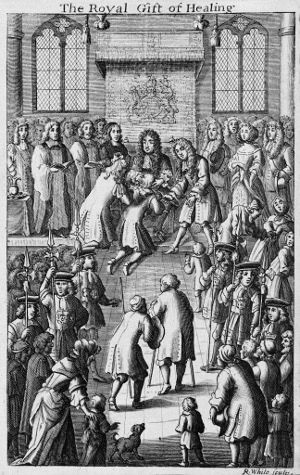
Both French and English monarchs have been touching their subjects ritualistically since the thirteenth century. To perform miracles, of course. Monarchs cured scrofula, a type of tuberculosis where the lymph nodes on the neck swell, by touching and blessing their subjects—regardless of class. Scrofula was also known as ‘the king’s evil’, because it was believed it could only be cured by the Royal Touch. In England, it is believed that Saint Edward the Confessor, who ruled from 1042 to 1066, was the first to perform this miracle. It became an administrative ritual in the late thirteenth century under Henry III. Importantly, it was a way to prove the holiness of the monarch as a public demonstration of their divine right to rule. The English monarchy thus carried God’s healing powers.
The Royal Touch would save an ailing person from their death. Someone infected with scrofula would seek out the king during Easter, likely after they had already sought other medical treatment, to be cured. Not only was Easter the holiest season of the year, but the cold spring air was also believed to prevent the spread of disease. Although, it is worth noting that the majority of scrofula cases would have gone away on their own anyway with adequate hygiene. Scrofula is caused by breathing in air filled with bacteria, but susceptibility increases with malnourishment and thus it disproportionately affected poor people.
The monarch actively sought out infected people, as they could use the touch to demonstrate their holy benevolence, ultimately increasing their popularity. Since there was a risk of contagion and a visible unsightliness to the disease, no one else wanted to touch someone disfigured by scrofula. Monarchs, on the other hand, were powerful and charitable. They would pray over the diseased person and make full contact with the scrofula abscesses and sores, curing them.
When the House of Tudor began a new dynasty of English rule after the Wars of the Roses, the family’s dynasty needed to cement its divine authority. Henry VII introduced more prayers, brought in chaplains, and developed a ritualistic performance to the Royal Touch which included the gift of a gold angel coin. Due to the inconsistent frequency of the Royal Touch (depending on the monarch and the year), these coins were prized. Unsurprisingly, some were pawned off to goldsmith shops.
Mary Tudor was the first queen to perform the Royal Touch. The only major changes from king to queen was that scrofula was known as the queen’s evil instead of the king’s. Elizabeth I also performed the miracle. It was vital in order for her to solidify Protestant authority over the Papacy. The Pope and English papists questioned Elizabeth’s birthright, but she proved herself by curing scrofula cases and demonstrating God’s power in her.
Both queens performed the Royal Maundy, another touch ritual in which they would wash the feet of poor people while also providing gifts of food and money. Their father, Henry VIII, did not perform this ritual, though many kings had before him. As female monarchs, Mary and Elizabeth needed awe-inspiring demonstrations of power and spectacle to earn respect. The queens did not just use these healing touch rituals as propaganda tools. They believed in their actions; they prayed to God emphatically for the people they touched to be cured. These actions were in imitation of Christ, an extension of God’s power. This was extremely unorthodox for a woman to perform. In fact, when Elizabeth menstruated, she refused to perform the Royal Touch because the touch of a menstruating woman was believed to harm living things. Reformers like John Knox hated women in power and described them as treasonous against divine order. Elizabeth I banned Knox from entering England and clearly proved him wrong with her curative actions.
James I, the first monarch of the House of Stuart on the English throne, was strongly advised that he needed to continue the ceremonies. He was skeptical of the miracle ceremonies because Protestants believed that God stopped performing miracles after the Church was established. He still performed around 350 touches every year, and the Stuarts ended up touching the most people, with a greater regularity than any other reigning dynasty in England. Charles II touched around 4,000 people every year of his reign. Once he was restored to the throne, he had to demonstrate that he was the rightful ruler and boost his popularity through these public displays of piety.
The Glorious Revolution and the installation of William and Mary on the British throne sensationalized experiences with the monarchy like the Royal Touch. The press transformed the Touch far beyond a religious ceremony. Even in modern times, Princess Diana touched many suffering people, not to heal them, but to comfort them. She offered people suffering from ailments the ability to be treated as humans because she treated them with compassion. The Royal Touch was a way to recognize humanity in us all, no matter our class or station. Perhaps this is how the miracle continues to be performed.
Bibliography
Brogan, Stephen. The Royal Touch in Early Modern England: Politics, Medicine and Sin. Royal Historical Society Studies in History New. Boydell & Brewer, 2015.
Levin, Carole. “‘Would I Could Give You Help and Succour’: Elizabeth I and the Politics of Touch.” Albion 21 (2): 191–205. 1989. https://doi.org/10.2307/4049925.
Xu, Jonathan. “The Royal Touch: Scrofula and Defining Monarchy.” Psychocutaneous Medicine 41 (1): 166–70. 2023. https://doi.org/10.1016/j.clindermatol.2022.09.009.
Image Credits
Engraving by R. White. Wellcome Collection. Source: Wellcome Collection. https://wellcomecollection.org/works/vkkwb683/images?id=ueg6h6sv

