
Written by Hannah Connolly
09/11/2026
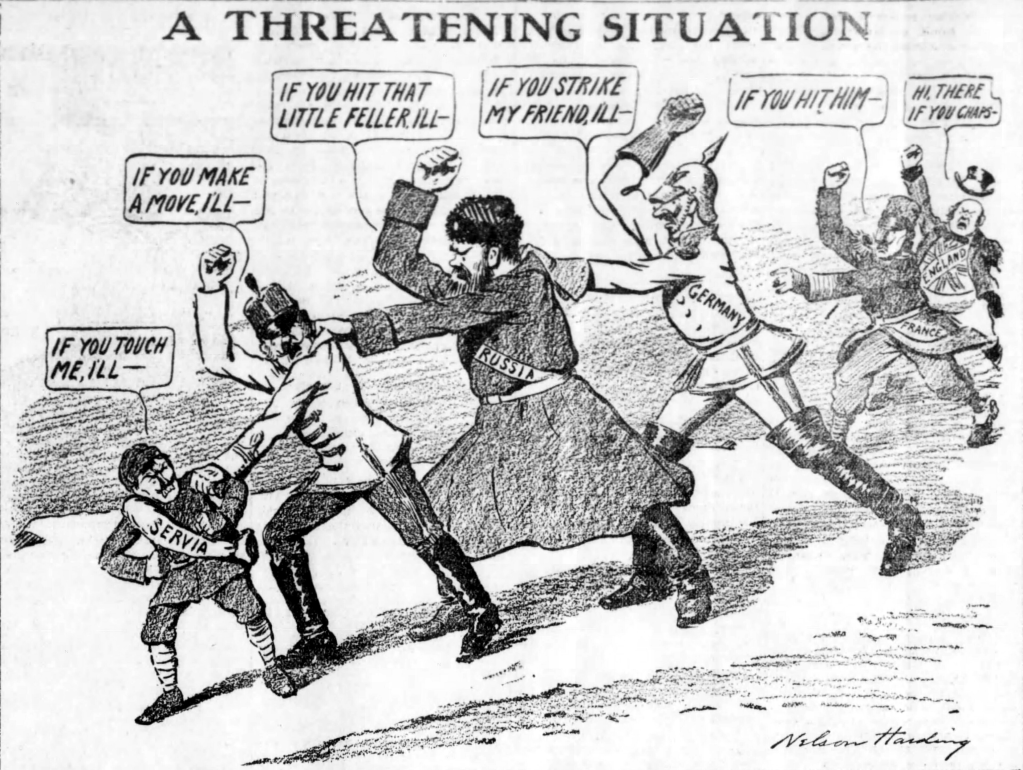
The collapse of the 1815 peace has long divided historians. Traditional interpretations portray 1914 as a sudden rupture, triggered by the July Crisis, whereas more recent scholarship sees the First World War as the inevitable outcome of a century-old system of Great Power rivalry, imperial ambition, and increasing militarisation. Through consideration of both short-term crises and long-term structural flaws, it can be concluded that the ‘long peace’ was never truly stable: the Vienna Settlement created a Europe whose balance of power depended on competition rather than cooperation. The events of 1914 merely exposed the contradictions that had been embedded within that system since its birth.
In popular imagination, the July Crisis of 1914 is often regarded as the event that shattered nearly a century of peace in Europe. The assassination of Archduke Franz Ferdinand in Sarajevo remains its most infamous episode; although “transformative” for European international relations, the deaths of the Austro-Hungarian heirs were part of a wider culture of political violence in the lead-up to war. By the early-twentieth century, the European state system was predicated on the assumption that war was both inevitable and imminent. The Russian ‘Great Programme’ of 1913, which sought to increase the Russian army by 40% by 1917, demonstrates the lengths to which states were prepared to go to secure an advantage in any future conflict. The ‘Great Programme’ was perceived as particularly threatening by the Germans and has been theorised as one of the reasons why Germany pushed so hard for Austria-Hungary to declare war in 1914. The Germans feared that waiting for a full Russian mobilisation would leave them unable to withstand a two-front assault by the Franco-Russian Entente. That Germany calculated in these terms indicates that political leaders no longer viewed peace as sustainable and instead sought control of the timings of war — a mindset that transformed crisis management into crisis escalation.
This militarised mentality unfolded against a backdrop of domestic instability, as leaders turned outward to manage internal division. By 1914, all the ‘Great Powers’ were embroiled in some kind of internal political crisis, with Samuel Williamson suggesting this led states to move towards conflict, to avert their own “domestic Armageddon”. In France and Germany, the rise of political extremes polarised parliamentary politics; in Russia, unrest continued from the revolution of 1905; and in Britain, the Irish crisis brought the country to the brink of civil war. These domestic tensions eroded faith in the established order, and, for some, war seemed not only inevitable but potentially redemptive, hoping to unify divided societies through external conflict.
Recent scholarship, however, has emphasised that the eventual collapse of the 1815 peace was embedded within the very terms of its creation. Following the defeat of Napoleon, the victorious powers met at the Congress of Vienna to settle borders, and to prevent any state from being able to gather continental hegemony, ignoring the social and political transformations unleashed by the Napoleonic wars, such as conscription, bureaucratic centralisation, and the spread of revolutionary ideas. One of the central principles of the post-1815 system was the balance of power where equilibrium among the Great Powers would ensure peace. Yet in practice, the Great Powers believed it their right to crush revolutionary movements and prevent the shift of power. The ‘long peace’ was thus less a system of harmony than a mechanism for enforcing control and expansionism. It endured only so long as these powers found peace useful to their own interests.
The balance of power preserved peace by allowing the Great Powers to manage disputes and control the state system, but this peace was run exclusively by and for the Great Powers. The system was abused by powerful European states, who expanded at the expense of lesser states under the pretence of maintaining the ‘balance of power’. This hypocrisy fostered mistrust, nourishing the belief that others were exploiting the system in similar ways. Outside Europe, the so-called “peace” offered no restraint at all: imperial competition intensified throughout the nineteenth century. The Great Powers saw conflict as no less legitimate, fighting over thirty wars between 1815 and 1871. Peace was not the product of a stable system, but of pragmatic restraint—statesmen in their “preponderance of power” chose to avoid direct continental conflict only when it suited their interests. Once those calculations shifted, so too did the commitment to peace.
Finally, it has been argued that the character of Great Power politics in the nineteenth century lies at the root of the descent of Europe into war. Increasing suspicion amongst the Great Powers led to a tightening web of international alliances and rivalries, which bipolarised Europe into “two competing communities”, in turn leading to conflicts such as the Crimean War, fought over the colonial interests of Britain and Russia. Imperialist ambitions were accompanied by consequential conflicts: Britain alone fought fifty major colonial wars between 1803 and 1901. International conflicts such as the German and Italian Wars of Unification further destabilised the continent. This period also saw the transformation of the balance of power itself. The unification of Germany in 1871 created a powerful new state at the heart of Europe, while the disintegration of the Ottoman Empire—the so-called “Eastern Question”—generated instability as rival powers vied for influence over its territories. States turned from cautious diplomacy to pre-emptive strategy, viewing their neighbours increasingly as threats rather than partners. The Balkans, formerly Ottoman territory, became Europe’s most volatile region, drawing the attention of the Great Powers and further destabilising the European system. The settlements that followed these wars “recalibrated” the balance between the powers in “dangerous ways”, intensifying rivalries. Thus, by 1914, the European state system—shaped by the reactionary conservatism of 1815, eroded by imperial competition, and inflamed by militarism—was primed for collapse.
The outbreak of war in 1914 did not represent the sudden failure of a stable peace, but the culmination of a century-long process where the pursuit of equilibrium masked the pursuit of power. The Vienna Settlement had imposed order through domination, suppressing the very forces of nationalism and reform that would later explode across Europe. Peace was maintained only so long as it was useful and attempts to preserve the balance of power ensured that rivalry, rather than reconciliation, defined international politics. When domestic crises, imperial ambitions, and militarised alliances converged, the fragile system finally imploded. The “long peace” of 1815–1914 was not peace at all, but a prolonged truce sustained by competition and fear, and that ended through conflict among those who had once enforced it. Europe’s descent into war was less a rupture than the logical conclusion of a century-long experiment in power politics.
Bibliography
Anderson, Sheldon. ‘Metternich, Bismarck, and the myth of the ‘long peace’, 1815 – 1914’ Peace and Change 32, no.3 (2007): 301 – 328.
Buzan, Barry and George Lawson. ‘The Global Transformation: The Nineteenth Century and the Making of Modern International Relations’ International Studies Quarterly 57 (2013): 620 – 634.
Clark, Christopher. The Sleepwalkers: How Europe Went to War in 1914. New York: Harper, 2013.
Copeland, Dale C. ‘International Relations theory and the three great puzzles of the First World War’ In The Outbreak of the First World War: Structure, Politics, and Decision-Making, edited by Jack S. Levy and John A. Vasquez, 167 – 198. Cambridge: Cambridge University Press, 2014.
Graaf, Beatrice de. ‘Taming the Evil passions: Moderation in the International Relations’ in The Politics of Moderation in Modern European History edited by Ido de Haan and Matthijs Lok, 89 – 107. Cham: Springer, 2019.
Hamilton, Richard F. and Holger H. Herwig. Decisions for War, 1914 – 1917. Cambridge: Cambridge University Press, 2004.
Levy, Jack S. and John A. Vasquez. ‘Introduction’ In The Outbreak of the First World War: Structure, Politics, and Decision-Making, edited by Jack S. Levy and John A. Vasquez, 3 – 29. Cambridge: Cambridge University Press, 2014.
Mulligan, William. ‘Restraints on preventive war before 1914’ In The Outbreak of the First World War: Structure, Politics, and Decision-Making, edited by Jack S. Levy and John A. Vasquez, 115 -138. Cambridge: Cambridge University Press, 2014.
Rasler, Karen and William R. Thompson. ‘Strategic rivalries and complex causality in 1914’ In The Outbreak of the First World War: Structure, Politics, and Decision-Making, edited by Jack S. Levy and John A. Vasquez, 65 – 86. Cambridge: Cambridge University Press, 2014.
Seaman, L. C. B. From Vienna to Versailles. London: Routledge, 1964.
Stephenson, David. ‘Militarisation and Diplomacy in Europe before 1914’ International Security 22, 1 (1997): 125 – 161.
Vasquez, John A. ‘Was the First World War a preventive war? Concepts, criteria and evidence’ In The Outbreak of the First World War: Structure, Politics, and Decision-Making, edited by Jack S. Levy and John A. Vasquez, 199 – 224. Cambridge: Cambridge University Press, 2014.
Williamson, Samuel R. ‘July 1914 revisited and revised: The Erosion of the German paradigm’ In The Outbreak of the First World War: Structure, Politics, and Decision-Making, edited by Jack S. Levy and John A. Vasquez, 30 – 62. Cambridge: Cambridge University Press, 2014.
Image Credits
The Chain of Friendship (A threatening situation) by Nelson Harding (Brooklyn Daily Eagle, 1912), via Wikimedia Commons (https://commons.wikimedia.org/wiki/File:Chain_of_Friendship_cartoon.jpg), Public Domain.


