
Written by Harry Child
09/11/2026
Introduction:
This here is number two out of three in my series of articles focussing on my research into the Second and Third Earls of Exeter. Of all three, this one is the most academically focused: I piece together the events and results of two policies instituted by these lesser-known earls in and around Stamford. Both policies resulted in a form of popular resistance, and as such, these stories provide a very interesting glimpse into life in mid-seventeenth century and how discontent was expressed by the people at that time. The first occasion of resistance occurred in late December 1640, and was centred around William, Second Earl of Exeter’s milling monopoly in Stamford. The second occasion occurred in June 1643, and centred around David, Third Earl of Exeter’s enclosures in the surrounding area of Easton.
Milling Riot, December 1640:
The relationship between the Cecils, their King’s Mill, and the Stamfordian public has received a good amount of attention: there is D. L. Thomas’ brilliant 1982 work, for example, and more recently, Nicholas Rudd-Jones’ equally interesting study into Stamford’s millstream. But one story both accounts neglect to mention is that of the December 1640 King’s Mill riot.
So where does this riot stem from? In 1561, Sir William Cecil, at this time principal secretary to Queen Elizabeth I, was given the Manor of Stamford along with its tolls and water mills up near the castle, known at this time as the North Mills, but also referred to as the Queen’s Mills, they had been part of Queen Jane Seymour’s jointure back in the reign of Henry VIII. Thomas tells us that from 1627, they were being referred to as the King’s Mills. The grant of these mills came with the requirement that all tenants of the town grind their grain, malt, and corn at these mills – the Cecils essentially had a monopoly on milling in the town. Thomas tells us such a monopoly was ‘resented’ by Stamfordians, but not necessarily because of the monopoly itself, but rather because the mills were small compared to how many people needed to use them, so people began taking their milling elsewhere as there were other operating mills in the surrounding villages, for example the one in Ryhall run by Thomas Robinson. The Cecils did their best to oppose this, and William, Second Earl of Exeter had a particularly antagonistic attitude to his milling monopoly. In 1639, during the Second Earl’s tenure, we can see that Stamfordians were making use of the mills around them, as Exeter brought a case against 234 inhabitants of the town, claiming they were trying to destroy his milling monopoly by sending their corn elsewhere. Exeter won this case and tenants were ordered and agreed to mill only at the King’s Mill, and to destroy all the other milling facilities, like quern stones in the town, on the provision that Exeter ground their corn at the King’s Mill with efficiency. Thomas tells us the monopoly side of this decree was “rigorously enforced” and sets the scene for the riot that breaks out just a year later.
On 30 December 1640, a group of “divers people riotously gathered together” in Stamford, people we can take, perhaps, to be tenants, and they proceeded to destroy the banks of the millstream of the King’s Mill, which Exeter’s widow had renovated, and broke down the stone bridge that ran over this stream. What was worse, the Justices of the Peace Jeremie Cole (also an alderman of Stamford) and Thomas Palmer had failed to contain the riot. Subsequently, in February 1641, the dowager countess of Exeter presented a complaint to the House of Lords, which they subsequently heard later that month. Cole and Palmer were brought before the House where they were required to answer to the offences that they had failed to sufficiently put down a riot in Stamford. The proceedings of this saw Cole and Palmer apologise for their lack of action, saying it was not done wilfully, but rather out of ignorance, and promising the damage would be fixed. Following this, the two, who had been imprisoned following the complaint, were released by the House.
After the riot, the Cecil family were just as uncompromising with their monopoly as before, as Thomas highlights: the Countess Elizabeth brought a case against Nicholas Lambe, a tenant, in 1642 for grinding corn at his own horse mill. For this Lambe was imprisoned in the Fleet Prison in London.
One interesting facet about the riot is its date: just after Christmas, and only six months on from the death of the Second Earl. This was a period when power is being transferred, and the new Earl of Exeter was busy with high political business, such as demanding Charles I open a new parliament, by signing the Lords Petition of 1640. As such, this was a perfect time to riot against an unpopular regime, when the locality of Stamford would not be the centre of attention.
Enclosure Resistance, June 1643:
In the early 1640s, David Cecil, recently made the Third Earl of Exeter after his uncle’s death, got permission to enclose the majority of Easton Woods for his own use. This had been agreed by the clerk of Northampton (Northamptonshire being the county Easton sits in), as well as “others” whom we have no names for. The agreement claimed that the Earl had to leave 130 acres of the woods as common land; the areas earmarked for this were Bulgate Sale, Bark Sale, and Rogue Sale, and as far as we can tell he kept to this. But not everyone was content with this new arrangement, especially having large swathes of land they had previously freely accessed taken away from them.
We know this because, on 16 June 1643, only a couple of months after the Earl had died at the young age of 39, his widow Elizabeth submitted a petition to the House of Lords on behalf of her young son, the new Fourth Earl of Exeter, who was still a minor at this time. In this she claims that “the Possession of Woods in Easton, in the County of North’ton is disturbed”. What happened was a group of common folk from the area had decided to, taking advantage of the Earl’s recent death and the succession to his earldom of a minor, pull down the enclosures of the Third Earl around the woods. They had done so, we are told, “in a violent manner”. In response to this the House called for such activity to be “quieted”, but this fell on deaf ears. On 2 November 1643, the Lords issued another decree calling for the “delinquents”, who had had “contempt to the order of this house”, namely Thomas Cumbrey, Robert Holt, Thomas Newton, and William Dunch, to face the lords. Following this, the paper trail goes quiet.
What this story illustrates is how nobles in mid-seventeenth century England, in the build-up to the English Civil War, were coming into conflict with the people living in and around their estates. The enclosure of what had been Common Land at the time was rejected by some of these individuals, driving them to what we might tentatively call popular resistance – an activity which clearly had ringleaders, if we trust the documents of the House of Lords journal. It is also quite interesting to see when this activity happened, during an unexpected transition of power, with the new noble unable to exert as much influence as his father had, not least of all because of his age.
Conclusion:
One linking feature between these two moments of resistance is how quickly they happened after each earl died. The Second Earl had been dead only a few months by the time of the December riot, and the Third Earl had only been dead a month before the June resistance. This might suggest that as the regime changed with a new earl coming to power, there was an opportunity to rebel against the exactions of the previous regime. The Third Earl appears rather pre-disposed with central government immediately following his predecessor’s death, so perhaps he was distracted from his estates in Stamford. When the Third Earl died, he left behind a minor as his heir, and thus in the absence of an adult earl to stamp out rebellion, they could revolt against what they felt were the unjust impositions of their late lord. This leaves behind the fascinating question as to whether these demonstrations of resistance were really designed to encourage a new lord to behave differently, or if they were mere moments of opportunism.
Bibliography
British Library, Additional MS 35331, f. 78r, retrieved from ‘‘Lords Petition (3 September 1640)’, Manuscript Pamphleteering in Early Stuart England, https://mpese.ac.uk/t/LordsPetition1640v1.html, accessed: 02/11/2026.
‘House of Lords Journal Volume 4: 22 February 1641’, in Journal of the House of Lords: Volume 4, 1629-42(London, 1767-1830), British History Online, accessed July 30, 2026, https://www.british-history.ac.uk/lords-jrnl/vol4/pp168-170.
‘House of Lords Journal Volume 4: 18 March 1641’, in Journal of the House of Lords: Volume 4, 1629-42(London, 1767-1830), British History Online, accessed July 14, 2026, https://www.british-history.ac.uk/lords-jrnl/vol4/pp188-189.
‘House of Lords Journal Volume 6: 2 November 1643’, in Journal of the House of Lords: Volume 6, 1643 (London, 1767-1830), British History Online, accessed September 12, 2026, https://www.british-history.ac.uk/lords-jrnl/vol6/pp290-293.
‘House of Lords Journal Volume 6: 16 June 1643’, in Journal of the House of Lords: Volume 6, 1643(London, 1767-1830), British History Online, accessed September 12, 2026, https://www.british-history.ac.uk/lords-jrnl/vol6/pp97-99.
Rudd-Jones, Nicholas. ‘Stamford’s Millstream’, Stamford Living, (2026).
Thomas, D. L. ‘The Cecil’s Monopoly of Milling in Stamford 1561-1640’, Stamford Historian, (1982), retrieved from Stamford Local History Society, https://www.stamfordlocalhistorysociety.org.uk/stamford-historian-articles/the-cecil’s-monopoly-of-milling-in-stamford-1561-1640, accessed: 02/11/2026.
The National Archives (TNA): YHL/PO/JO/10/1/151.
Image Credits
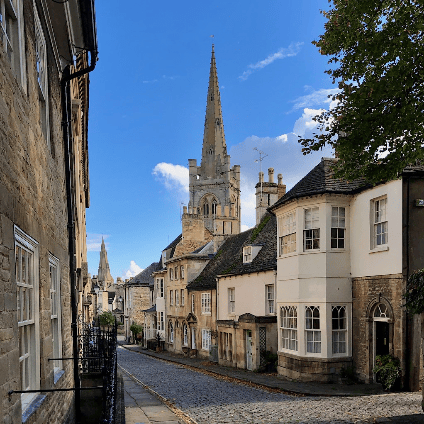
Barn Hill, Stamford by Paul Harrop, via Geograph (https://www.geograph.org.uk/photo/7627373), licensed under CC BY-SA 2.0 (https://creativecommons.org/licenses/by-sa/2.0/).

