
Written by Sophia Blaeser
02/11/2026
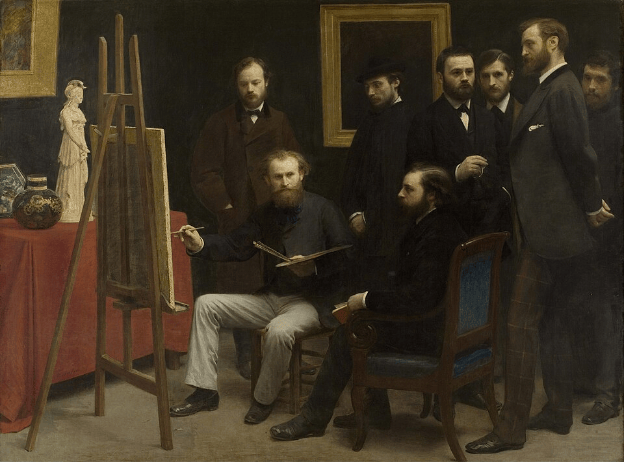
Like other Impressionists of their time, Edgar Degas and Édouard Manet shared a modern approach to art, choosing to represent contemporary scenes of Parisian life rather than the historical narratives and classical portraiture that dominated the strict legacy of the Paris Salon—the official, government-sanctioned art exhibition of the Académie des Beaux-Arts in Paris.
Yet though their later art was subversive, both men started their careers from a traditional approach. Manet and Degas were both academically trained and came from relatively affluent backgrounds. Degas’ family was involved in international banking across France, Italy and the United States, while Manet’s father was a judge who was determined that Manet should study law. The two men supposedly met at the Louvre while drawing a master copy of a Velasquez painting, the Infanta Margarita, a piece that is a far cry from what we would consider today to be part of the Impressionist canon. Both artists were drawn to classical subjects and were often inspired by the same historical and contemporary subjects, which would later result in them imitating each other’s works.
While Manet is in many respects considered to be the father of Impressionism, as he pioneered innovative techniques, represented urban life and was friends with many impressionists, he himself was not an impressionist, but rather a modernist. He refused to exhibit in the independent Impressionist Salon that was established in 1874 by Degas and others and instead continued to submit his controversial works to the Paris Salon year after year, stubbornly attempting to enact institutional change from within with his work.
Degas also exhibited for the Salon, but his debut in 1870 received very little attention, and all subsequent works earned the same treatment. While he was rejected less than Manet, he became disillusioned with the Academy and broke away to establish the Impressionist exhibition. Even though Degas is considered an Impressionist today, collaborating with the likes of Cézanne, Sisley, and Pissarro on creating the Société Anonyme and its later Exhibition, he disliked being labeled as such and never adopted the habit of painting en plein air as was customary amongst his peers. He was notoriously conservative and incompatible with the more left-wing politics of the movement. He once noted that he never attained the unconscious artistic habits of his friends. Later, his ideological differences with the Impressionists would lead to the fracturing of the independent exhibition in 1886.
Though Degas was more socially conservative, he disengaged from the rigid structures of the Paris Salon, while the more liberal Manet continued to work within it. Yet, both Manet’s and Degas’ work often informed one another from within and beyond the Salon, as is apparent in the companion pieces The Absinthe Drinker by Edgar Degas, and Plum Brandy completed a year later by Manet. Manet’s piece is considered a reaction to that of Degas, which is said to have been a take on a different painting of Manet’s completed twenty years earlier.
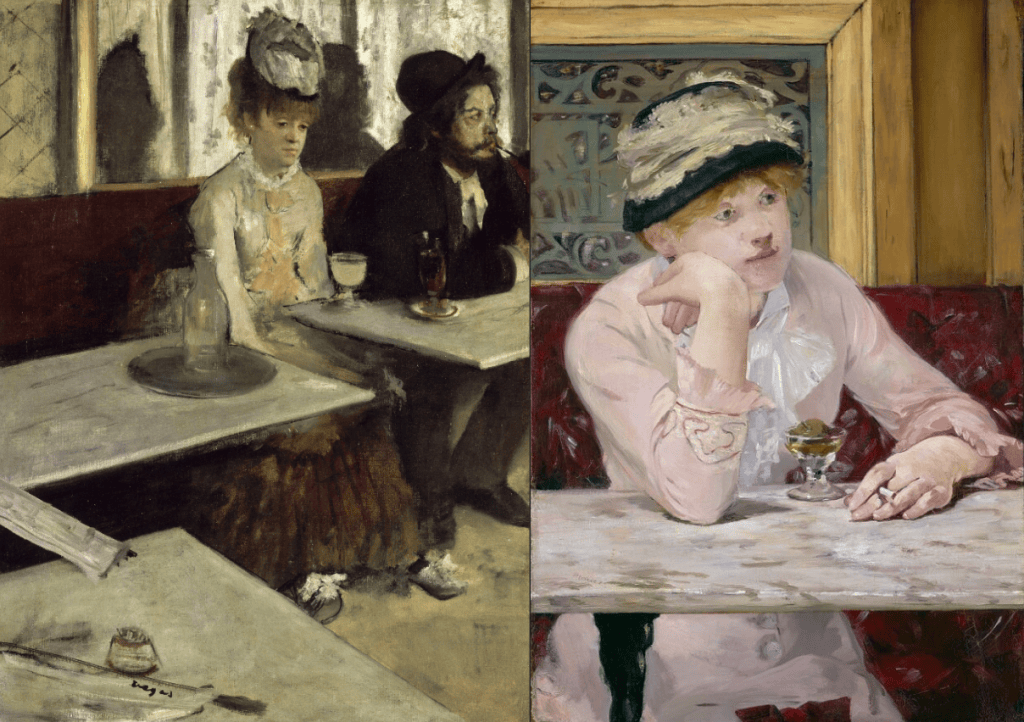
The differences in depictions of the Absinthe Drinker and Plum Brandy are incredibly apparent when placed side by side. While Degas’ portrays the drunken sitter in a gloomy and abject position, Manet’s is coloured by a softer and more dreamlike atmosphere. Degas’s lady sits side by side with a man, yet appears socially isolated from him, with her absent gaze and slumped shoulders denoting a vacancy of feeling, representing the alienating forces of modern vice. In contrast, Manet’s interpretation is much more generous and lighthearted, highlighting his more republican ideals that celebrated modernity. Together these paintings can help us understand where Degas’ and Manet’s perspectives differed.
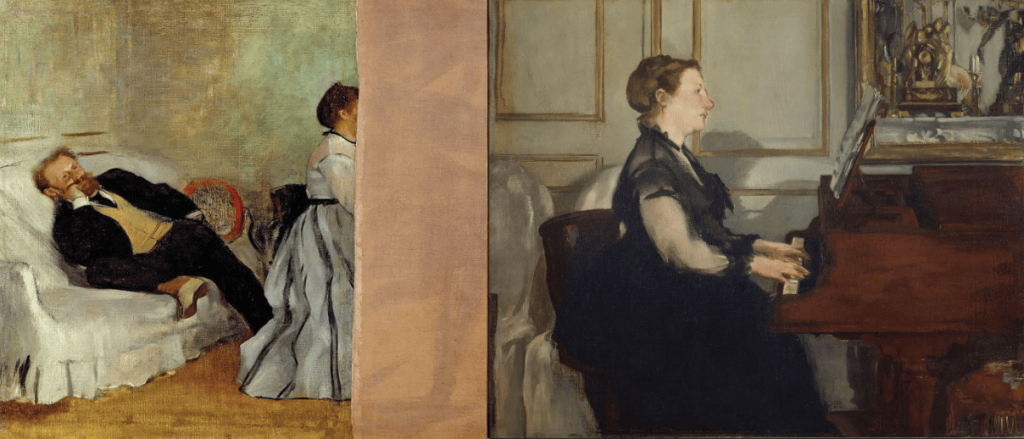
In 1868, the famous incident occurred between the two friends that is reported to have permanently affected their relationship. After Degas gifted Manet a painting of him and his wife, Manet slashed the painting down the middle, cutting off his wife’s face from the composition. While the exact reason is speculated, it is said that Manet did so because he disliked how Degas painted his wife, thinking the likeness deformed. Degas, understandably offended, took the painting back, saying he would repaint the destroyed section. In response, Manet recreated the painting of his wife at the piano, curiously omitting himself from the scene.
In the end Degas did not finish the painting. Instead, he restored the canvas that was torn off but added no paint, only signing his name. Later, after Manet’s death, in a photo taken of Degas in what is presumably his apartment, hangs the painting on the wall, still unfinished.
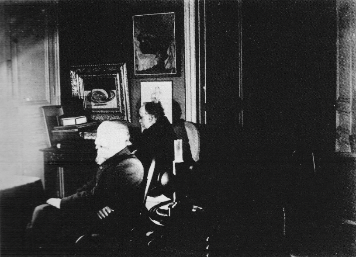
Whilst we do not know whether Degas hung it there as a reminder of their feud or in Manet’s memory, it is clear that Manet’s passing deeply impacted Degas. Following his death in 1883, he spent the next several years gathering as many of his friends’ works as he could. He brought together the now defunct Société Anonyme for a memorial banquet in 1885, a testament to Manet’s legacy and impact amongst the Impressionists, even whilst operating on the outskirts of the movement.
Bibliography
Manet/Degas – The Metropolitan Museum of Art. Accessed October 26, 2026. https://www.metmuseum.org/exhibitions/manet-degas/visiting-guide.
Nord, Philip. “The New Painting and the Dreyfus Affair.” Historical Reflections / Réflexions Historiques 24, no. 1 (1998): 115–36. http://www.jstor.org/stable/41299109.
Researchers, University of Melbourne. “Friday Essay: When Manet Met Degas.” Find an Expert : The University of Melbourne. Accessed October 26, 2026. https://findanexpert.unimelb.edu.au/news/4914-friday-essay–when-manet-met-degas.
Stoichita, Victor I., and James Bugslag. Vaporization and/or centralization: On the (self-)portraits of Manet and degas, January 1, 1999. http://www.jstor.org/stable/10.2307/42630607?refreqid=fastly-default.
Image Credits
A Studio at Les Batignolles (c. 1870). Henri Fantin-Latour. Courtesy of the Musée D’Orsay, Paris via Wikipedia.
The Absinthe Drinker (c. 1875–1876). Edgar Degas. Courtesy of the Musée D’Orsay, Paris via Wikipedia.
Plum Brandy (c. 1877). Édouard Manet. Courtesy of the National Gallery of Art, Washington, D.C.
Monsieur et Madame Édouard Manet (c. 1868-1869). Edgar Degas. Courtesy of Kitakyushu Municipal Museum of Art via Wikimedia Commons.
Madame Manet ou Piano (c. 1867-1868). Édouard Manet. Courtesy of Musée D’Orsay, Paris via Wikimedia Commons.
Degas et Bartholomé (c. 1895-1897). Unknown author. Courtesy of Bibliotheque Nationale, Paris via Wikimedia Commons.

