
Written by Andrey Georgiev
26/10/2026
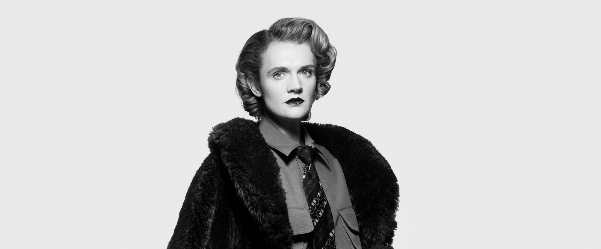
When you think of Edinburgh in the 1930s, fascism is unlikely to be the first thing that comes to mind. Yet in David Harrower’s adaptation of The Prime of Miss Jean Brodie, fascism enters the city through an unlikely ambassador – an eccentric Edinburgh schoolteacher.
This National Theatre of Scotland production is running between the 2 and 18 October at the Royal Lyceum Theatre, Edinburgh, and later touring across Scotland until the 7 November. Directed by Vicky Featherstone, this production sought to “remain close to the book while amplifying the transgressions and passions to resonate with our lives today.” Through its costumes, classical imagery, and comic treatment of Brodie’s admiration of Benito Mussolini, this production presents fascism as a performance of authority to expose the appeal and absurdity of authoritarian politics.
Muriel Spark’s classic 1961 novel follows the lives of Miss Jean Brodie (Gayle Rankin) and her pupils – often called the ‘set’ – at the prestigious Marcia Blane School for Girls in Edinburgh during the tumultuous interwar period. To the girls, Brodie is both a confidante and instructor. Yet she exploits their impressionability to cultivate a following of her own, famously declaring: “Give me a girl at an impressionable age, and she is mine for life.”
Brodie’s classroom is more than the setting of her eccentric teaching – it is a miniature hierarchy in which she selects and conditions her followers, attempting to determine their futures. Set designer Chloe Lamford’s choice of a carpeted, light pink, classical amphitheatre echoes the fascist arenas of 1930s Europe and establishes Brodie as the sole orator. This space physically reinforces her authority.
Brodie’s hierarchy echoes the education system of the time, when parents paid high sums for their children to pass the ‘qualifying examination’ and ensure them a place at a senior secondary. However, Brodie’s eccentric teaching does without the standard curriculum, instead using her own travel stories to cultivate the girls’ interests. She talks at length about her trips to Italy, gleefully praising Mussolini’s strong government when compared with the ‘weak’ Ramsay MacDonald (Prime Minister of the United Kingdom between 1929 and 1935). To a modern audience, it might seem comedic to praise such a dictator, but as Harrower reminds us – “the UK government [at the time] was… cheerfully appeasing the aggression of Mussolini and his Blackshirts.” Fascism often exploited the perceived weaknesses of liberal democracies, presenting authoritarian rule as a solution to political instability, and it is this which Brodie advocates for. Simply calling her a fascist overlooks the complexity of her character.
While Brodie’s character is herself a contradiction – expecting the girls to share their innermost secrets and desires, while her interior remains hidden as she denies us her self-reflections – so too were her political beliefs.
Her worship of Mussolini and his fascist agenda is in stark contrast to how she lives her life. In Italy, female employment was portrayed negatively, and yet Brodie works as a teacher. In Italy, a woman’s duty was to be a mother, and yet Brodie has several affairs and enjoys sexual independence. In this production, Brodie adopts the aspects of fascism which suit her own cult of personality, overlooking those that restrict her freedoms. However, when Brodie praises Mussolini, the audience’s laughter can puncture the grandeur she attempts to evoke, exposing the absurdity of her political idealisation.
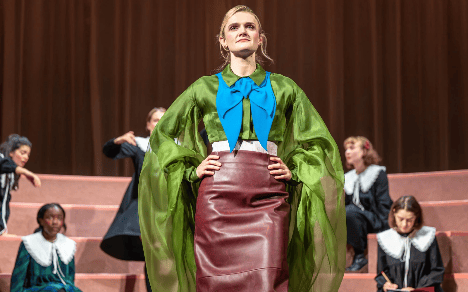
The visuals of this production are particularly striking. The sleek lines of Lamford’s classical amphitheatre transform the classroom into a spectacle, with costume designer Anna Orton’s designs establishing Brodie as its centre. The very first time we see Brodie, she appears from behind the amphitheatre in a burgundy leather skirt and an arsenic-green chiffon blouse, which evokes the billowing form of an academic gown. In the second act, Brodie is seen in a utility-esque suit, with exaggerated pointed shoulders – a militarised silhouette which gives her authority a physical presence. Her appearance thus complements her political rhetoric, as she does not merely express admiration for power and strength but actively embodies it. On the other hand, headmistress Miss Mackay dresses in frumpy, conservative long skirts and blazers. In this regard, the production portrays Brodie as a rebel against institutional conformity.
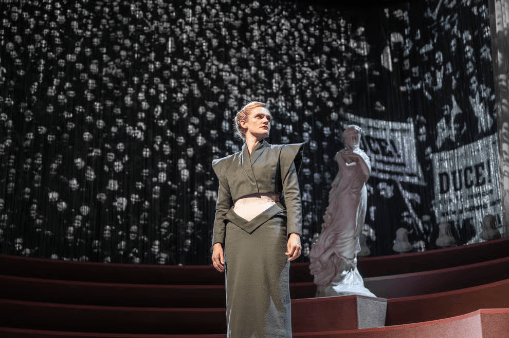
The use of classical imagery in this production is vital to how fascism is portrayed. A prominent example is the classical amphitheatre. Mussolini heavily relied on Italy’s Roman imperial prestige and its past to cultivate legitimacy. Furthermore, classical statues and busts are used throughout the classroom. Another important design choice is that of video designer Lewis den Hertog to project Renaissance Italian art onto the back curtain. In the second act, these curtains slowly pull back to reveal a mass of people at an Italian fascist rally holding ‘Duce!’ signs. This reflects Brodie’s change in character – from insightful and nurturing teacher to an orator who pushes her views on her impressionable pupils.
Near the end of the play, the school holds a memorial service for Joyce-Emily, a pupil pushed by Brodie to fight in the Spanish Civil War for the nationalists under Franco. I felt a chill in this scene, as we realise how consequential Brodie and her views are to the girls. We can no longer dismiss her eccentricity and beliefs as harmless.
This production excelled in demonstrating not just why fascism was appealing but also how its language and imagery can make domination seem attractive. The ‘Brodie set’, however, eventually outgrow their teacher’s control. By the end of the play, Brodie has been dismissed from Marcia Blane and is dying of cancer. Sandy, once Brodie’s closest confidante, returns as a successful woman, declaring that she succeeded despite her. This final rejection undermines Brodie’s belief that she can possess her pupils for life. Ultimately, Brodie’s downfall exposes the limits of her carefully constructed authority: that although she may have shaped her pupils’ future, she could never truly own them.
Bibliography
Brown, M. (2026). This ingenious production of The Prime of Miss Jean Brodie is theatre at its very best. [online] The Telegraph. Available at: https://www.telegraph.co.uk/theatre/what-to-see/the-prime-of-miss-jean-brodie-national-theatre-of-scotland/ [Accessed 11 Oct. 2026].
Hay, R. (2026). The Prime of Miss Jean Brodie. [online] Our Man On The Ground Travel and Lifestyle. Available at: https://omotgtravel.com/culture/the-prime-of-miss-jean-brodie/ [Accessed 11 Oct. 2026].
McMillan, J. (2026). The Prime of Miss Jean Brodie Review, the Royal Lyceum, Edinburgh: ‘Spectacular’. [online] The Scotsman. Available at: https://www.scotsman.com/arts-and-culture/edinburgh-festivals/the-prime-of-miss-jean-brodie-review-lyceum-edinburgh-9279438 [Accessed 11 Oct. 2026].
Milton, A. (2026). The Prime of Miss Jean Brodie (2026), The Royal Lyceum Theatre Edinburgh, Review. [online] EdinburghGuide.com. Available at: https://edinburghguide.com/reviews/theatre/the-prime-of-miss-jean-brodie-2026-the-royal-lyceum-theatre-edinburgh-review-22162 [Accessed 11 Oct. 2026].
Murray, L. (2026). Review: The prime of Miss Jean Brodie, Lyceum Theatre Edinburgh. [online] West End Best Friend. Available at: https://www.westendbestfriend.co.uk/news/review-the-prime-of-miss-jean-brodie-lyceum-theatre-edinburgh [Accessed 11 Oct. 2026].
National Theatre of Scotland (2026). Programme for ‘The Prime of Miss Jean Brodie’. Edinburgh: Royal Lyceum Theatre.
Wilson, P. (2012). Women in Mussolini’s Italy, 1922–1945. In: R.J.B. Bosworth, ed., The Oxford Handbook of Fascism. [online] Oxford Academic. Available at: https://academic.oup.com/edited-volume/34510/chapter/292827058 [Accessed 11 Oct. 2026].
Image Credits
The Edinburgh Reporter, https://theedinburghreporter.co.uk/2026/02/new-production-of-the-prime-of-miss-jean-brodie-announced/?print=print
The Telegraph, https://www.telegraph.co.uk/theatre/what-to-see/the-prime-of-miss-jean-brodie-national-theatre-of-scotland/
The Scotsman, https://www.scotsman.com/arts-and-culture/edinburgh-festivals/the-prime-of-miss-jean-brodie-review-lyceum-edinburgh-9279438

