
Written by Hannah Connolly
26/10/2026
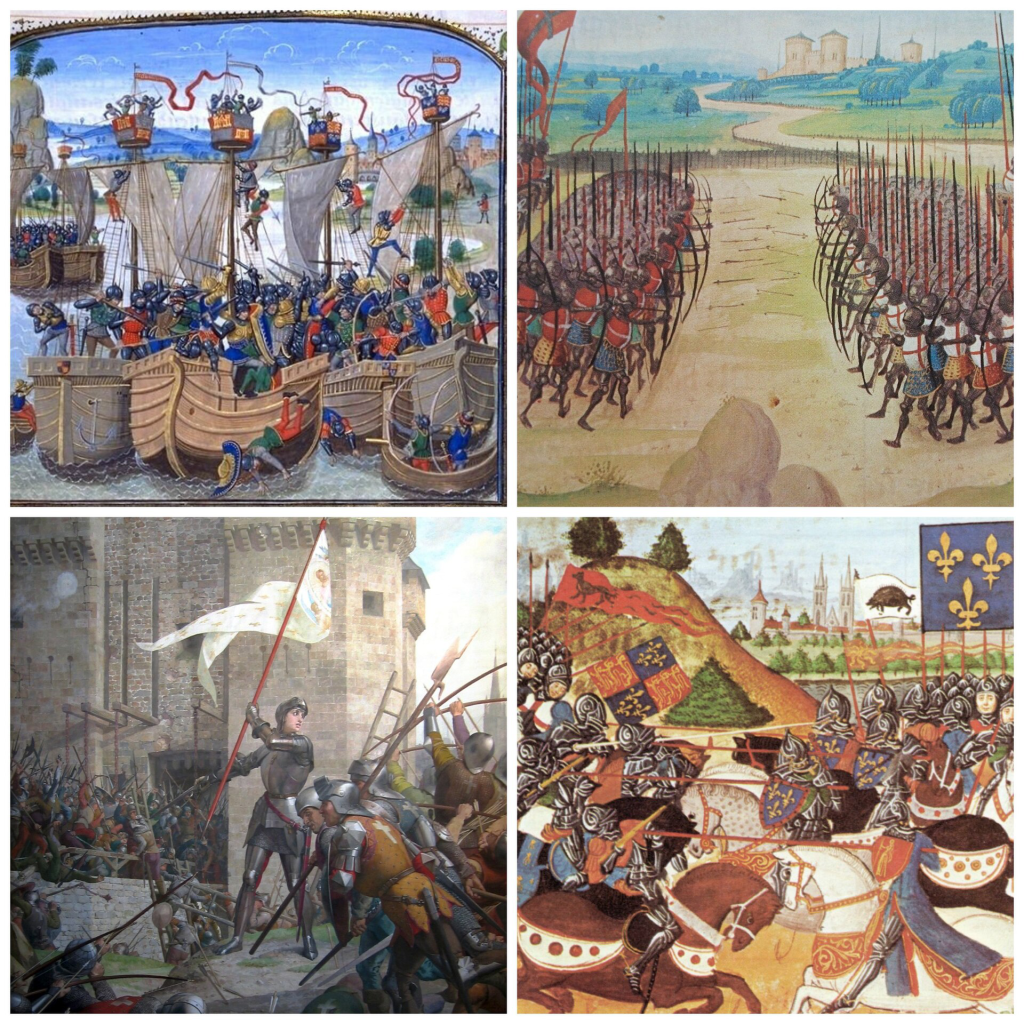
Across the fourteenth and fifteenth centuries, the Hundred Years War dominated English politics and society. As the seemingly endless conflict continued, it helped reshape what it meant to be ‘English’ and how that identity could be expressed. The Crown needed to mobilise a wider community to support its campaigns, yet the consciousness it encouraged was increasingly autonomous of those who had designed it. The war helped create a public that increasingly recognised its place within a political community, rather than simply responding to patriotic language promoted by the Crown.
Whilst the Hundred Years War undoubtedly strengthened the English understanding of nationhood, it was crucially, not born of it. A coherent idea of an ‘English people’ was already present in written sources across the thirteenth and fourteenth centuries. This identity, however, was built in large part by strong connections to the European continent, particularly the elites of France, through widespread cross-channel landholding amongst elites and indeed, the royal family. For subsistence communities across England, disputes over Aquitaine and the English claim to the French throne could appear to be the “playground” of the elite rather than a matter of direct concern to ordinary people. The distance between dynastic politics and the concerns of the wider population helps explain why the Crown later needed to cultivate a broader sense of participation in the war. The Hundred Years War therefore saw the intensification and redirection of this identity into a domestic idea of nationhood used by the kings of England to ensure continued support for their wars, though this effort had consequences that the Crown could not always control.
The pressures of war made public acceptance increasingly important to the Crown. The Hundred Years War placed heavy demands on the institutions of English administration and meant that the royal government needed to ensure the acceptance, or at least acquiescence, of its subjects to the financial and political demands of war. In January 1340, Edward III assumed the title ‘King of France’ and his claim had to be presented as legitimate and compatible with the interests of the country, particularly because he had previously performed homage to the French King. The subsequent propaganda movement sought to present the conflict as a kind of defence of ‘Englishness’ institutionalised the idea that a sense of belonging to a particular nation could be used to maintain popular support. Within propaganda narratives, the libelling of the French and the Scots helped to solidify a sense of distinct Englishness, and the French increasingly functioned as an ideological foil against which English identity could be defined. Symbols associated with French authority were frequently appropriated or ridiculed. Edward III’s decision to quarter the fleurs-de-lis with English lions on his crest was a visual challenge of Anglo-French historic ties, and by adopting a central symbol of French monarchy, the Crown was able to reframe Edward’s dynastic claim within a narrative of English legitimacy.
The royal writ was a particularly important tool for this dissemination of ideas, as the announcements enabled a pseudo-direct communication between the king and his subjects, and made use of the English vernacular, where previously the language of government and administration had been French. These methods did not simply describe the war but encouraged people to understand it as something they were also involved in. Political messages were often delivered to church congregations through writs de orando pro rege, which requested prayers for the king during military campaigns. First used during the reign of King Edward I, pro rege prayers encouraged the belief that the war had been divinely sanctioned but also served to inform the populace of the course of the war. It was through such writs that the English people were told of victories like Poitiers and Agincourt.
Part of the reason royal writs were so effective was their embeddedness into the existing societal frameworks of medieval English society. At this time, the Church was one of the most powerful forces shaping the beliefs and values of the people, and in the fifteenth century the king could use this to present kingship in a religious context, reflecting the belief that political action required divine approval. By blending religious rhetoric with news from the battlefield, it was much easier to legitimise the war effort and the dynastic ambitions of the king. Interweaving church doctrine and politics in this way created what Morgan describes as a ‘religion of nationalism’ which gave the French Wars a quasi-crusading tone that emphasised English righteousness.
The widespread circulation of propaganda contributed to increasing political awareness among the population, particularly concerning the progress of the conflict. Although the war was fought on foreign soil, it was understood in increasingly national terms, and reports of the conflict from France could be impactful on the mood of the country. When kings secured public support, like Edward III during the first few decades of the conflict, the nation felt motivated by and involved in the conflict. The war was exceedingly popular in the 1440s and 1450s and the Black Prince’s return to London in 1357 after victory at Poitiers was met with jubilant celebration. However, this consciousness was constant. Because the English people were now emotionally responsive to the war as it unfolded, whilst victories strengthened morale, defeats were more difficult for the public to reconcile. Devastating losses such as at Patay (1429) and Castillon (1453) seemed entirely incompatible with the greater narrative of English supremacy, legitimacy, and righteousness. In this way, the king’s ability to mobilise support for his wars became increasingly dependent on whether he was able to fulfil public expectations. When he was unable to do so, the very public he had empowered to have a political role could, and indeed did, use it to challenge their rulers.
Despite expressions of patriotic fervour, most supported the war for the opportunities it gave them personally, namely for profit, advancement, or honour. When this was not possible, the newly empowered populace was incredibly dangerous and not a body that kings could afford to ignore regularly or overtly as they began to affect the nature of domestic politics. It was this debate that characterised the discontents caused by the war of every English king’s reign between 1337 and 1453; whether to continue with a ruinous war or to submit to a shameful peace – neither of which their people would readily accept. National consciousness and personal advantage were therefore not mutually exclusive, but neither did patriotic language guarantee lasting support for the Crown’s aims.
The costs of war exposed the limits of the Crown’s ability to direct public feeling. Heavy taxation and levies placed intense pressure on the domestic economy and brought about resistance and even rebellion in England. Direct taxation again required a level of public consent, and whilst the political community was more willing to accept taxes that were directed towards the war effort, the financial burden of war on the people was considerable. As early as 1340, Edward III was met with widespread refusal to pay war taxes, a sign that attempts to mobilise the population could encourage people to see themselves as participants in the political community, but that awareness could also provide a basis for refusing royal demands. As time went on, the public increasingly turned against the endless nature of their exploitation and the national consciousness that the administration had worked so dutifully to curate became a key mechanism in challenging their policy. Criticism levelled at those deemed responsible for ‘French disasters’ was violent and wide-reaching. As the people became a distinct political influence, the war was increasingly directed by domestic public opinion. These developments demonstrate that the Hundred Years War strengthened English national consciousness to a significant extent but not in a straightforward or uniformly advantageous manner. It also exposed tensions within the kingdom as the very awareness and engagement that the Crown encouraged, enabled subjects to criticise royal policy and resist the burdens of prolonged warfare. National consciousness therefore developed not simply through hostility toward France but through the growing political interaction between crown and society created by sustained war.
In conclusion, the Hundred Years War did not create an English sense of nationhood, but it was highly impactful in strengthening and reshaping it. War gave the Crown a powerful incentive to cultivate a broader sense of political community through propaganda, religious discourse, visual symbols, and appeals for public support. These measures fostered a growing awareness among the English population of their collective identity and shared interests, particularly in opposition to France. Yet this political consciousness the Crown encouraged enabled the public to criticise, resist, and influence royal policy when the war proved costly or unsuccessful. Living in a sustained conflict strengthened English national consciousness not simply through hostility towards France, but through the growing and sometimes contentious interaction between Crown and society over the demands and purposes of war.
Bibliography
Brown, Michael. Disunited Kingdoms: Peoples and Politics in the British Isles, 1280 – 1460. London: Routledge, 2014.
Danbury, Elizabeth. ‘English and French artistic propaganda during the Hundred Years War: source evidence from royal charters’ in Power, culture and religion in France, c.1350 – c.1550, edited by C. T. Allmand, 75–97. Woodbridge: Boydell Press, 1989.
Jones, W. R. ‘The English church and royal propaganda during the Hundred Years War,’ Journal of British Studies 19 (1979): 18–30.
McCulloch, D. and Jones, E. D. ‘Lancastrian politics, the French war and the rise of the popular element,’ Speculum 58 (1983): 95–135.
Morgan, D. A. L. ‘The banner-bearer of Christ and Our Lady’s Knight: how God became an Englishman revisited’ in St George’s Chapel Windsor in the Fourteenth Century, edited by Nigel Saul, 51–61. Woodbridge: Boydell Press, 2005.
Ormrod, W. M. ‘The domestic response to the Hundred Years War’ in Arms, Armies and Fortifications in the Hundred Years War, edited by Anne Curry and Michael Hughes, 83–101. Woodbridge: Boydell Press, 1994.
Ormrod, W. M. ‘The use of English: language, law, and political culture in fourteenth-century England,’ Speculum 78 (2003): 750–87.
Ruddick, Andrea. English Identity and Political Culture in the Fourteenth Century. Cambridge: Cambridge University Press, 2013.
Shakespeare, William. Richard II. 1597.
Image Credits
Blaue Max. (2016). Hundred years war collage [Digital image]. Wikimedia Commons. https://commons.wikimedia.org/wiki/File:Hundred_years_war_collage.jpg

