
Written by Phoenix Chandler
26/10/2026
Artemis is known as the goddess of the hunt and the wilderness. In Archaic Greek art as early as 550 BCE she is usually flanked by animals, and she is often depicted amongst deer or hunting deer. In the Classical period her representation developed so she is shown without any animals or her distinctive bow and quiver, however she is sometimes shown with an animal skin nebris and boots. There is evidence of Artemis in Bronze Age Crete as Artemis Eileithyia, who accepts models of female genitalia for a safe and successful childbirth. However, she is also known as the huntress who brings death to animals and humans alike, as well as life. Like her brother, Apollo, she is also known as the bringer of disease. She was worshipped at many of her sanctuaries and festivals across Greece, notably Brauronia, Munichia, Charisteria, and the Amarysia festivals. The sanctuary of Orthia has a long history dating back to the Archaic period in the Greek city-state of Sparta.
Artemis Orthia was an epithet for the maiden goddess; it is thought that Orthia was a goddess from the Minoan-Mycenaean pantheon that survived by later being associated with Artemis. Within this sanctuary there would be processions of young girls known as parthenoi who would perform pieces of choral poetry in traditional rituals. Young girls were protected in Artemis’ cult and their transition from virgin to womanhood was celebrated within it and the preparations for marriage were often made during rituals for Artemis.
Both Artemis and Apollo were commonly known as protectors of children; Artemis’ cult practices show that she had a role of guardianship over the maidens in her sanctuary until they reached the stage of motherhood. She encompasses the transitional state for young maidens across the ancient Greek world, trapped between childhood and puberty. The cult practices dedicated to Artemis involved several different rituals. The festivals at Brauron and Munichia that were dedicated to Artemis every year were centred around the choral performances of a group of maidens. They would participate in the cult dances before serving as arktoi, meaning ‘little bears’.
Dancing to honour a god or goddess was a cult practice most often found in dedication to Dionysus, but Artemis appears to have had a significant amount of the ancient Greek world honouring her in song. Across the ancient Greek world, the art of dance was held in high regard, and its skill was a carefully honed craft. Lucian of Samosata makes it clear that the ancient Greek passion for dance required great dedication and thought. It is implied that talent in dance and song was a divine gift, perhaps from the Muses, perhaps from Artemis or Dionysus himself.
“Those historians of dancing who are the most veracious can tell you that Dance came into being contemporaneously with the primal origin of the universe, making her appearance together with Love—the love that is age-old. In fact, the concord of the heavenly spheres, the interlacing of the errant planets with the fixed stars, their rhythmic agreement and timed harmony, are proofs that Dance was primordial.” (Lucian, The Dance, 221, 7)
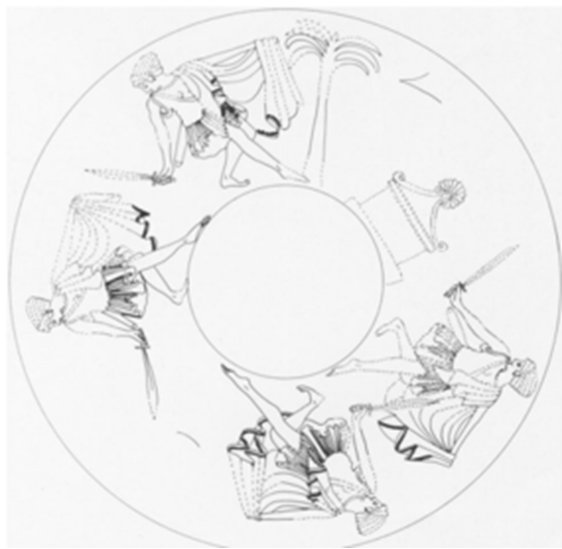
Sparta was famous for its unique dance styles, including pyrrhic dancing, which is described as a war dance, sabre dance or sword dance. This style was most often performed by men in festivals and usually naked; however, there are instances of female pyrrhic dancing in honour of Artemis or Athena. The fragments of a red Attic cup in the Paul Getty Museum show a group of women performing a pyrrhic dance. The palm tree iconography paired with the young female dancers, which could be parthenoi, is a common image paired with Artemis and palm trees were used as offerings in her temples. A pyrrhic dance such as this is meant to replicate a battle so the association of the female pyrrhic with Artemis has a logical progression as she is the goddess of the wilds and her sanctuaries are there for the protection of maidens. Perhaps the sword dances were a way to teach the young girls to protect themselves or to tap into the wild nature they are usually taught to smother.
The purpose behind a female sword dance appears to be more of an initiation performance rather than a test of skill like the male sword dancing. It is possible that this form of dancing was based on the Amazons’ way of life and a way to test the strength of a woman before her marriage. Athenaeus lists various dances in Book 14 of his Deipnosophistai and the female sword dance is not mentioned explicitly, although the dances are only named and not described so it is possible that the female sword dance has an unknown name. The male sword dances such as the pyrrhic, the apokinos and the prylis were only ever known as male performances. The apokinos could have been danced by women in Cephisodorus’ play called The Amazons, but this Attic red cup is clearly connected to Artemis and not the Amazons.
The palm tree featured on the cup heavily indicates a connection to Artemis’ cult, as Leto gave birth to both her and Apollo in the trunk of a palm tree on Delos as is described in Nonnus, Dionysiaca (27.259). Pausanias’ Description of Greece also confirms this connection as he describes the palm trees growing in front of the sanctuary of Artemis to be not as edible as the dates in Palestine, but riper than the ones found in Ionia.
The strong association between Artemis and dance culture is continually perpetuated throughout ancient literature. Callimachus explains the summer solstice as Helios watching Artemis dance with a group of nymphs on earth as he drove the sun chariot across the sky. He halted the chariot in the sky to watch her dance and elongated the daylight (Callimachus, Hymns, 3.170). The festivals of Artemis called Brauronia usually hosted groups of young girls dancing to mimic a bear. This practice was associated with the myth of the sacred she-bear in Brauron that was killed, and as a result Artemis sent a plague which could only be stopped with a performance of the she-bear from a group of girls, as instructed by a local oracle.
The cult activity at Brauron is associated with the arkteia ritual where girls between the ages of five and ten would ‘become’ bears. It has been suggested that this is a transition rite of passage marking the maturation of girl to woman, maiden to wife, parthenoi to gynaikes, to reiterate the wildness of their youth. Artemis is used as the protector of children helping to ease the transition from one stage of life to another as a married woman and her protection extends to mothers in childbirth. She existed in the transitional places across the region, at the borders of cities, on mountain passes or at springs or rivers. The rural sanctuary at Brauron was near a spring and faced a small harbour near the sea and the sanctuary of Artemis Orthia was located at the south bank of the Eurotas river, indicating the importance of water in the purification for virgins and for women after childbirth. This sanctuary at Brauron was the main sanctuary for Artemis in Attica and was flourishing between the eighth and third centuries BCE. The main purpose of these sanctuaries was to prepare maidens psychologically and mentally for wedlock as soon as they were physically ready to bear children.
It seems that no matter where Artemis finds herself her cult will worship her with dance. Dance was a way for the young maidens throughout ancient Greece to feel protected and embrace their true nature without judgement or scorn. The importance of dance in the ancient Greek world is not easy to ignore. The songs produced by Greek poets brought life to the cult performances and showcase the remnants of their dance culture. Plato mentions Apollo, Dionysus and the Muses as the leaders of dance who men took great pleasure in and that they are the divine spirits who gave humanity harmony and rhythm. As a warrior’s prowess in battle was seen as a gift from the gods, a performer’s talent could be seen in the same light. Dance can be a cathartic cleansing of the soul, whether for a cult ritual in ancient Greece or modern day at the school disco. We have never left behind the idea of dancing as a group, performing something purely for the joy of it. Artemis’ cult brought chorus performances into the spotlight and gave women and girls a space to dance whether to train their bodies, prepare them for the transition to adulthood or to let them embrace their true nature.
Bibliography
Bevan, E. (1987) ‘The Goddess Artemis, and the Dedication of Bears in Sanctuaries’, The Annual of the British School at Athens, 82, pp. 17–21. doi:10.1017/S0068245400020268.
Bielawski, K., (2025.) ‘Why Should I Dance (Τί δεῖ με χορεύειν)? Dance in Greek–Words, Postures, Interpretations.’ Studia Choreologica, 26, pp.61-79
Borthwick, E.K., (1970.) P. Oxy. 2738: Athena and the pyrrhic dance. Hermes, 98(H. 3), pp.318-331.
Bron, C., (1996.) The sword dance for Artemis. The J. Paul Getty Museum Journal, pp.69-83.
Calame, C., (2001.) Choruses of Young Women in Ancient Greece: Their Morphology, Religious Role, and Social Functions. Bloomsbury Publishing PLC.
Clark, C. (1996.) “The Gendering of the Body in Alcman’s Partheneion 1: Narrative, Sex, and Social Order in Archaic Sparta,” HELIOS-TEXAS-. TEXAS TECH UNIVERSITY PRESS
Fain, G.L., (2004.) ‘CALLIMACHUS’ HYMN TO ARTEMIS AND THE TRADITION OF RHAPSODIC HYMN.’ Bulletin of the Institute of Classical Studies, 47(1), pp.45-56.
Faraone, C.A., (2013.) ‘Playing the bear and the fawn for Artemis: female initiation or substitute sacrifice?. In Initiation in ancient Greek rituals and narratives’ (pp. 56-81). Routledge.
Ferrari, G., (2008.) ‘Alcman and the Cosmos of Sparta.’ University of Chicago Press.
Harris, J.R., (1916.) ‘The origin of the cult of Artemis.’ Bulletin of the John Rylands Library, 3(2-3), pp.147-184.
Lawler, L.B., (1964.) ‘The dance in ancient Greece’ (p. 128). London: Adam & Charles Black.
Léger, R.M. (2015) Artemis and her Cult (Doctoral dissertation, University of Birmingham).
Lykesas, G. and Mouratidisof, I., (2005.) ‘Dance during the classical period in Greece, Athens and Sparta.’ Stiinta Sportului, 46(1), pp.3-20.
Pomeroy, S.B., (2002.) Spartan women. Oxford University Press, USA.
Sourvinou-Inwood, C., (1985.) ALTARS WITH PALM-TREES, PALM-TREES AND” PARTHENOI”. Bulletin of the Institute of Classical Studies, (32), pp.125-146.
Too, Y.L., (1997.) ‘Alcman’s” Partheneion”: The Maidens Dance the City.’ Quaderni Urbinati di Cultura Classica, 56(2), pp.7-29.
Vikela, E., Kaltsas, N. and Shapiro, Α., (2008.) ‘The worship of Artemis in Attica: Cult places, rites, iconography. KALTSAS, N.; SHAPIRO, A. Worshiping Women, Ritual and Reality in Classical Athens.’ New York, Alexander S. Onassis Public Benefit Foundation, pp.79-87.

