
Written by Oran Crane
23/11/2026
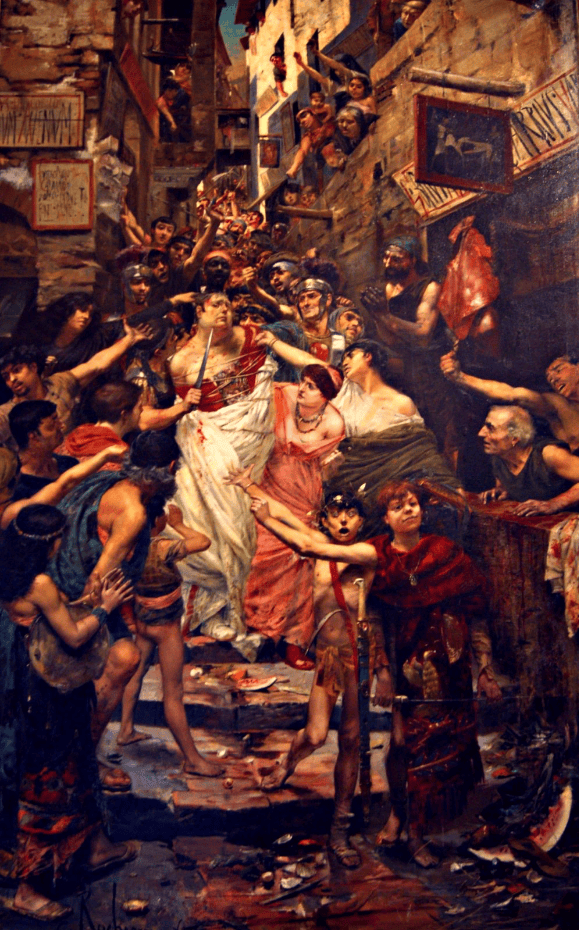
It is late December in 69 CE and through the city the Emperor Vitellius is dragged, to screams of abuse, while his head is held up at the point of a sword. Vespasian has been victorious and now it is time for the erstwhile Emperor to die. He is taken to the Gemonian Steps where he is slaughtered and hauled away with a hook to be dropped in the Tiber (Suet. Vit. 17). Like many political enemies of the early Empire, Vitellius’ death is an extremely public and ritualistic affair. He is humiliated by the people and is aware that his body will not be allowed the full funeral rites and purification so central to a Roman aristocrat’s concept of death. Through the executions of the Praetorian Prefect Sejanus, the Emperor Vitellius himself, and the later Emperor Elagabalus, we can examine the use of the Scalae Gemoniae as a setting for capital punishment, the involvement of the Roman populus in the degradation of their political enemies, and the importance of the Tiber river as a setting for the disposal of these enemies’ bodies.
The Scalae Gemoniae, translated from Latin as the ‘Stairs of Mourning,’ were an addition to the centre of Rome during the early imperial period. It ran past the carcer (prison) and the Forum, as well as being close to the Tarpeian Rock, where criminals had formerly been flung off to their death. The Stairs were utilised as a place of execution, or else to display the bodies of slain political enemies. Dio remarks how an executioner would drag the dead with hooks from the prison to the Forum (where the Stairs were), and then from there to the Tiber where they would be disposed (Cass. Dio 61.35). This process ensured that punishment would endure beyond their demise through degradation even after their execution.
The first momentous instance of the Gemonian Steps being used in the form of an execution came in 31 CE, when the conspiracy of Sejanus was exposed. Sejanus was the Praetorian Prefect under the Emperor Tiberius and had plotted to eliminate the Emperor’s heirs and take the title for himself. His conspiracy was unveiled and he was caught. Dio tells us that while he was being held in custody, he was witness to the destruction of his statues and portraiture, ensuring that his legacy would be damned. Following this, he was killed and his body was displayed on the Scalae for (according to Dio) three days, being attacked by the masses before eventually being thrown into the Tiber (Cass. Dio 58.11). The poet Juvenal gleefully recounted the process of Sejanus’ images being destroyed and the man himself being hooked, to the cheers of the people (Juv. Sat. 10.55-70). The violence did not stop there; his family and associates were also dispatched “scattered or piled in mounds”, before eventually also ending up in the Tiber river (Tac. Ann. 6.19). The statues underwent the same fate that he himself, and the people that he was involved with, ended with. This violence towards his images and the corpses themselves became central to the ideology of the people when dealing with the political enemies of the state.
It would have been seen as madness to conceive of an Emperor being placed in such a position, despite the ends of Caligula (assassinated in 41 CE) and Nero (suicide during civil crisis in 68 CE). During the year of civil war in 69 CE, typically known as the ‘Year of the Four Emperors’, Vitellius became the third non-Julio-Claudian Emperor. His rival in the east was the General Vespasian, who quickly defeated Vitellius’ forces. The emperor was found and dragged through the city. Supposedly, excrement was thrown at him as he was dragged along the Sacred Way. His head was held up by his hair and at the point of a sword so he could witness the hatred of the masses as they hurled insults at him. As with Sejanus, his body was attacked by the people on the Scalae following his death, before he was hooked and dumped into the Tiber (Cass. Dio 64.20-22; Suet. Vit. 17, Tac. His. 3.84-85). Vitellius’ death was particularly poignant due to him having imposed the same fate on the brother of the incoming Emperor Vespasian, Flavius Sabinus, an example that Tacitus is keen to highlight (Tac. His. 3.85). The death and humiliation of an Emperor in this manner was a new thing, but it was not the final time such an event occurred.
Over a century and a half later, another Emperor would meet a similar fate. Elagabalus (r. 218–222 CE) had reputedly attempted to have his cousin and heir, Severus Alexander, assassinated, due to the fear that the army and senate preferred Alexander to him. The Praetorian Guard revolted against the emperor, with him, his mother, and his retinue being murdered. Although there is no specific mention of the Scalae Gemoniae in connection to his death, the treatment of their bodies is particularly telling in conjecture with the ritual of execution for prominent enemies within the state. According to Herodian and Dio, the bodies of Elagabalus and his mother were decapitated, stripped naked, and dragged around, before the emperor’s body was stuffed into a sewer and then eventually deposited in the river (Cass. Dio 80.19-20; Hdn. 5.8.8-9). The erratic Historia Augusta expands on the degradation of Elagabalus, reporting that he was found hiding in a latrine prior to his execution (HA Elag. 16-17). The end that Elagabalus met emphasises the need for the Roman people to participate in the deaths of the foremost villains of their society. The masses, once they had a fixed image of the perceived enemy to the state, engaged in the executions with bloodthirsty glee.
Romans achieved the destruction of a person’s legacy and soul in two central ways. Firstly, when a Roman died, their body would undergo the proper rites and purifications before a proper burial. The disposal of the executed in the Tiber ensured that their body would not undergo such a process, and therefore their soul would remain restless. Secondly the destruction of statues was also important and part of a wider trend of damnatio memoriae. Several Emperors (such as Nero and Domitian) had their memories condemned by the senate, with inscriptions and statues torn down or destroyed. The people’s engagement with this custom was exemplified during the trial of another high-profile offender during the early Principate. During the reign of Tiberius, in 20 CE, the former governor of Syria, Piso, was put on trial over the death of Tiberius’ heir Germanicus, as well as plotting to take control of the whole province of Syria. He committed suicide before he could be convicted, but during the trial the people of Rome dragged Piso’s statues to the Stairs of Mourning and began destroying them there (Tac. Ann. 3.14). The destruction of Rome’s political enemies through damaging their images is here connected to the Scalae Gemoniae and its own legacy of humiliation.
For the political enemies of the Roman state, their end truly was degrading. The destruction of their statues and memorials was a means for the populus to be involved with the humiliation of the condemned. Additionally, the execution itself was a public affair, typically taking place on or near the ritualistic Scalae Gemoniae. The last moments of the prisoners were filled with insults and the knowledge that their body would be abused following their demise. The Tiber River was utilised as a means of stopping the necessary funeral rites from taking place, ensuring that the dead would remain restless as they perceivably deserved. The whole process was ritualistic in its nature and intended to provide total and utter disgrace to the political enemy of the Roman people.
Bibliography
Barry, W. B. (2008), ‘Exposure, Mutilation, and Riot: Violence at the Scalae Gemoniae in Early Imperial Rome’, Greece and Rome, Vol. 55 (2), 222-246.
Braund, S. M. (2004), tr., Juvenal, Persius: Juvenal and Persius, Cambridge, MA.
Cary, E. and Foster, H. B. (1924), tr., Dio Cassius: Roman History, Volume VII: Books 56-60, Cambridge, MA.
Cary, E. and Foster, H. B. (1925), tr., Dio Cassius: Roman History, Volume VIII: Books 61-70, Cambridge, MA.
Cary, E. and Foster, H. B. (1927), tr., Dio Cassius: Roman History, Volume VIX: Books 71-80, Cambridge, MA.
Emmerson, A. L. C. (2020), ‘Re-examining Roman Death Pollution’, The Journal of Roman Studiess, Vol. 110, 5-27.
Erasmo, M. (2008), Reading Death in Ancient Rome, Columbus.
Jackson, J. (1937), tr., Tacitus: Annals: Books 4-6, 11-12, Cambridge, MA.
Kyle, D. G. (2012), Spectacles of Death in Ancient Rome, London.
Magie, D. (2022), tr., Historia Augusta: Volume II. Revised by D. Rohrbacher, Cambridge, MA.
Moore, C. H. (1925), tr., Tacitus: Histories: Books 1-3, Cambridge, MA.
Moore, C. H. (1931), tr., Tacitus: Histories: Books 4-5. Annals: Books 1-3, Cambridge, MA.
Rolfe, J. C. (1914a), tr., Suetonius: Lives of the Caesars, Volume I, Cambridge, MA.
Rolfe, J. C. (1914b), tr., Suetonius: Lives of the Caesars, Volume II, Cambridge, MA.
Varner, E. R. (2001), ‘Punishment after death: Mutilation of images and corpse abuse in ancient Rome’, Mortality, Vol. 6 (1), 45-64.
Varner, E. R. (2004), Mutilation and Transformation: Damnatio Memoriae and Roman Imperial Portraiture, Boston.
Whittaker, C. R. (1970), tr., Herodian: History of the Empire, Volume II: Books 5-8, Cambridge, MA.
Image Credits
‘The Emperor Vitellius Dragged through the Streets of Rome by the People’ by Georges Rochegrosse (1882) – Wikimedia commons

