
Written by Phoenix Chandler
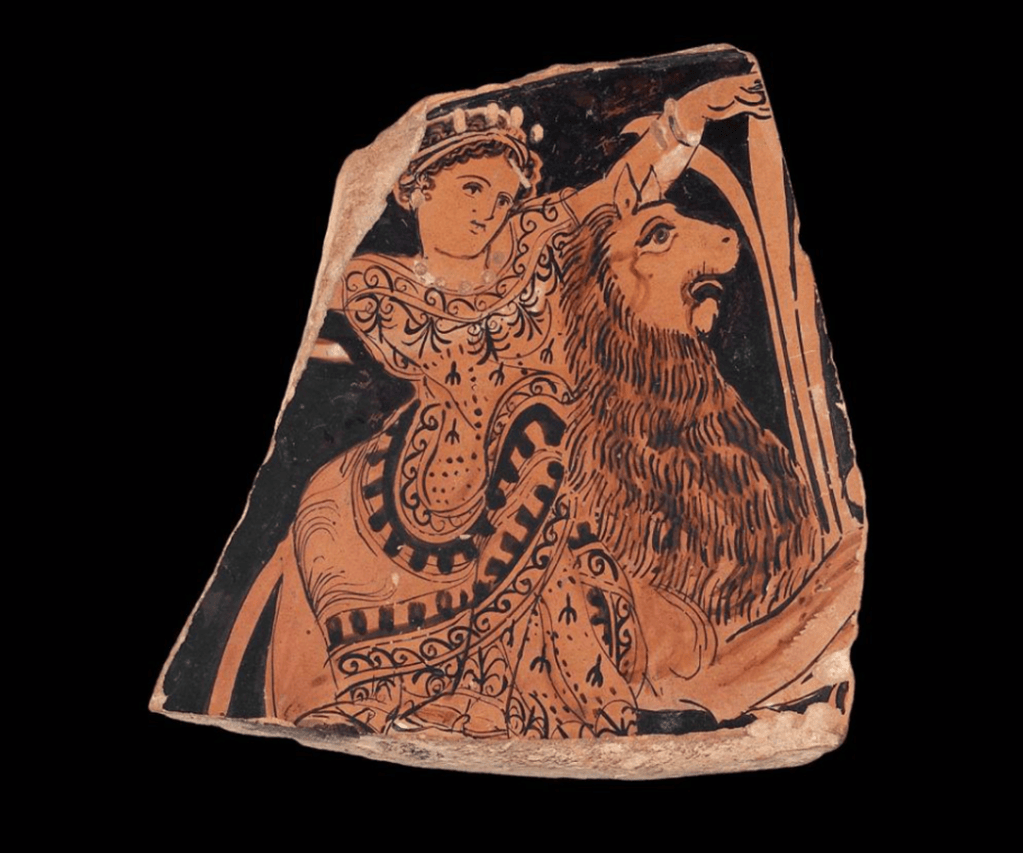
The mother goddess from Anatolia was worshipped in mountainous settings and described as Mother of the Gods. She has been consistently represented sitting on a throne, flanked by two feline animals (often lions). This is a powerful image to have followed a goddess from Western Asia to Europe; the lions appear to be the most important part of her image and are a key part of identifying her. If she is not flanked by them, she is either riding them or they are pulling her chariot. This showcases her connection to nature and wildlife, considering lions roamed in areas from south-eastern Europe to India during the Neolithic period, and her cult first resided in modern day Turkey. Once her cult travelled to Greece she earned the titles Meter Theon, Meter Dindymene and Meter Oreia, translated as “Mother” followed by the name of the mountain nearest that particular cult. As her cult travelled further west she retained the epithets of Great Mother or Mother of the Gods, and when her cult presence continued through the Roman empire she was called Matris Deum and Magna Mater.
The story of this goddess starts in the ancient Mediterranean, in Anatolia. While knowledge from her time in her homeland is limited, evidence of her cult can be pieced together from the fame she accumulated later in Roman times. Her cult presence grew from Phrygia to other parts of Anatolia, and to Greece where she was associated with Rhea (the old age mother goddess), and finally to Rome where she was celebrated. So much of what makes the Meter goddess cult unique was born of Phrygian customs and influences. Before Phrygia was influenced by the ancient Greeks’ presence, the worship of the goddess was much more in tune to nature and the mountainous landscape where her altars resided.
The inscriptions that have survived from the Phrygian cult are on rock faces in western Phrygia, and some stone monuments in central and eastern Phrygia. Their placement on rock faces near mountains and caves tell us she was worshipped in the mountains, in the wilderness, with altars and monuments of stone. Many of the inscriptions refer to the goddess as “Mater”, meaning Mother, or “kubileya/kubeleya”, meaning “of the mountain”, which is the origin of her Greek name Kybele. The translation of this Phrygian word is heavily debated, but it most likely means mountain. Whether it is a reference to a specific mountain named Kubileya or the Phrygian word for ‘mountain’ cannot be confirmed. Therefore, the epithet “Mater Kubileya” could very well be translated as “the mother of the mountain”.
Within Anatolia there are two Neolithic sites that have been the main contribution to the collection of materials that resemble the Phrygian cult. Catalhöyük is one of these sites: a large mound was found here which was used between 6200 and 5400 BC, with a flat top and a ladder entrance. There are several rooms situated around a large courtyard and very little variation in size or elaborate design to indicate any social hierarchy. If one layer of this housing situation was destroyed, another layer of houses was simply built on top. Many wall paintings and objects were preserved within this settlement and include several figurines of a woman sat on a throne with two feline creatures supporting her while she gives birth, as well as wall paintings depicting women giving birth or holding young children. This shows that a large settlement in Catalhöyük had a connection to this mother goddess with a large collection of ritualistic material dedicated to the Mater goddess. Perhaps they were engaged in worshipping her or perhaps they found this iconography brought them luck and safety for both for the mother and baby when giving birth. Whatever the reason, her image in Greece removes her from this role.
The Greeks saw so much of their own mother goddess within this Anatolian one, and so she was incorporated and associated with Rhea from the sixth century BC onwards. Once she became known in Athens, her image became associated with Rhea and she earned her name Meter Theon. By the fourth century BC, evidence of her cults could be found in almost every Greek city, including Olympia, Ionia and Kolophon. Despite being assimilated into Greek religious spaces she was still seen as a barbarian goddess and foreign deity, therefore her journey across the Greek world was not made as easy as it appears. While it is uncertain why the Anatolian mother goddess’s cult ventured out towards Greece, it is certain that they were successful in strengthening and enlarging her cult following.
As Alexander the Great racked up his conquests, the cult of Kybele became increasingly assimilated with the Greek cults. She was still worshipped mostly in private settings compared to the Olympian Gods who had temples and public offerings, but she became a goddess who represented what the Greeks thought of as an Oriental barbarian deity rather than the religion and culture of Phrygia that she once symbolized. Her name started appearing in Greek literature by the fifth century BC and she was first referred to as Mother of the Gods in Homeric Hymn 14, which shows both how the Greek world viewed this Goddess as an outsider and also as a deity to be revered.
“Celebrate, clear-voiced Muse, Daughter of great Zeus, the Mother of all gods and all mankind, whose pleasure is the din of cymbal-clappers and tambours and the bray of the shawms, the howling of the wolves and fierce lions, the echoing mountains and wooded valleys. So I salute you, and all goddesses in my song.” – Homeric Hymn 14.
The addition of cymbals and tambours and the howling wolves are all a part of the newer Greek version of Kybele and not something that was ever seen within the Phrygian cult. While accepting her as a goddess of great renown and mother of the gods and humankind they also push to see her as ‘other’, something slightly more unknown and different, even though the Greek people quickly adopted this goddess because of her similarities to Rhea, the mother goddess to their own Olympians. She has simultaneously retained her Phrygian state and completely changed into a new goddess. As soon as Kybele’s cult left her homeland she was welcomed, but the worship she received in Greece had conditions. She could not truly find a new home there and was constantly remembered and thought of as a foreign goddess. They dressed her in their clothes but gave her the instruments of another country so the dancing within her cult was not matched in other cults surrounding her. She was remembered as the Phrygian goddess of the mountain, but she did not retain the goddess that she was when she was there. Even her feline companions changed from supportive figures to protective regal images, though they stayed by her side.
However, in Roman society, she was given a home on Mount Ida and the Megalesian festival of Cybele in Ovid’s Fasti. In many parts of Roman society, this cult was actively encouraged and sought after. Her arrival in Rome was shortly followed by the construction of a temple in 204 BC which demonstrates that the cult presence in Rome was notoriously large. There was an extensive amount of archaeological material including shrines and much iconographical evidence found in her temple. Instantly, it can be seen that the Roman treatment of Cybele differed from the Greek treatment of Kybele: the festival they celebrate for her in the spring was a major part of Roman life and the cult of Magna Mater had an effect on Roman politics (at least for the first hundred and forty years).
From a small kingdom in Anatolia, this goddess gained fame and popularity across three different cultures and many cities and states. Evidence of her cult is found in many corners of the world and yet her image has remained similar enough to be recognisable with centuries and hundreds of miles between them.
Bibliography
Alvar Ezquerra, J. and Gordon, R.L. (2008) Romanising Oriental Gods : myth, salvation and ethics in the cults of Cybele, Isis and Mithras. Leiden: Brill
Bøgh, B., (2007). The Phrygian background of Kybele. Numen, 54(3), pp.304-339.
Green, T. (2015). THE PRESENCE OF THE GODDESS IN HARRAN. In Cybele, Attis and Related Cults, Leiden, The Netherlands: Brill.
Lane, E. N. (2015). THE NAME OF CYBELE’S PRIESTS THE “GALLOI”. In Cybele, Attis and Related Cults, Leiden, The Netherlands: Brill.
Pachis, P. (2015). “Γαλλαîον Κυβέλης ỏλόλυγμα” (ANTHOL.PALAT.VI, 173). L’ÉLÉMENT ORGIASTIQUE DANS LE CULTE DE CYBÈLE. In Cybele, Attis and Related Cults, Leiden, The Netherlands: Brill
Robertson, N. (2015). THE ANCIENT MOTHER OF THE GODS A MISSING CHAPTER IN THE HISTORY OF GREEK RELIGION. In Cybele, Attis and Related Cults, Leiden, The Netherlands: Brill.
Roller, L. 1999. In Search of God the Mother: The Cult of Anatolian Cybele. Berkeley: University of California Press.
Roller, L. (2015). REFLECTIONS OF THE MOTHER OF THE GODS IN ATTIC TRAGEDY. In Cybele, Attis and Related Cults, Leiden, The Netherlands: Brill
Takács, S. A. (2015). MAGNA DEUM MATER IDAEA, CYBELE, AND CATULLUS’ ATTIS. In Cybele, Attis and Related Cults, Leiden, The Netherlands: Brill.
Vassileva, M., (2001). Further considerations on the cult of Kybele. Anatolian Studies, 51, pp.51-64.
Image Credits: Plate with Kybele riding a lion from late 5th century Greece at the Museum of Fine Arts, Boston 10.187

