
Written by Mia Hutchins
09/11/2026
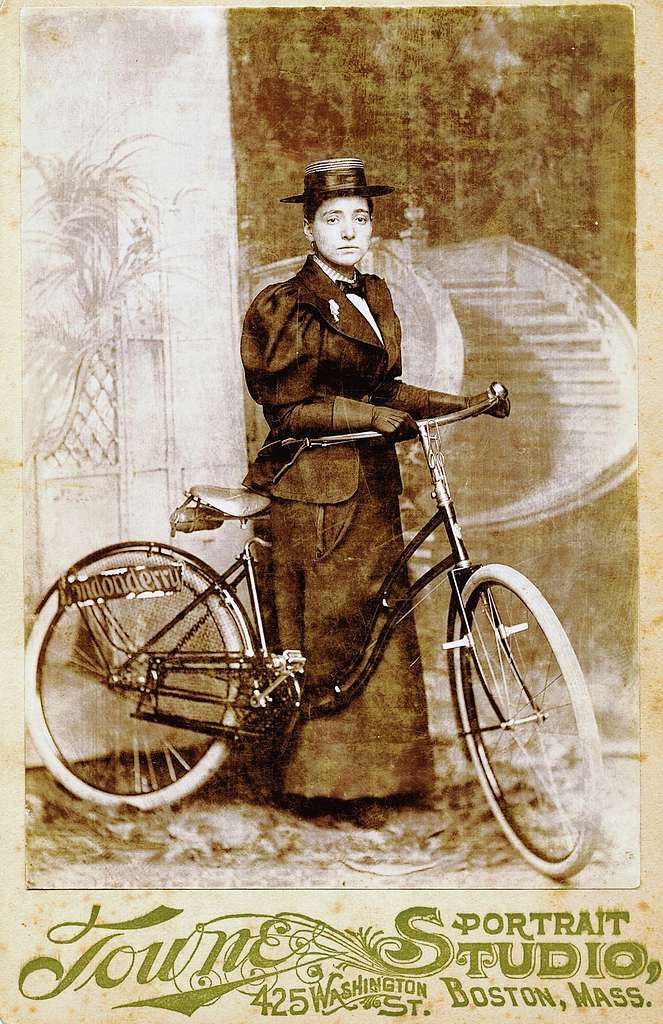
In the 1890s, bicycles became all the rage. Popularity had shifted from the dangerous high-wheeler bike towards the stable ‘modern-day’ bike with two equal-sized wheels. The new craze allowed women to move away from restrictive domestic space and clothing as they began to ride bicycles. This marked the start of the Rational Clothing Movement. This movement encouraged women to wear more comfortable clothes, such as bloomers (which resembled men’s pants) and to abandon tight skirts and corsets.
The bicycle gave women the personal mobility that men enjoyed throughout the nineteenth century, offering a source of freedom from home. They were not only much cheaper than horses but also easier to maintain, making them a popular choice. A Latvian-American cyclist named Annie Londonderry was the first woman who, in 1894, allegedly cycled around the world. She advocated for women to be liberated from their tight corsets and pushed women to begin cycling. Annie started her journey wearing the full skirts of a housewife and returned in bloomers as a heroine of her time.
This newfound freedom women had gained was despised by many men at the time. Doctors invented a condition called ‘bicycle face’ to scare women away from riding. Doctors argued that the constant stress of balancing a bicycle could cause a new nervous condition which acted as a serious threat to women’s delicate beauty. As it turns out, bicycle face was just the start. Soon, ‘bicycle hump’ and ‘bicycle stoop’ were the next conditions women needed to avoid, in fears that the bikes were ruining women’s posture and spine.
Despite the health warnings, many women active in the suffrage movement embraced bicycles and the independence they brought. As more women rode bicycles, they challenged traditional gender roles and paved a way for greater equality. In 1897, Dr Sarah Hackett Stevenson definitively dispelled the issue of ‘bicycle face,’ claiming it was a hoax. Her work helped reassure women that they could enjoy the advantages of cycling without having to worry about ruining their faces.
The eruption of motor cars in the early 1900s drove down the bicycle craze; however, for women, bicycles stayed a source of liberation. Women today can still gain freedom from bicycles, for example in allowing women to escape the sexual harassment possible on public transport and offer them safety. More than a century later, the bicycle still carries the same promise of freedom to women as it did in Victorian times.
Bibliography
Ostroff, Hannah S. . 2018. “How the 19Th-Century Bicycle Craze Empowered Women and Changed Fashion.” Smithsonian Institution. May 17, 2018. https://www.si.edu/stories/19th-century-bicycle-craze.
bikeleague. 2013. “Women’s (Bike) History: Annie ‘Londonderry’ Kopchovsky | League of American Bicyclists.” League of American Bicyclists. March 6, 2013. https://bikeleague.org/womens-bike-history-annie-londonderry-kopchovsky/.
Ward, Tara. 2026. “Bicycle Face: The Terrifying Medical Condition That Threatened 1890S Cyclists.” The Spinoff. March 9, 2026. https://thespinoff.co.nz/society/09-03-2026/bicycle-face-the-terrifying-medical-condition-that-threatened-1890s-cyclists.
“Victorian Doctors Warned of ‘Bicycle Face’ in Women Cyclists – Historyandmystery.Org.” 2024. Historyandmystery.Org. July 27, 2024. https://historyandmystery.org/interesting-history/victorian-doctors-warned-of-bicycle-face-in-women-cyclists/.
Howat, Kenna. 2017. “Pedaling the Path to Freedom.” National Women’s History Museum. June 27, 2017. https://www.womenshistory.org/articles/pedaling-path-freedom.
Image Credits
“Annie Londonderry vers 1896” by Studio Toune (Boston), c. 1896. Sourced via PICRYL / Wikimedia Commons. Public Domain.

