
Written by Eve Hudson
09/11/2026
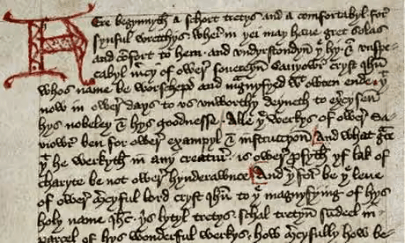
Margery Kempe (1373 – ca. 1438) was a medieval English woman known for writing The Book of Margery Kempe, a spiritual autobiography detailing her intense visions of Christ and experiences as a woman and mystic. This biography gives us rare insight into the life, autonomy, and religious devotion of medieval women at the time. The Book of Margery Kempe follows Margery’s spiritual journey as she turns to a chaste life and marriage after having fourteen children. She claims she is guided by visions of Christ and even establishes an alleged personal relationship with him. While Margery Kempe’s experience cannot be generalized to all medieval women, it does demonstrate an astonishing level of personal freedom for a woman at the time.
When considering Kempe’s life, it is vital to understand her nuanced social position and how this formed the conditions for her pilgrimages and writing of her autobiography. Kempe was the daughter of John Brunham, a merchant and mayor in the city of Lynn, which was a prominent medieval trading port. Aside from her social status, Margery also inherited a significant amount of money from her family, which is repeatedly discussed in her book. This allowed Margery a unique position of social and financial freedom, and it forms the foundation of her life as a woman with the autonomy to travel on various pilgrimages, author an autobiography, and spend time with and among the English aristocracy.
All of this must be taken into account when considering the incredible amount of autonomy, mobility, and influence Margery had. It’s revealed in The Book of Margery Kempe that her entire inheritance is hers alone and kept separate from her husband’s finances. She goes so far as to negotiate paying off her husband’s debts in exchange for agreeing to keep a chaste marriage. Kempe was also incredibly mobile and well-traveled, as she went on various pilgrimages ranging from England, Rome and to as far as Prussia. This, in combination with the ability to author a spiritual autobiography, paints an image of Kempe’s life that seems shockingly contemporary.
While this may be true, closer examination of Kempe’s life shows that while her autonomy and freedom was revolutionary for the time, it was still constrained by her position as a woman. Despite Kempe being met with admiration for her religious devotion, she was simultaneously incredibly controversial. Much of Margery’s visions of Christ and performances of religious devotion, including wailing and crying publicly, was met with skepticism. As a woman she was neither trusted to interpret her own visions nor was she allowed to preach. Kempe repeatedly pushed the boundaries of the religious establishment and its expectations of a devout wife and how they should connect with God. It is also vital to note that Margery’s pilgrimage wouldn’t have taken place without the expressed permission of her husband, and The Book of Margery Kempe had to be transcribed by a man as Kempe herself was functionally illiterate.
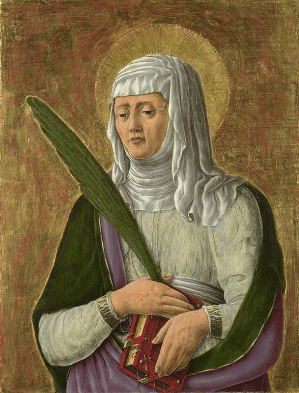
Margery Kempe’s significance is clear today. After the rediscovery of The Book of Margery Kempe in 1934, her legacy has solidified as the author of the first ever autobiographical work written in English and by a mystic, who is now recognized by the Church of England and honored every November 9th. While her life provides clear evidence for a variety of levels of autonomy for Medieval women not typically associated with the period, it is also significant to note that much of the expansiveness of her life was not possible without the cooperation of men.
Bibliography
Bragg, Melvyn, et al. “Margery Kempe and English Mysticism.” In Our Time, BBC Radio 4, 2 June 2016.
Dinshaw, Carolyn. ‘Margery Kempe.’ The Cambridge Companion to Medieval Women’s Writing. Ed. Carolyn Dinshaw, David Wallace. Cambridge: Cambridge University Press, 2003: 222-239
Kempe, Margery. ‘The Book of Margery Kempe.’ The Norton Anthology of English Literature: The Middle Ages Volume A. Ed. Stephen Greenblatt, et al. W. W. Norton, 2024: 233- 247
Scudeler, Beatrice. ‘Who is Margery Kempe?’ Fairer Disputations: Sex-Realism Feminism for the 21st Century. 12 May 2026.
Image Credits
A Female Saint by Giorgio Schiavone (c. 1456–1461) – Image courtesy of The National Gallery, London via Art UK.
A page from the original manuscript of The Book of Margery Kempe – Photo by the British Library via The Guardian.

