
Written by Emma Morey
09/11/2026
In Western artistic traditions, naturalism was deemed the culmination of technological and stylistic advancement, favored over depictions deviating from the observable world. This has often resulted in the sidelining and minimisation of abstract depiction; abstraction has been presented as a shortcoming in the pursuit of naturalism, with their practitioners having inferior artistic technologies and skills. One such practitioner was Teotihuacan, one of the most influential cities of pre-Columbian Mesoamerica from roughly 100 BCE to 600 CE. The assumption of a lack of sophistication in abstraction denies Teotihuacan of its technological developments, undermining the tradition’s artistic effectiveness. Abstraction in Teotihuacan was used to create a set of easily recognisable patterns to identify key figures and the ideologies they represented. A prime example of this is the Mesoamerican storm deity Tlaloc, whose relevance to the city as a social and governmental unit is depicted across various mediums. A closer examination of works designed to petition and praise him provides a clearer image of the religious justification of Teotihuacano authority and militaristic endeavours.
To gain a better understanding of depictions of Tlaloc and their exemplification of interactions between religious and authoritative ideology, one should consider representations upon which other works built specific attributes or ideas. Ubiquitous in his manifestations across contemporary Mesoamerica, Tlaloc is the god of rain and storms, harnessing the power to control water phenomena such as natural disasters and harvests. Tlaloc was associated with coyotes, shells, and feathered serpents across Teotihuacano art, introduced to his representations in the form of abstract icons or symbols.
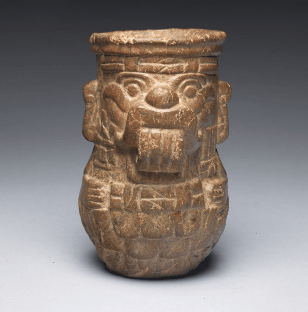
The Storm God’s many recognisable features are seen in commonplace depictions, such as in the Tlaloc jar of Figure 1. These jars appear to be indicative of popular religion in that they were a practical visual reminder of a primary deity, but do not exhibit the ostentation of elite ceramics. The jar features Tlaloc as a simple, plump figure, eyes rimmed by circles, characteristic of his many depictions. A semi-circle with four lines emerges from the mouth, creating the illusion of fangs. These are recognised as some of Tlaloc’s key identifying elements, this vessel exemplifying the fundamental features clearly demarcating him in Teotihuacano art.
Despite its simplicity, the jar carries symbolic meaning: the rim is decorated with parallel lines intersected by perpendicular ones framing a central circular form, which may have represented a headdress out of which the jar’s offering might have sprouted, completing the top of the headdress in a manner emphatic of the owner’s sacrifice held within. Given the preponderance of Storm God iconography in ritual locations, ritualised use of these jar’s seems a fair assumption. Simpler depictions of Tlaloc provide the foundation upon which others expanded, but even they include additional detail to emphasise certain characteristics. Tlaloc is striking in these depictions particularly because of his dissimilarity to the natural world and those venerating him, such abstraction was used to great practical effect.
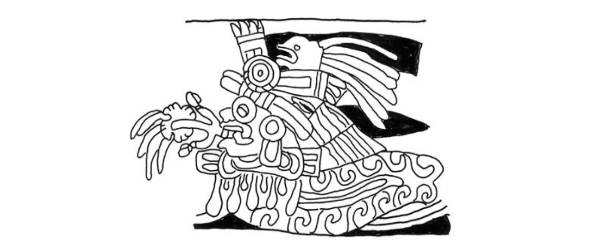
Ceramics, a popular medium and major Teotihuacano export, similarly illustrate the integration of supplementary iconography to connect Tlaloc to other facets of Teotihuacano life. Exemplified by the tripod vessel of Figure 2. Tripods were ritual items, involved in a ceremony dedicated to whichever figure they depicted. Figure 2 represents Tlaloc with an elaborate headdress, featuring the fangs, rings around his eyes, curved lip, and headdress traditionally indicative of him. Its supplementary iconography, however, complexifies Tlaloc’s religious significance. The headdress in Figure 2 features three triangles and four curved icons with forked bottoms. The triangles likely representative of mountains, as Teotihuacan was surrounded by mountains and associated them with divine creation. The reptilian heads on Tlaloc’s sides appear to be serpents, which Kubler identified as indicative of pieces of Mesoamerican liturgy. The vessel’s ritual purpose and religious iconography connected to Tlaloc highlights his role as one of the foremost Teotihuacano deities.
Supplementary symbols in Figure 2 introduce an element of violence to Tlaloc’s ritual significance. The curved shapes with pronged bottoms on Tlaloc’s headdress are strikingly like what Langley identified as a trilobe, which represents a falling liquid, often blood. This demonstrates an emphasis on violence, and in conjunction with religious iconography this can be interpreted as Tlaloc’s calling his people to arms. The Storm God was likely channelled for the protection of combatants or celebration of a warlike cause or lifestyle, indicating the deity’s implicit connection to the defence and the martial lifestyle.
This tripod condenses Tlaloc’s identifiable features into a small space, relying upon his key characteristics to differentiate him, succinctly including additive iconography to support his call for violence. These small, effective symbols which constitute Teotihuacano abstraction thoroughly express concepts like divinely supported violence, especially in mediums like ceramics with limited space. This emerged on a grander scale in Teotihuacan murals, rooting Tlaloc’s approval of violence within the context of his justification of secular authority.
The abstraction in Teotihuacano murals with greater detail provide a better idea of the ideological association between the deities, authority, and militarism. Teotihuacano murals used moulds to create uniform human subjects, but this did not preclude differentiation of human subjects entirely. Clothing denoted social position, and incorporating iconography associated with the deities invoked their individualised protection for secular leaders.
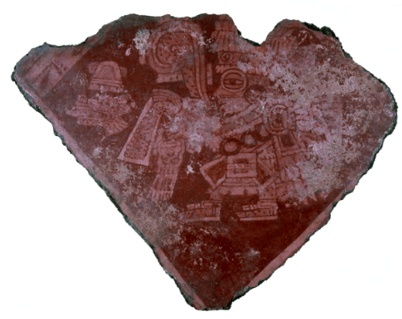
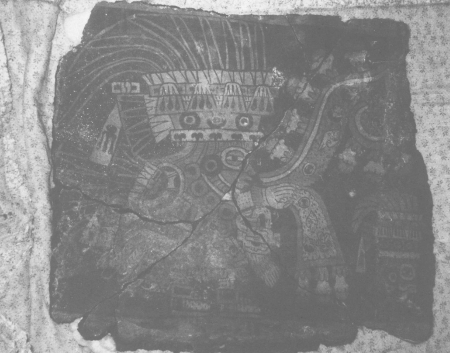
The idea of headdresses demonstrating the religious exigence behind Teotihuacano secular authority becomes evident in Millon’s study of two Teotihuacan wall fragments of a mural, Figures 3 and 4, designed to praise or petition Tlaloc. Millon connects these figures in the same mural from the shared red hue and border of feet, recognising their similar outfitting in cotton armour indicated by dots on their clothing. This armour, she suggests, categorises the figures as soldiers. Furthermore, the tassel glyph and coyote in Figure 3, as well as the jade icons and upper fangs in Figure 4, are recognisably indicative of Tlaloc. It seems likely that these soldiers had his protection as a deity focused on war. Milton’s examination of the mural in Figures 3 and 4 reveals not only a militarism justified and protected by the city’s religious figures, but her attention on the figures’ headdresses introduces a hierarchy to Teotihuacano warfare. The most influential symbol associated with Tlaloc, seen in both the mural and other works throughout the region, was his tassel headdress. Teeotihuacanos, including officeholders and temporal elites, wore headdresses not only in ritual contexts, but to indicate political or military status and to specify association with a deity. The warrior-priests’ or pious lay soldiers’ Storm Deity iconography likely indicated belonging to a regiment dedicated to his service and protection. That both figures called upon Tlaloc in their headdresses underscores his connection to authority, indicating that he may have been used to support, if not justify, secular authority. Highlighting him in an object intended to display status creating a connection between the god and the authority bestowed upon the wearer of his symbols. From symbolic representation on the mural in Figures 3 and 4, Tlaloc was referenced to abstractly to identify high-ranking soldiers whose authority he bestowed and reinforced. Tlaloc’s role within Teotihiacano society was broader than protecting citizens from natural disasters from afar, rather his abstract artistic depiction allowed him to exemplify of a religious culture integrated into Teotihuacano martial life and used to justify secular authority.
Murals of Tlaloc intentionally represented abstract anthropomorphic figures rather than naturalistic ones, drawing greater attention to the religious figures the citizens were shown to be summoning, than the attention drawn to the citizens themselves. Use of abstraction shifts one’s focus from the unremarkable soldiers to their elaborate costumes by way of the outlandishness inherent in the style of abstraction. This, in turn, draws more attention to the Storm God himself, making him easily identifiable and clearly portraying his support for authority in Teotihuacan militaristic and governmental pursuits. The message emerges; Tlaloc was the one to bestow authority on Teotihuacano officials and victory on the town itself. This use of abstraction enabled the viewer to focus more on the ideology Tlaloc represented rather than the figures immediately depicted in the mural.
Abstraction was used at Teotihuacan to formulate a set of symbols and iconography that clearly represents one of their principal deities, the Storm God Tlaloc through corporeal and divine attributes. The depiction of these complex ideologies is achieved with far more concision and recognisability than could have been seen in naturalistic depiction. The different mediums in which Tlaloc was depicted utilize his distinct iconography differently. However, collectively they support the conclusion that he was used as a religious justification for authority and militarism of Teotihuacano officials. Through the Storm God’s example, it becomes evident that the abstraction of Teotihuacano art was far from a technological downfall but rather one of its greatest strengths.
Bibliography
George L. Cowgill, ‘State and Society at Teotihuacan, Mexico,’ Annual Review of Anthropology 26 (1997), 129-161.
Annabeth Headrick, The Teotihuacan Trinity: The Sociopolitical Structure of an Ancient Mesoamerican City (Austin: University of Texas Press, 2007).
George Kubler, ‘The Iconography of the Art of Teotihuacan,’ Studies in Pre-Columbian Art and Archeology, no. 4 (1967), 3-40.
James C. Langley, ‘The Forms and Usage of Notation at Teotihuacan,’ Ancient Mesoamerica 2, no. 2 (1991), 285-298.
Michael Love, “The Archaic and Formative Periods of Mesoamerica,” in The Cambridge World Prehistory, ed. Renfrew, Colin and Bahn, Paul G., (New York: Cambridge University Press, 2014) 955-969.
Clara Millon, ‘Painting, Writing and Polity in Teotihuacan, Mexico,’ American Antiquity 38, no. 3 (1973) 294-314.
Margarita de Orellana, Debra Nagao, Eduardo Matos Moctezuma, Leonardo López Luján, George L. Cowgill, James C. Langley, Yoko Segiura, Gordon Ross and Esther Pasztory, ‘Teotihuacan Ceramics,’ trans. Debra Nagao, Artes de Mexico, no. 88 (2008), 65-80.
Saburo Sugiyama, Human Sacrifice, Militarism, and Rulership: Materialization of State Ideology at the Feathered Serpent Pyramid, Teotihuacan (Cambridge: Cambridge University Press, 2005).
Image Credits
Teotihuacan artist(s), Storm God Vessel, c. 1-150 CE, New York, Metropolitan Museum of Art.
Teotihuacan artist(s), [‘Drawing of a relief design on a tripod vessel representing a goggled rain figure alternating with a frayed-skin face’] n.d. Reproduction drawing found in George Kubler, ‘The Iconography of the Art of Teotihuacan,’ Studies in Pre-Columbian Art and Archaeology, no. 4 (1967), 33.
Teotihuacan artist(s), Fragment of a Mural Depicting a Priest, c. 500-700 CE, Columbia, Museum of Art and Archeology, University of Missouri-Columbia. Found in Clara Millon, ‘Painting, Writing and Polity in Teotihuacan, Mexico,’ American Antiquity 38, no. 3 (1973), 295.
Teotihuacan artist(s), [Lower wall painting depicting the Storm God in elaborate costume, speaking through a speech scroll], c. 500-700 CE, Humlebæk, Louisiana Museum of Modern Art. Found in Clara Millon, ‘Painting, Writing and Polity in Teotihuacan, Mexico,’ American Antiquity 38, no. 3 (1973), 296.

