
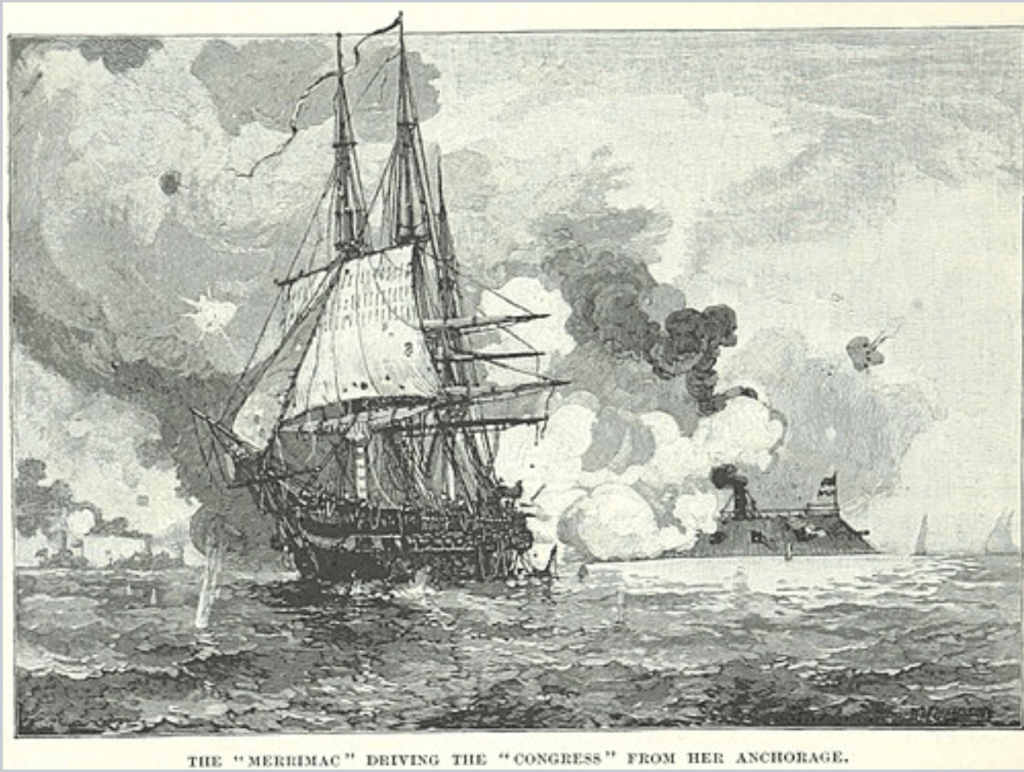
Written by Thomas Fernyak
One of the fiercest battlegrounds during the American Civil War was not the ‘ground’ at all. Seas and rivers played a critical role in the struggles that defined the Civil War. The newly separated Confederate States of America was an extremely agricultural society. Due to the primacy of slave plantations, the main economic activity of the South was the exportation of cash crops like cotton and tobacco. In the decades before the war, the general economic pattern of American cash crops flowed smoothly: generally, crops grown on southern slave plantations were shipped out to the wider world (often Western Europe) by northern shipping fleets to the benefit of both parties. When war broke out, this system was entirely disrupted. The South needed exports for the survival of their economy but lacked a navy or shipping fleet to execute that goal. The North, for their part, had enough diverse economic activity that the loss of revenue from southern exports was damaging, but not critical. Crucially, most shipping vessels were owned by northern sympathizers and stayed in northern ports, and the majority of seagoers (and therefore navy sailors) were northern, leading to most of the navy staying with the Union.
Led by Union General Winfield Scott, the North devised a strategy nicknamed the ‘Anaconda Plan’ to take control of the important waterways and restrict the economic activities of the Confederacy. In theory, the US Navy would impose an all-encompassing blockade on the ports and coastal regions of the southern states, while utilising other elements to cut off Confederate access to the vital Mississippi River. They would then apply pressure over land with the Union Army, eventually strangling the Confederacy’s economy exactly as an anaconda surrounds and strangles its prey. Faced with this threat, the Confederacy was forced to get creative. Smuggling, of course, became a very profitable activity due to the continued European demand for southern crops. Confederate raiding ships such as the famous CSS Shenandoah and CSS Alabama poached on Union trading and shipping across the world from outside the Union blockade. Confederate ingenuity led to the development of the HL Hunley, the first submarine to sink an enemy ship in combat (despite its failure to return safely to port). However, perhaps the most impressive invention of the war at sea was the introduction of the ironclad ship. Both sides developed ironclad ships, with Union efforts spurred on by worrying reports of a new type of ship being created in the port of Norfolk, Virginia. On 9 March 1862, two ironclads, the USS Monitor and the CSS Virginia (previously the USS Merrimack), faced off against one another for the very first time.
The Ironclads
The USS Monitor was the first ironclad built for the US Navy and finished construction earlier in 1862. Designed by the Swedish engineer John Ericsson, the Monitor was a low and heavy ship, 54.6 metres in length. The main feature of the ship was a rotating gun turret that stuck up from the centre of the deck and featured two eleven-inch (two hundred and eighty millimetres) Dahlgren guns in the absence of the intended fifteen-inch guns (three hundred and eighty millimetres). The ship and turret were heavily plated, leading to a very slow and cumbersome ship, though not quite so cumbersome as the Virginia.
The CSS Virginia was built from undamaged portions of the USS Merrimack which had been previously burnt and sunk by retreating US Navy forces in Norfolk. The Confederates raised the ship, gave it a new ironclad identity, and outfitted it as a ramming vessel with four heavy Brooke rifles (6.4 inches/163 millimetres and 7 inches/178 millimetres) as well as six nine-inch (229 millimetres) Dahlgren guns that had been recovered from the Merrimack in gun ports along the side. Though the Confederacy started construction before the Union’s Monitor, the vessel was not fully completed when it sailed into battle in March 1862, so several functions of the ship could not be used. It took nearly forty five minutes for the Virginia to turn in a full circle, a huge detriment in comparison to the Monitor.
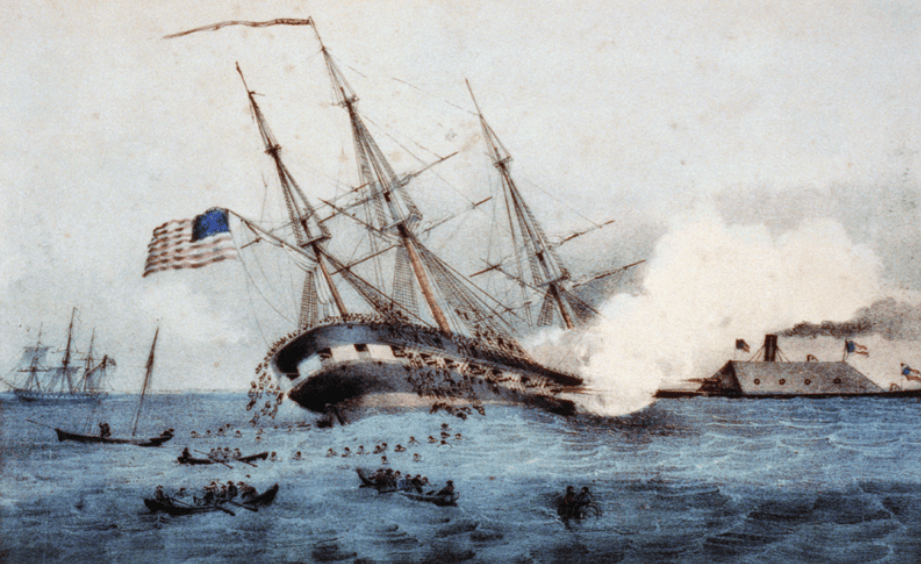
USS Congress being rammed and sunk by the CSS Virginia.
The Battle
On the morning of 8 March, the CSS Virginia steamed out into the Chesapeake Bay to do battle with the waiting wooden ships of the US Navy blockade. The Virginia went into battle with workmen still aboard, making finishing touches on the rebuild of the vessel. Accompanied by several Confederate wooden supporting warships, the Virginia steamed past Union bay batteries to face the main squadron. After getting into close range with the USS Congress and USS Cumberland, who fired shots to no real effect, the Virginia rammed and sank the Cumberland. Turning next to the Congress, which attempted to escape the ram’s threat by placing itself in shallow water, the two ships exchanged volleys. With a severe imbalance in defensive capabilities becoming clear, the Congress surrendered in a heavily damaged state. In retaliation for further Union hostilities amid the surrender, the Virginia fired hot shot into the Congress, leading to a fire which eventually engulfed the ship. The lightly damaged Virginia then moved her attention to the remaining Union ships but was soon thwarted by the end of daylight. She therefore retreated to recover and return in the morning to complete the destruction of the blockade. She had caused upwards of two hundred and fifty casualties and destroyed two ships at the loss of only two of her own crew (and her wounded captain).
The next morning, the CSS Virginia plodded back out to face the remainder of the blockade, singling out the USS Minnesota. However, having raced to Chesapeake overnight in order to protect the blockade fleet, the USS Monitor sat waiting patiently for the return of the Confederate squadron and the ultimate test of ironclad abilities. After taking some time to survey the new situation, the Virginia fired first against the Monitor, and the following battle lasted many hours. Both ironclads proved defensively sound, and neither vessel had the offensive capabilities to inflict lasting damage on the other. Later in the day, after much circling and pivoting, a shot hit the pilot house of the Monitor, spraying hot metal into the captain’s eyes and disabling his eyesight, which forced the ship to break free momentarily while a secondary officer took over his job. The Virginia interpreted this move as a retreat and, claiming victory, pulled back into the harbour of Norfolk. When the Monitor returned to continue the battle, it saw the Virginia returning to harbour, and it too claimed victory. In reality, neither ship had caused enough damage to the other to prove a decisive result, despite the significance of their clash. They did not face each other in direct combat again.
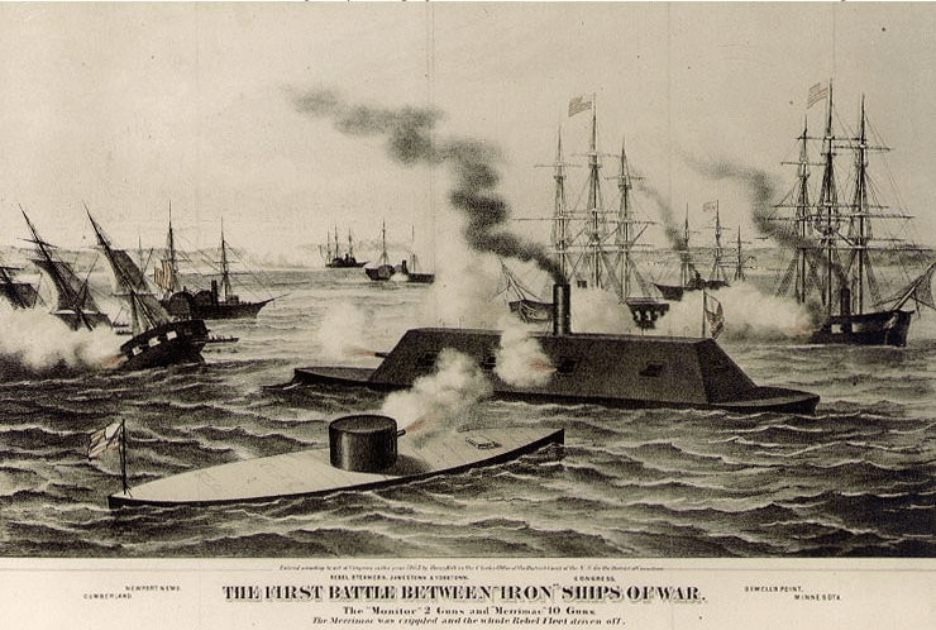
The USS Monitor and CSS Virginia face off with blockade ships in the background.
Why does this stalemate matter?
This first clash of two ironclad ships marked a monumental shift in naval warfare up until the advent of World War I. The success that the CSS Virginia had on 8 March against the wooden ships of the Union blockade did not go unnoticed by the world. France and Great Britain, who had already been keeping watch on the war due to their financial interest in southern cotton, took note of this victory and the way it was achieved. This was the beginning of the end of the Age of Sail. While ironclad ships could destroy wooden ships almost at will, they proved to be an even match against one another. The Union created many more ‘monitor’ class ships, which found usage especially on rivers, due to their low height and weakness towards rough seas (the USS Monitor sank later in 1862 due to its stability issues in the open ocean). France and Britain copied the strengths that these ships demonstrated as they updated their fleets into ironclads. In particular, the ramming feature of the Virginia that caused so much havoc with its wooden opponents was applied for several decades in many iterations of the monitor class design. While much was left to be desired in the functionality and battle effectiveness of ironclad ships (especially while facing one another), it became abundantly clear in the spring of 1862 that wooden ships had begun to pass into obsolescence.
The duel of the USS Monitor and the CSS Virginia had little effect on the outcome of the American Civil War, but it changed the face of naval warfare forever. It proved the effectiveness of the ironclad warship once and for all in the eyes of the Western world. Monitor class ships modelled after those at Hampton Roads set the standard for the total conversion of the world’s navies into the destroyers, cruisers, and heavy warships that shaped future conflicts. No longer would the oceans be ruled by the grand sailing ships of previous centuries. The era of steel and the industrialization of the seas had just taken its first baby steps.
Much of the context for this article and the battle has been provided by the ‘The American Civil War,’ a podcast/audiobook featured on Audible by the Great Courses and Gary Gallagher. Anybody curious to learn more about the history of the American Civil War at large would benefit greatly from this trove of information.
Bibliography
American Battlefield Trust. ‘Battle of Hampton Roads Facts & Summary’. American Battlefield Trust, American Battlefield Trust, 7 March 2019. https://www.battlefields.org/learn/civil-war/battles/hampton-roads.
Fuller, Howard. ‘“The Whole Character of Maritime Life”: British Reactions to the USS Monitor and the American Ironclad Experience’. The Mariner’s Mirror 88, no. 3 (2002): 285–300.
Gallagher, Gary. ‘The American Civil War’. The Great Courses: Modern History. Released 8 July 2013, on Audible.
Gallen, Jim. “Unlike Anything That Ever Floated. The Monitor and Virginia and the Battle of Hampton Roads, March 8-9, 1862.” Northern Mariner / Le Marin Du Nord 32, no. 1 (2022): 81–83.
Holloway, Anna Gibson. Our Little Monitor : The Greatest Invention of the Civil War. La Vergne: Kent State University Press, 2018. ProQuest Ebook Central.
McPherson, James. War on the Waters: The Union and Confederate Navies, 1861-1865. University of North Carolina Press, 2012. http://www.jstor.org/stable/10.5149/9780807837320_mcpherson.
Musicant, Ivan. Divided Waters: The Naval History of the Civil War. HarperCollins, 1995.
Roberts, William. Civil War Ironclads: The U. S. Navy and Industrial Mobilization. Baltimore: Johns Hopkins University Press, 2002. ProQuest Ebook Central.
Worden, John Lorimer, Dana Greene, Samuel, Ashton Ramsay, H. and Winslow Watson, Eugene. The Monitor and the Merrimac: Both Sides of the Story. Scituate, MA: Digital Scanning Inc., 2009.
Image Credits
Bill, Henry. First Battle of Iron Ships of War. 1862. Lithograph, Image available at https://en.wikipedia.org/wiki/Battle_of_Hampton_Roads
Newman, F. The Sinking of the ‘Cumberland’ by the Iron Clad ‘Merrimac’, off Newport News Va. March 8th 1862. In Library of Congress. 1862, Image available at https://en.wikipedia.org/wiki/Battle_of_Hampton_Roads

