
Written by Iona Scott-Elliot
‘But I do talk to him more than I used. I am sure I do. Did you not hear me ask him about the slave trade last night?’
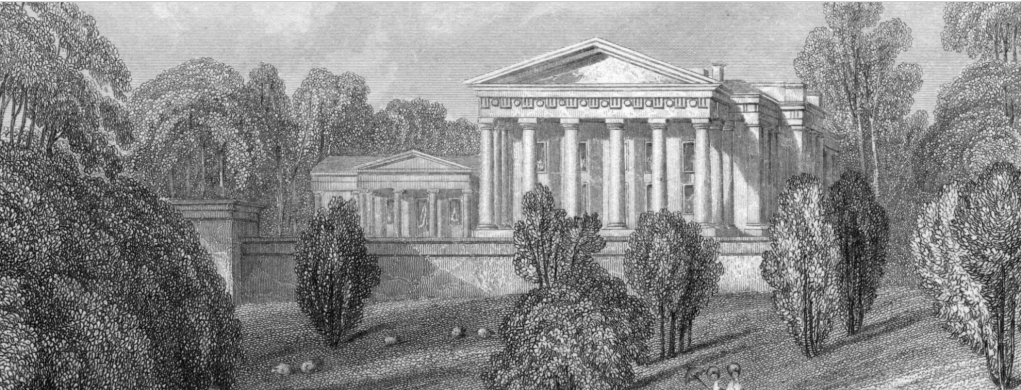
These are the words of the heroine of Jane Austen’s 1814 novel Mansfield Park, Fanny Price, about her uncle, Sir Thomas Bertram, a West Indies plantation owner. In many of the novels of Austen, and her contemporaries, country houses like Mansfield Park are often so central to the story they are almost a character in themselves. The eighteenth and nineteenth centuries saw an increase in the construction of the classic country house that we still flock to see today as the wealth of Empire flooded into the country. But what was the source of this wealth—were these icons of Englishness built on the proceeds of slavery?
There is dispute among scholars over Fanny Price’s words. Much depends on when the book takes place, the exact date of which we do not know, although this is crucial in determining the political context in which Fanny is making this statement. The Abolition Act in Britain was put into force in two stages in March and May 1807. This Act, while abolishing the trade of enslaved people, did not abolish the practice of slavery. Further questions arise from exactly what was the context of the conversation—in what way was Fanny asking her uncle about the slave trade? Sir Thomas’s wealth from his plantation likely could not have been created without slavery, which creates a direct correlation between slavery and the setting of the book itself, the house of Mansfield Park. This grand house, beloved by our heroine, remains maintained by the trade of enslaved people.
The country house has been a popular staple of British culture ever since the days of Austen. Think of the grand, sweeping shots of Downton Abbey, the various iterations of Mr. Darcy’s country seat Pemberley in Pride and Prejudice, or Brideshead Castle, the core component of Evelyn Waugh’s Brideshead Revisited. Not only prevalent in the media, the country house has become a popular tourist destination around the UK, attracting millions of visitors each year. Described by Sathnam Sanghera as “one of our most English institutions”, the country house has almost become a symbol of Britishness. So much so that the post-World War Two widescale demolition of country houses, combined with the decline of the Empire, made many think that the British way of life was being destroyed. Laurajane Smith states in her book, Uses of Heritage, that the monumental, the grand, rare or aesthetically impressive is most often identified as being quintessentially representative of national identity”, which could certainly be used to describe how some Britons feel about country houses. However, not all these cornerstones of British culture have innocent origins.
With the British Empire and the Transatlantic Slave Trade quickly becoming a gold mine, the country house became a way to invest the money gained from these ventures. They were popular amongst plantation owners (fictionalised in characters such as Thomas Bertram, mentioned above) and people who earned their riches through colonial companies like the East India Company. This included the more ‘mundane’ jobs of civil servants, such as those who overlooked the taxes of plantations. One such example is seen in William Blathwayt (1649-1717), a colonial administrator who inherited Dyrham Park in Gloucestershire through his marriage to Mary Wynter, whose family was connected to West Indian plantations. Blathwayt’s wealth was accumulated through the empire and slavery, which he used to make improvements and changes to Dyrham. His wealth (he was earning the modern equivalent of around £800,000 a year) allowed him to afford the upkeep of the estate, where much of his money went. Furthermore, colonial elements are reflected in the artefacts present in the house—including two decorative stands, which depict chained African men, given to him by his uncle Thomas Povey. Initial guidebooks of the house did not address the colonial elements of his work; however, revised editions have been updated to reflect this.
Another example is the Hibbert family, specifically William Hibbert (1759-1844), who bought Hare Hill, Cheshire in 1798 and used the land to build Hare Hill Hall. Hibbert travelled to Jamaica in the 1780s, working as part of his uncle’s slave factorage business. This involved buying enslaved Africans from slave ships and then reselling them to plantation owners. Alongside this, the Hibberts also owned plantations, worked by enslaved people, and were vocally opposed to the abolition movement. When abolition did come into force, William and his son, William Tetlow Hibbert (1792-1881), received compensation from the British government for their ‘loss’ of enslaved people. The family gained £103,000 in compensation, equivalent to around £7 million today.
A National Trust Interim Report published in 2020 found that “29 properties now in the care of the National Trust have links to successful compensation claims for slave-ownership and somewhere in the region of one-third of properties can be directly connected to colonial histories.” And yet despite these connections with slavery and the Empire, the status of the British country house still seems relatively unchanged. This could be seen to reflect a wider forgetting or lack of remembering, willful or not, when it comes to the British Empire and its role in slavery. Since there was an ocean between Britain and the plantations in the West Indies, there is not the obvious connection between slavery and country homes as there is with some stately homes in the United States, such as shown in the grand columns of the post-bellum homes in Gone with the Wind. Laurajane Smith says, “A sense of forgetting acknowledges that there may be some memories or pasts that are not necessarily ‘good’”. This can be seen in the case of the country house—slavery does not ‘fit in’ with the narrative presented by country houses of Britishness and threatens some people’s national pride. These attitudes are also reflected in the responses to the 2020 report by the National Trust—it was described as ‘woke’, with the head of the Trust even receiving death threats.
The same National Trust report emphasised that the Trust was working on academic partnerships with English Heritage and the University of the West of England to research the colonial backgrounds of country houses. Houses that featured strong links to slavery had workshops and awareness-raising events held on their grounds about slavery and the empire. At the end of an article entitled “Addressing our histories of colonialism and historic slavery”, the Trust said: “We still have much more research to do to reveal more about the lives of these people. We must also uncover, and give voice to, the names and stories of many whose experiences have become hidden by histories written by, and for, the voices of privilege and authority.”
Efforts are being made to address the complex histories behind country houses, but in a world where simply stating the facts about people’s histories and how these influenced country houses is deemed overly ‘woke’, how effective will this be on a society which seems unable to accept these facts? Alongside these efforts, maybe a wider societal re-evaluation of how we look at symbols of ‘Britishness’ is needed—not only of country houses, but also historical figures who had connections to empire and slavery.
Readers of Mansfield Park will know of Fanny Price’s love for the house which she is raised in. Within the novel, it pales in comparison to the other grand houses that they visit. However, does reading the novel with the knowledge we have of slavery, plantations and how the profits from this were used to fund the upkeep of country estates, leave one with a slightly bitter feeling towards it? Sir Thomas, whilst seeming intimidating to Fanny at first, is eventually seen to have a kind soul, but the reader is left with questions about the nature of his plantation ownership. The country house not only exhibits a double life with the contrasts between the families who lived in them and the staff who worked in them, but behind its glittering facade hides the questionable ways in which they were purchased and kept up. Mansfield Park may seem oceans away from the plantations of the West Indies, but in reality they are much closer.
Bibliography
Austen, Jane. Mansfield Park. edited by Kathryn Sutherland. Penguin Books, 2014.
Huxtable, Sally-Anne, Fowler, Corinne, Kefalas, Christo, Slocombe, Emma. Interim Report on the Connections between Colonialism and Properties now in the Care of the National Trust, Including Links with Historic Slavery. 2020.
Moody, Jessica and Small, Stephen. “Slavery and Public History at the Big House: Remembering and Forgetting at American Plantation Museums and British Country Houses.” Journal of Global Slavery 4, no.1 (2019): 34-68.
National Trust. “Addressing our histories of colonialism and historic slavery.” Accessed October 23, 2026.
National Trust. “Colonial Connections at Dyrham Park.” Accessed October 23, 2026. https://www.nationaltrust.org.uk/visit/bath-bristol/dyrham-park/colonial-connections-at-dyrham-park
National Trust. “History of Hare Hill.” Accessed October 24, 2026. https://www.nationaltrust.org.uk/visit/cheshire-greater-manchester/hare-hill/the-story-of-hare-hill
Sanghera, Sathnam. Empireland. Penguin Books, 2021.
Sherwood, Harriet. “National Trust boss said she received death threats amid ‘woke’ row.” The Guardian, January 3, 2022. https://www.theguardian.com/uk-news/2022/jan/03/national-trust-boss-says-she-received-death-threats-woke-row.
Smith, Laurajane. Uses of Heritage. Routledge, 2006.
Image Credits
The Grange Festival, ‘Mansfield Park’, image available at https://thegrangefestival.co.uk/productions/mansfield-park/

