
Written by Maria Magdalena
02/11/2026
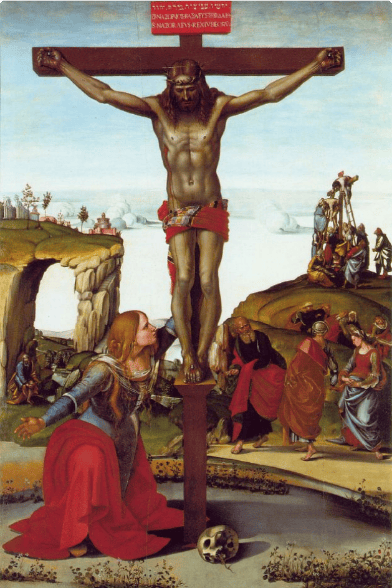
The Catholic Church contains a fundamental contradiction regarding women that has spanned millennia. In religious feminist circles, it is the view that women are venerated by Church leaders and laypeople alike, and yet their positionality to Jesus and Catholic wisdom has been consistently undermined. On an institutional level, women are prohibited from nearly all relevant realms of epistemological power, the primary domain being priesthood.
This prevents women fulfilling the sacrament of Holy Orders in the Roman Catholic Church, thereby haemorrhaging the experience of receiving Christ’s grace through all channels of rite. This begs the question: how does scripture define a woman’s role in the Church and what happens when this intersects with the socio-political contexts of its audience?
The vitality of women in scripture is made obvious through the figure of Mary Magdalene. In the Gospels she acts as a conduit and messenger of Jesus’ resurrection. Mary Magdalene, also referred to as ‘Mary called the Magdalene’ or ‘the Magdalene Mary’, is part of a large group of women from Galilee who follow Jesus (Luke 8:2). The Magdalene is a crucial feature of Jesus’s death, burial and resurrection, culminating in Jesus’ ordering of Mary Magdalene to deliver the news of his rebirth to the twelve male disciples. The Gospel of Matthew is the only gospel which does not explicitly reference Mary Magdalene as the informant of the resurrection, rather stating that a group of women ran to tell the disciples; Mark, Luke and John all mention Mary Magdalene specifically, outlining her specialised role as a messenger of the Lord.
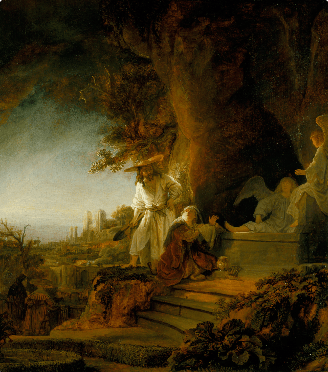
It is important to mention that the Gospel of John portrays the most emotive account of the interaction between the risen Jesus and his devoted apostle, Mary. Upon the discovery of the empty tomb, Mary Magdalene sits near the entrance weeping and when she sees the angels and Jesus for the first time, believes that he is a gardener and comically accuses him of taking the body away. The risen Lord only has to say her name before she finally realises that she is in fact talking to her Messiah and runs to hold him.
11 Now Mary stood outside the tomb crying. As she wept, she bent over to look into the tomb 12 and saw two angels in white, seated where Jesus’ body had been, one at the head and the other at the foot.
13 They asked her, ‘Woman, why are you crying?’
‘They have taken my Lord away,’ she said, ‘and I don’t know where they have put him.’ (John 20: 11-13)
The emotional response to the revelation is demonstrative of the special relationship between Jesus and Mary Magdalene. When Peter and the other disciple see that Jesus’ body has disappeared, they leave and accept the loss, while Mary Magdalene returns to the tomb and sits hopelessly and begs for his return. The contrast of these responses reinforces a close bond between the two characters as she embraces grief and at the same time refusing to believe the objective absence of Jesus’ body. She even suggests that she will find and move the body back to the tomb herself, emphasising the depth of her devotion since she would presumably be defying her pre-existing strength to lug a dead body back to its resting place. This passage solidifies Mary’s status as an apostle of Jesus.
All of this to say what exactly? It certainly is not unusual that women would be the first to re-enter the tomb and subsequently be the first to discover the missing body. Moreover, the
male disciples are shown to have equally united bonds with Jesus, even if some hesitate. What some early church fathers thought unusual is the notion that Mary Magdalene would be the first to have witnessed the revelation of the Lord, given the primacy of the twelve disciples. This is made plain in scripture itself, as Mary Magdalene’s account is met with great suspicion in Luke, with the women’s words being referred to as nonsense (Luke 24: 11).
The Gnostic Gospel of Mary expands this suspicion, as an argument erupts between the men pertaining to the validity of Mary’s claim with Peter going as far as saying, “’Did he really speak with a woman without our knowledge and not openly? Are we to turn about a listen to her? Did he prefer her to us?’” (17.16-22). An insecurity in his position as most loved disciple is called into question, suggesting that Jesus could not possibly speak to a woman before he speaks to a man. There is a clear patriarchal motivation behind these words; Peter assumes the priority of men in receiving secrets truths of Christ and is appalled by the dissolution of this hierarchy of thought. Eventually, the disciple Levi defends Mary Magdalene and reinforces the authority of women and the special companionship Mary Magdalene has with Jesus, but it is important to remember that the Gnostic Gospel of Mary is non-canonical. Remaining in the canon is scepticism and a gradual reduction in the role of women in the church.
The foundation to this reduction is the relationship between Peter and the origins for the church. In establishing apostleship and the line of succession of who is able to preach the good news, women are absent. The authority of Peter as the first priest of the Catholic church did not fit with the scriptural account of Mary Magdalene as the first witness of the resurrection, so much in fact, that Paul completely omits her (and all other women) in the list of people who Christ visits, thereby removing women wholly from apostolic succession:
The tradition I handed on to you in the first place, a tradition which I had myself received, was that Christ […] appeared to Cephas; and later to the Twelve; and next he appeared to more than five hundred of the brothers at the same time… then to all the apostles. (I Corinthians 15: 3-8)
Ambrose in the fourth century reinforces this, blaming a naturalised weakness of women making them incapable of spreading the word of God:
But as she has too little consistence to preach, as her sex is too weak to perform, it is to men that the function of evangelizing is handed over.
A Catholic priest can therefore can only be a male direct successor of St. Peter for he was given the ultimate authority to instate the Catholic Church. His ordinance left him in conflict with Mary Magdalene and early church fathers entrenched this through the omittance of the Magdalene as the first to have been presented with the resurrected Christ by virtue of her womanhood. Adriana Valerio argues that the cultural environment of these church fathers differs greatly from Galilee, recognising her apostleship with Christ, but unable to recognise it on a juridic level. Though we also can observe that suspicion of women is likewise present in scripture as faith is not separated from patriarchal conceptions, thus isolating women.
You will have noticed that nowhere in this article it is mentioned that Mary Magdalene is a prostitute, a harlot, a daemon or anything of the sort. That is for the simple fact that this is not mentioned in scripture. This image only begins to appear after Gregory the Great (540-604) merges an anonymous prostitute who anoints Jesus with expensive perfume and another who wets Jesus’ feet with her tears, with the character of Mary Magdalene. This conflation has further alienated women from the patriarchal hierarchy of the Roman Catholic Church and naturalised the idea that women are unfit to preach due to their moral sins. For a prostitute could never be suitable for the sacrality of the Word, though ‘lesser’ sinners (such as St. Paul who betrayed Jesus three times) are far more suitable. Here begins what Valerio aptly calls “the great deception.”
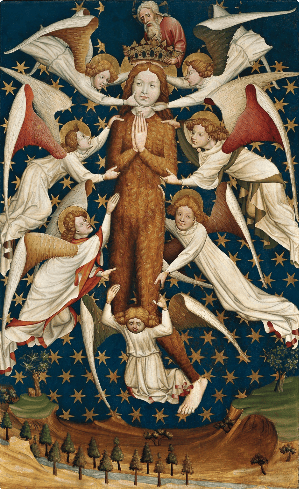
No matter what scripture says, interpretation will always take precedence in the dissection of women in the light of the Lord. The Catholic Church has historically held intense symbolic capital regarding discourses on gender, where their scripture is both a source of religious knowledge and a reinforcing power. As certain aspects become morphed and interpreted in a certain way to fit a particular social context, women become an aesthetic tool of observing faith, but nothing more. I do want to end this article on a more positive note, as the legacy of Mary Magdalene as a rightful apostle of Jesus Christ is kept alive through the ‘Roman Catholic Women Priests’ (RCWP), a worldwide movement that works to reshape the Church from within through a ‘spiritual uprising’. Though excommunicated, the ordination of the ‘Danube Seven’ in 2002 demonstrates a vital resistance to canon that undermines the power of women. Scripture is a powerful tool in the West, but nothing is as powerful as the people we let dictate the understanding of it.
Bibliography
Bible Gateway. New International Version UK (NIVUK). 2011. https://www.biblegateway.com/versions/New-International-Version-UK-NIVUK-Bible/ .
Bible Gateway. New King James Version (NKJV). 1982. https://www.biblegateway.com/versions/New-King-James-Version-NKJV-Bible/ .
Bieringer, R. “Mary Magdalene in the Gospel of John.” In The Oxford Handbook of Mary Magdalene, edited by D. Apostolos-Cappadona, 135–151. Oxford, 2024/5.
The Gnostic Gospels. “Gospel of Mary.” Accessed 26 October, ,2026. https://thegnosticgospels.org/gospels/gospel-of-mary/ .
Roman Catholic Womenpriests. Accessed 26 October, 2026. https://www.romancatholicwomenpriests.org/ .
Valerio, A. Mary Magdalene: Women, the Church and the Great Deception. Italy, 2021.
Image Credits
Wikimedia Commons, image available at: https://commons.wikimedia.org/w/index.php?curid=3137149 .
Wikimedia Commons, image available at: https://commons.wikimedia.org/w/index.php?curid=21977430
Belvedere Museum, https://www.belvedere.at/
Wikimedia Commons, image available at: https://commons.wikimedia.org/w/index.php?curid=12114517 .

