
Written by Olivia Porta
02/11/2026
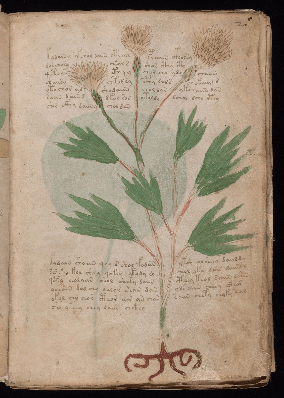
In 1912, an antiquarian bookseller by the name of Wilfrid Voynich purchased a codex written in an unfamiliar language from the Nobile Collegio Mondragone in Frascati. The codex features striking illuminations on nearly every page, ranging from large plants and celestial diagrams to women bathing in pools. This text has been a topic of interest in both academic and public spheres for decades. Despite generations of recorded attempts to translate and decode the script commonly referred to as ‘Voynichese’, there is no clear academic consensus on the decipherment of the Voynich manuscript. However, that has not stopped anyone from trying.
Based on carbon-14 analysis, the vellum has been dated between 1404 and 1438. A historical timeline of the codex can be pieced together thanks to a letter written by Joannus Marcus Marci found tucked between its pages. Marci, the official physician of Emperor Rudolph II of Bohemia, possessed the manuscript between 1665 and 1666. He then gifted it to Athanasius Kircher around the same time. As described by M. E. D’Imperio in his book The Voynich Manuscript: An Elegant Enigma, Marci’s letter states that the manuscript was sold to Rudolph II for 600 ducats. The use of infrared light revealed a partial signature written on the first page that reads ‘Jacobj à Tepenese’. The owner of that signature was identified to be Jacobus Horcicky de Tepenecz, the director of Rudolph II’s botanical gardens. Because he did not receive the title ‘de Tepenecz’ until 1608, it can be presumed that he possessed the codex at some point between 1608 and his death in 1622.
The manuscript does not enter the historical record again until its purchase by Voynich, who retained it until his death in 1930. The codex was willed to Voynich’s wife, who in turn bequeathed it to Anne Nill, their assistant and friend. Nill sold the book to Hans P. Kraus in 1961, who, after failing to sell it himself, then donated it to the Beinecke Library of Yale University, where it remains today. The entirety of the work has been scanned and uploaded onto the library collections page.
A recent surge in the popularity of the Voynich manuscript online has triggered numerous amateur theories to be brought forth, many of which being spiritual in nature. On 25 September, TikTok user @raisingthevibration posted a video with the caption, “Maybe the Voynich Manuscript is nothing more than a strange medieval medical text… or maybe it’s got the secrets of the universe woven in its pages. Maybe it’s a coded book for those who have a higher vibration.” In the comments of a video posted by @thenotfrenchgirl wherein she creates her own copy of the Voynich manuscript, user @letsmoveanddance commented, “You were one of the original authors!✨ You HAD to be!! The desire and execution to complete this work HAD to be driven through Divine Right!!”.
Other users have taken a less abstract position. In the caption of a video posted on the 22nd of September by @echooftheeighth, they state that “these women may be bathing in water charged beneath the moon. Their menstrual blood enters the water, which nourishes the unusual plants depicted throughout the manuscript.” One user even suggested that the Voynich manuscript has never been deciphered because only men have been the ones to attempt it. Beyond this statement being an obvious case of the Dunning-Kruger effect, it also relies on the bio essentialist position that women are the only ones who have access to intuition and are more connected to the non-corporeal. Confining the ability to comprehend material to one gender only serves to further assist sexist ideologies in permeating the psyche of the general populace.
Though there is no academic consensus on the decipherment of the codex, and the topic of a mysterious medieval manuscript is certainly seductive, that does not mean every theory holds the same weight. Just as it would be difficult to review all theories circulating in online spaces, it would present a similar challenge to address all known decipherment attempts made in academic spaces. Voynichese appears to display consistent grammatical patterns and possesses ‘linguistically identifiable roots, prefixes, and suffixes’ (Davis 2020). Therefore, the popular academic position is that Voynichese is a natural language, meaning that it is not gibberish or invented. The earliest decipherment attempt of note was done by William R. Newbold of the University of Pennsylvania in 1928. Newbold, like Voynich, suspected that the manuscript had been produced by Roger Bacon and based his cipher on ancient Greek shorthand. His decipherment steps included transliteration, syllabification, commutation, translation, reversion, and recomposition. While his theory was received well initially, a wave of reasonable criticisms inevitably washed it away from the academic sphere.
Professor Leonell C. Strong, a cancer researcher at Yale, put forth a theory based on medieval English in 1945 and again in 1947. He believed the Voynich manuscript was a text on women’s health that included herbal remedies for a multitude of ailments, including a contraceptive. His method was never made public, and his theory was rejected immediately. Thirty years later, another Yale professor attempted to decipher the text, this time relying predominantly on Latin. Robert S. Brumbaugh claimed that the manuscript had been a forgery made to extract a large sum from Rudolph II, and that the name of Roger Bacon was present within the manuscript. This theory did not receive as harsh a reaction, though it was not embraced as a solution, either. Another theory of note produced within academia comes from Professor Greg Kondrak, though more for its controversial nature than its plausibility. Together with his graduate student at the University of Alberta, Kondrak fed the Voynich manuscript into an A.I. database, which concluded for him that the text was likely written in Hebrew. Kondrak then used Google Translate to identify words. This was received poorly by medieval scholars and the public.
One may interpret the lack of a solution from the realm of academia as a credit towards the spiritual approach commonly found online. Even so, the presence of methodology, however perceivably bizarre, presents a replicability factor that the stereotypical online perspective lacks. However, working outside of academia does not imply incompetence. For instance, independent researchers Doireann Herold and Caira Andrade are currently working on creating a translation of the codex which could potentially provide evidence for the Italo-Celtic theory. Herold takes a logical linguistic approach to the text while Andrade researches its historical provenance. Both Herold and Andrade post regular updates on their findings on Substack. A lack of university resources does not equate to a lack of brain power.
It is unclear at this time if there will ever be a decipherment of the Voynich manuscript that is embraced by all. However, this, in and of itself, is not a tragedy. The Voynich manuscript has been the catalyst for necessary, albeit, frustrating at times, discourse on language and cryptography. As the pandemonium grows, so does the knowledge base.
Bibliography
Andrade, Caira. “Caira Andrade.” Substack. Accessed 20 October 2026. https://cairandrade.substack.com/.
Daley, Jason. “Artificial Intelligence Takes a Crack at Decoding the Mysterious Voynich Manuscript.” Smithsonian.com, January 31, 2018. https://www.smithsonianmag.com/smart-news/artificial-intelligence-takes-crack-mysterious-voynich-manuscript-180967983/.
Davis, Lisa Fagin. , “How Many Glyphs and How Many Scribes? Digital Paleography and the Voynich Manuscript,” Manuscript Studies 5, no. 1 (2020): 164-180. https://www.proquest.com/scholarly-journals/how-many-glyphs-scribes-digital-paleography/docview/2443869756/se-2.
D’Imperio, M. E. The Voynich Manuscript : An Elegant Enigma. Fort George E. Mead, Md: National Security Agency/Central Security Service, 1978.
Herold, Doireann. “Blesst_butt.” Substack. Accessed 19 October 2026. https://substack.com/@blesstbutt.
Schinner, Andreas. “The Voynich Manuscript: Evidence of the Hoax Hypothesis.” Cryptologia 31 (2007): 95–107. doi:10.1080/01611190601133539.
Yale Library. “The Beinecke Cipher (Voynich) Manuscript.” Yale Library. Accessed 25 October 2026. https://beinecke.library.yale.edu/beinecke/collections/beinecke-cipher-voynich-manuscript.
@echooftheeighth. TikTok. Accessed 17 October 2026. https://www.tiktok.com/@echooftheeighth/video/7688465519611071774?_r=1&_t=ZG-9Aqs4luZPsX.
@raisingthevibration. TikTok. Accessed 17 October 2026. https://www.tiktok.com/@raisingthevibration/photo/7689331763704876302?_r=1&_t=ZG-9AqrecM9Ejh&image_index=2.
@thenotfrenchgirl. TikTok. Accessed 17 October 2026. https://www.tiktok.com/@thenotfrenchgirl/video/7661734794811739422?_r=1&_t=ZG-9AqrxOUpLPt.
Image Credit
The Voynich Manuscript. Ca. 1404–1438. Beinecke MS 408. Beinecke Rare Book and Manuscript Library, Yale University, New Haven, CT. Yale University Library Digital Collections.

