
Written by Maria Eduarda Encinas Anganuzzi
The growing knowledge of medical science in eighteenth-century Britain, particularly in human anatomy, gave the medical profession a new degree of social prestige. This status resulted in a considerable increase in the number of medical students. In turn, this growth created a greater demand for the supplies necessary to conduct medical training, especially for the dissection of human bodies. The number of legally available bodies failed to meet the demands of universities across the United Kingdom, resulting in increased petitioning to Parliament for access to more cadavers.
In response to this growing demand, Britain passed the Murder Act of 1752, which stipulated that the bodies of executed murderers would not be buried, but instead subjected to public dissection. Even this measure, however, proved insufficient to meet the growing demand of medical schools. As a result, many students and professors resorted to purchasing corpses from body snatchers. Resurrectionists, as they were sometimes called, exhumed recently buried bodies and sold them to medical institutions and individuals for dissection.
Under British law at the time, corpses were not considered property. As a result, people could exhume bodies for sale without fear of prosecution for theft. The price of a body could range from 2 to 14 guineas, a sum equivalent to several months’ wages for a labourer, or sometimes even more. As body snatching became increasingly common in cities such as Edinburgh, one of Europe’s leading centres for anatomical study, people began taking precautions to protect the remains of their family members and loved ones. In Scotland, for example, some graves were protected by iron cages known as mortsafes, which made it more difficult for body snatchers to remove the remains.
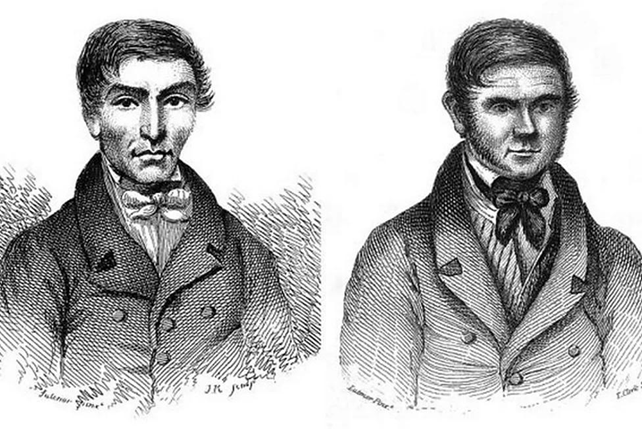
This was the scenario in which Edinburgh found itself when William Burke and William Hare met in the early 19th century. The two Irishmen became friends while living in a boarding house run by Hare in the West Port area of the city. The pair would later become notorious for the murder of 16 people over a period of just 10 months.
It all began when one of Hare’s lodgers, an elderly man known as Old Donald, died of natural causes while still owing Hare rent. The men decided to sell his body to the anatomist and ethnologist Robert Knox, who ran a private medical school at Surgeon’s Square. They made a considerable sum of money from the transaction.
A couple of months later, a female lodger became ill with a fever, causing Hare to worry that people would avoid staying at his boarding house for fear of contracting the illness. With Burke’s help, he murdered the woman and sold her body to Knox. Realising how much money they could make from selling bodies, the two men continued their murder spree over the following months, mostly targeting Hare’s lodgers. The murders were carried out through suffocation, with Hare choking the victims while Burke sat on their stomachs to prevent them from resisting.
The two men were finally caught after the body of their last victim, Margaret Docherty, was discovered by other lodgers. After hearing sounds of a struggle in the middle of the night, and noticing the sudden disappearance of their fellow lodgers, Ann and James Gray, a couple who were also staying at Hare’s boarding house, went to investigate. They discovered Docherty’s body poorly concealed beneath a straw mattress. The police were called, and on 2 November 1828, William Hare and William Burke were finally arrested.
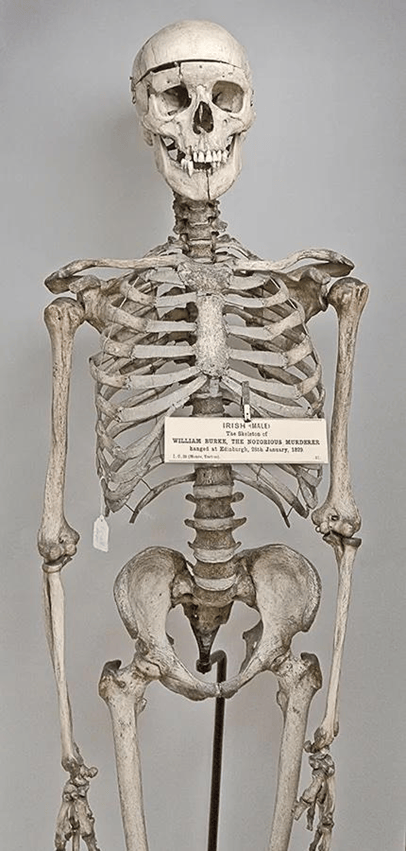
This is where their paths diverged significantly. Hare was offered a deal: he would be granted immunity in exchange for testifying against his accomplice. With Hare’s help, the evidence against Burke was overwhelming. Burke was eventually found guilty and sentenced to be publicly hanged at Edinburgh’s Lawnmarket. His execution took place before a crowd of more than 20,000 spectators. Afterwards, his body was publicly dissected at the University of Edinburgh Medical School, and his skeleton was preserved. It remains on display today at the University of Edinburgh’s Anatomical Museum.
Dr Knox, who purchased the victims’ bodies, was never tried. He claimed that he had no knowledge of where the bodies came from, insisting that he had never dealt with Burke and Hare personally and conducted business with them through his assistants instead. Nevertheless, although he faced no legal repercussions, his reputation was irreparably damaged. He later moved to London, but even in a new city, he was unable to regain his former social standing. Hare’s fate, meanwhile, remains a mystery to this day.
Bibliography
Encyclopaedia Britannica. “William Burke and William Hare.” Encyclopaedia Britannica. https://www.britannica.com/biography/William-Burke-and-William-Hare.
National Library of Scotland. “From Crime to Collection: Burke and Hare at the Library.” https://www.nls.uk/collections/stories/scottish-history/burke-and-hare-at-the-library/.
University of Edinburgh, College of Medicine and Veterinary Medicine. “Burke and Hare.” September 9, 2024. https://medicine-vet-medicine.ed.ac.uk/about/history/burke-and-hare.
Escape the Past. “Who Were Burke & Hare? Edinburgh’s Infamous ‘Body Snatchers.’” August 2025. https://www.escapethepast.co.uk/post/burke-hare-edinburgh-body-snatchers.
BBC Bitesize. “Anatomy and crime – Burke and Hare: The body snatchers.” https://www.bbc.co.uk/bitesize/articles/zvrsydm#zx7ybqt.
Burrows, Rebecca. “The Anatomy Act of 1832: The Story of Bodysnatching, Dissections, and the Rise of Anatomy.” TENOR, vol. 9, no. 1, 2019. https://scholarworks.harding.edu/tenor/vol9/iss1/8/.
Escape the Past. “A History of Grave Robbing in Edinburgh.” https://www.escapethepast.co.uk/post/a-history-of-grave-robbing-in-edinburgh.
Scott-Wilson, Sion. “Resurrection Men: The Scourge of the Body Snatchers.” Sky HISTORY. https://www.history.co.uk/articles/resurrection-men-and-body-snatchers.

