
Written by Aimee Owen
The Age of Enlightenment was one of the most impactful movements in the history of philosophy. The new American government was basing its constitution on its social principles of individual liberty and natural rights, and French Revolutionaries were demonstrating unrestrained hostility towards organised religion and instead triumphing over the supremacy of human reason. Alongside this, scientific reasoning was encouraging widespread fascination with natural sciences and the pursuit of knowledge, and the Enlightenment initiated a cultural movement which would inform modern ideas of government, law, economics, politics, religion and society. Whilst the Enlightenment’s legacy as one of the most influential philosophical episodes is exalted in history, the extent of its impact is questionable given the apparent hypocrisies of the societies it is claimed to have enlightened; the practice of slavery continued well into the nineteenth-century, socioeconomic inequality remained firmly entrenched and little had been done for sociopolitical reform according to Enlightenment ideals. The application of Enlightenment theory seemed to fall short when held against its own aspiration of social, political, intellectual, and cultural progress, raising the question of whether the Enlightenment really was enlightening to the eighteenth-century after all.
The core principles of Enlightenment philosophy were heavily expounded on by the preceding Scientific Revolution of sixteenth and seventeenth-century Europe. Both were primarily characterised by scepticism and empiricism, championing a rational understanding of the world. The Enlightenment took this rationality and empiricism further by sharing the focus on natural science alongside philosophy with its influence further reaching politics, economics, science, law and religion. Immanuel Kant, one of the leading figures of the Enlightenment, defined the period as “man’s emergence from his self-imposed immaturity,” further underscoring how the Enlightenment’s apparent aspiration was to liberate humanity from a previous state of intellectual ignorance to guide them towards a brighter one of understanding and insight. This was true in its principles of liberalism, socialism, individual liberty, rule of law, reason and freedom of religion, which aimed to radically reform politics and law in the name of human progress. Other core doctrine of the Enlightenment which hinted to its ultimate aims of intellectual, cultural and social liberation and advancement included atheism, deism, religious tolerance, separation of church and state, empiricism, rationalism, scepticism, utilitarianism, consequentialism, feminism, cultural relativism and the abolition of slavery. However, putting these theories to practice was easier said than done.
The Enlightenment was certainly impactful at least in the political sense; the American and French Revolutions were firmly grounded in the Enlightenment political philosophy of human liberty, natural rights and liberalism, with their new governments situating their constitution and legitimacy within this politically progressive context. However, society and politics remained relatively conservative while Enlightenment philosophers and their audiences made up a minority in the eighteenth-century social and political scenes. Even in France, with the Revolution’s abolition of the nobility and ancien regime and the United States’ exaltation of equality for all, contemporary society continued under the same rigid social hierarchy and organisation which they claimed to have liberated themselves from. The centralising of governments and the emergence of Enlightened Absolutism within monarchies further stunted political progress at a local and regional level as the tradition of power being concentrated in the hands of a ruling class continued. This prevented the masses of the European population to remain unfazed by the revelations introduced by the Enlightenment who, instead, continued to cherish traditional pillars of power and social structuring such as the church and the hierarchal social system that contained a distinct ruling elite.
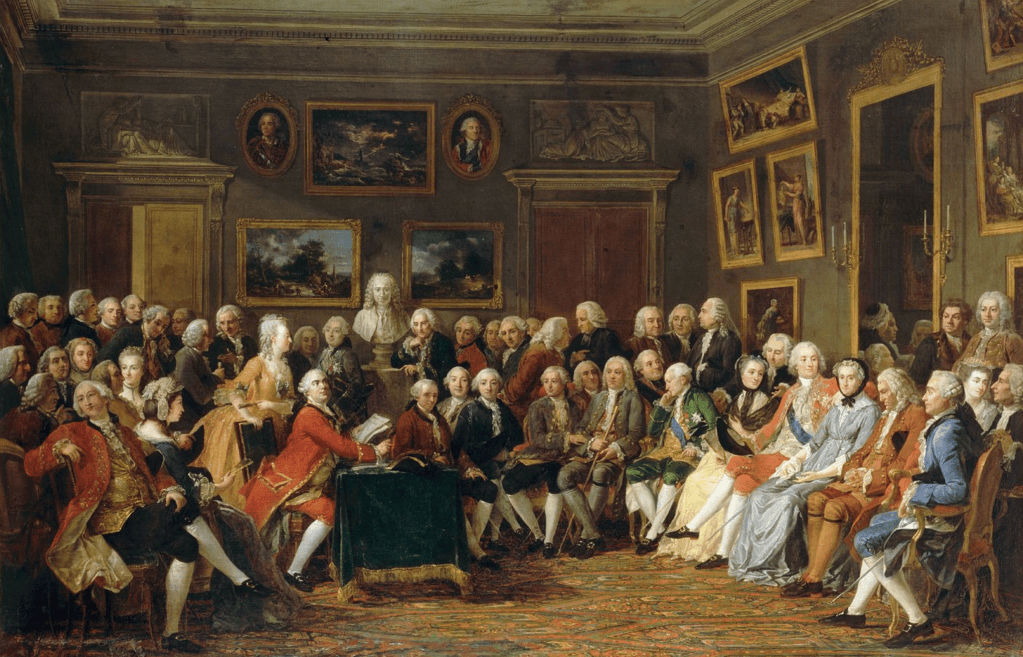
Lecture de la tragédie de L’Orphelin de la Chine de Voltaire dans le salon de Madame Geoffrin (Anicet Charles Gabriel Lemonnier, 1812)
However, whilst the American and French Revolutions attest to the Enlightenment’s legacy as a revolutionary movement in and of itself, the method pursued by the Enlightenment to manifest its ideals says otherwise. Indeed, most of the key figures and developers of Enlightenment thought enjoyed their proximity to the traditional pillars of power. Many of them had heritage within aristocratic circles, but they all had to appreciate the patronage provided by nobles and royal courts as they consisted of the Enlightenment’s main consumers, thus making such philosophers just as conservative as their audience with much of Enlightenment critique towards social and political structures being rooted in the arguments of reform rather than revolution. Reform allowed these structures to resist any serious withdrawal of privilege, working more towards a meritocracy rather than a heredity.
Developments in Enlightenment ideas towards science and history also did more harm than good when impacting social and political ideas. For example, attitudes towards slavery and ideas of race were not always rooted in the progressive and liberal tendency of Enlightenment thinking. A teleological interpretation of Enlightenment thinking may support how it has come to be understood as a movement made of progressive ideals, with each decade and philosopher conjuring more liberal ways of thinking than the last. However, the issue of slavery and the debate over its abolition proves how not all Enlightenment philosophers had a unified outlook on the matter. Public concern over slavery did not emerge until at least the 1750s, well into the Enlightenment period, and it was only in the 1770s that organised action against slavery began with the formation of pressure groups across Western Europe and the United States. Nevertheless, these nations continued in this manner of treating concerns over slavery as a fringe and secondary social episode; the French Revolution, supposedly guided on the Enlightenment principles of liberty and justice, did legally abolish slavery in 1794 but soon reversed this to appease plantation owners. Similarly, in Britain, abolitionists failed to pass a bill through Parliament banning the slave trade and whilst this would eventually succeed in 1807, slavery continued in the Caribbean colonies until 1834. In arguably the most famous example of the Enlightenment failing to practice what it preached, the United States, also basing its revolution and government on the Enlightenment principles of liberty, justice and equality for all, did not abolish slavery until 1865, which was necessitated by a civil war. Such resistance to the abolition of slavery shows how Enlightenment philosophy had failed to enact serious reform to sociopolitical thinking and its standards.
The Age of Enlightenment, therefore, seems to have been one of the most paradoxical movements in the history of philosophy. The many grandiose writings and developments in moral, ethical, economic, legal, and political thinking from its philosophers ultimately fell flat in their aspirations of trying to liberate humanity from its “self-imposed immaturity.” Indeed, this ultimate goal was nothing more than another one of the Enlightenment’s ideals; when faced against its contemporary situation, its optimism was too impractical to ever manifest itself as it had hoped to do. Throughout the Enlightenment’s course, conservatism within society and politics inevitably rendered the movement a minority within social culture and would also disrupt progress from within the movement itself. Political and economic imperatives took precedent over the moral and ethical concerns of the Enlightenment as illustrated with the issue of slavery, centralisation of government and the maintenance of a ruling class who alone could exercise executive and judicial power within a social hierarchy. Given its contemporary challenges, it is easy to consider how the Enlightenment failed in its aims of applying itself to social and political progress, however the hypocrisies it demonstrated in its application and philosophical maturity also implies its firm commitment to conservatism and traditional social and political structures.
Bibliography:
Curran, Andrew. The Anatomy of Blackness: Science and Slavery in an Age of Enlightenment. Johns Hopkins University Press, 2011.
Kant, Immanuel, and Wood, Allen. “An Answer to the Question: What Is Enlightenment? (1784).” In Practical Philosophy: The Cambridge Edition of the Works of Immanuel Kant, edited by Mary J. Gregor. Cambridge University Press, 1996.
Love, Ronald. The Enlightenment. Bloomsbury Publishing USA, 2008.
Outram, Dorinda. The Enlightenment: New Approaches to European History. Cambridge University Press, 2019.
Stinchcombe, Arthur. Sugar Island Slavery in the Age of Enlightenment : The Political Economy of the Caribbean World. Princeton University Press, 1995.

