
Written by Emma Hixson
26/10/2026
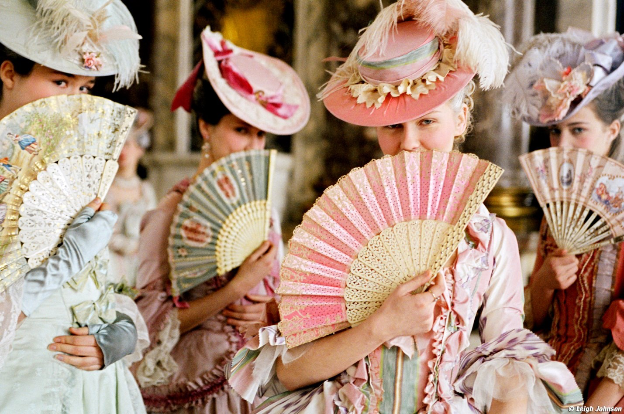
In the annals of online discourse, 2026 will be remembered as the year everyone with an X account decided to become a costume historian. Since the first set images of Christopher Nolan’s The Odyssey were released in early 2025, the film has become a battleground on which people voiced their opinions on the importance of historical accuracy in visual media. In honor of the twentieth anniversary of Sofia Coppola’s critical-blunder-turned-beloved-cult-classic Marie Antoinette, a film known for its playful anachronisms, I wish to throw my hat in the ring of this never-ending debate in defense of the creatives who take such liberties in their work to better serve the stories they tell.
Filmmaking is, first and foremost, a visual medium: as an art form, it relies on images to communicate information and meaning to the viewer. One of the primary tools of this kind of visual storytelling is costume design. What a character wears should tell the audience exactly who they are, or who they’re pretending to be, without the actor having to open their mouth. This goal does not change when a designer is tasked with creating costumes for a period film. If a character appears to be rejecting the fashion trends and customs of their time, this can tell us they are independent and rebellious, unconcerned with the opinions of others, or that they are aloof or even outdated. Costumes also aid in the creation of a film’s tone. Greta Gerwig’s Little Women (2019), featuring costumes by Oscar winner Jacqueline Durran, indicates a tonal shift through the cozy, wintry plaids and youthful pastels of the nostalgic childhood sequences to the deep plums, greys, and muted blues the characters don in their bleaker realities as adults. Another important task of the costume designer is to ground the audience in a particular setting. The tricky part is balancing all of these duties in a way that supports the narrative. Unfortunately for costume historians, this often means sacrificing a certain degree of historical accuracy.
This year saw a fair number of films undergo trial for their crimes against period costuming. For Emerald Fennell’s controversial adaptation of Wuthering Heights, costume designer Jacqueline Durran utilized synthetic materials like rainbow cellophane and bright red “latex” in silhouettes ranging from the sixteenth to the twentieth centuries. Paired with equally fantastical production design, the film’s wardrobe explores ideas of artificiality, excess, and melodrama more successfully than the script itself; in this case, critics had bigger fish to fry than a few plastic dresses.
The newest rendition of Jane Austen’s Sense & Sensibility hit theaters this fall, drawing its own share of criticism for the wild, unkempt hairstyles of protagonists Elinor and Marianne Dashwood. The adaptation follows in the footsteps of the 2005 Pride & Prejudice in its naturalistic approach to costuming, but goes even further, incorporating natural dyes, pared-back silhouettes, shared clothing items between characters, and signs of wear like muddy dress hems and berry stains. These elements also illustrate the destitution of the Dashwood women, especially when contrasted with wealthier family members and friends. The hairstyling takes this same approach: the Dashwood sisters, especially when at home, have messy, lived-in hairstyles, often left completely undone. Critics called out the lack of the proper updos and tight ringlet curls expected of the period. However, instead of the Regency setting so often chosen for Austen adaptations, director Georgia Oakley chose to set hers in the late 1790s, when the novel was likely written. Portraiture and fashion plates from the time actually depict young women with loose hair quite frequently, as Western Europe moved away from the artifice and structure of the Rococo period into the naturalism of the Romantic. Such criticisms pale in comparison, however, to the volume leveled at one of the most successful films of the year, Christopher Nolan’s adaptation of The Odyssey.
Leading up to the release of The Odyssey in theaters, it seemed like any search related to the film on any social media platform would uncover take after take about how Christopher Nolan was spitting in the faces of classicists everywhere because Matt Damon’s helmet was decorated with a horsehair plume (belonging to the Archaic period the poem comes from, which in fact appears in the text) instead of boar tusks (belonging to the Bronze Age Mycenaeans the poem depicts). When critiquing the film, the classicist Emily Wilson, whose bestselling translation of The Odyssey was cited by Nolan himself as the primary reference for his screenplay, pointed out that though the film was a visual “mishmash” of historical periods, so too was Homer’s poem an amalgamation of “bits and pieces from different eras, dialects and traditions.” I do not find it totally fair to hold a Hollywood production made over two thousand five hundred years later to a higher standard than the work it is based on.
So, if the costumes, designed by Ellen Mirojnick, are not 100% accurate, are they still good costumes? Do they contribute to the story the filmmaker wants to tell ? The answer is subjective, but I believe they are successful (with a few caveats). Perhaps the most chatter-inducing piece in the film was the black-and-gold armor worn by Agamemnon, leader of the Greek forces. The costume largely obscures actor Benny Safdie’s face and exaggerates his physical stature, making him a foreboding presence onscreen, especially when he is revealed to be standing right outside the gates of Troy during the Greeks’ nighttime siege. Furthermore, the Laestrygonians’ full-body steel plate armor, seen in much of the visual marketing, was intentionally designed to give the giants an otherworldly quality. It certainly succeeded in making me feel like I was watching a different movie; in motion, the smooth, dull armor took on a low-budget sci-fi quality that felt a bit too out of place from the established material world.
The opening title card tells the audience they are about to enter “a time of apparent magic.” The gods are primarily seen the way the ancient Greeks would have seen them, as Zendaya’s Athena poignantly explains, in ‘thunder,’ ‘fire,’ ‘a child’s smile,’ and ‘a good harvest.’ Tom Holland’s Telemachus spends the film looking for Athena in the eyes of strangers, a nod to the goddess’ frequent shapeshifting in the poem. The only deities who appear onscreen are Athena, Calypso, and Circe, but you wouldn’t know they were goddesses by looking at them, as Mirojnick adopts Nolan’s magical realism in her designs. Calypso’s wardrobe is comprised of materials she could have sourced from her remote island: fishing nets, sails, and other linens washed up from shipwrecks. Similarly, Circe dresses quite masculine, wearing items she’s collected from the male travelers she transforms into animals. Athena appears not as the aegis-bearing warrior she is so ubiquitously depicted, but in a simple, off-white hooded garment. Her costume suggests innocence and pacifism, which seem antithetical to her characterization in Homer, where she is often a conniving instigator of violence. The reason for this choice is made clear towards the end of the film, when (spoiler alert?) it is revealed, in one of Nolan’s most affecting scenes, that Athena has taken on the appearance of a young Trojan priestess whom Odysseus witnessed the Greeks beheading in the goddess’ temple. Her presence at Odysseus’ side is recontextualized as a manifestation of his guilt for the trick of the Trojan Horse, and it is first communicated to the audience through this unconventional costuming.
My favorite pieces were those done for the character of Penelope, portrayed by Anne Hathaway. In an interview with Digital Spy, Hathaway said that after her initial costume fittings where she wore “dusty pink,” Christopher Nolan requested that her character’s color palette shifted to “bright jewel tones.” The actress realized later on in the filming process that Penelope’s vibrant wardrobe demonstrated her refusal to mourn her husband Odysseus, and that “she gets dressed up and does her hair every single day because today could be the day that he’s coming home.” Other Ithaca-based characters like Telemachus and Antinous have similarly pristine and elaborate costumes, as they remain untouched by the turmoil and decline Odysseus feels responsible for instigating at Troy. Even though certain pieces are not to my taste (and there are far too many pairs of trousers), Mirojnick manages to innovate the standard sword-and-sandal period garb for Nolan’s fresh take on a timeless story.
Why do we find it so irresistible to dunk on a Hollywood movie for its historical inaccuracy? The simple answer, I think, comes from the basic human joy of being right about something; but in order to be right, we often have to remove the nuance from certain issues and make them black-and-white. If a period costume is inaccurate, it must be a bad costume, period. This tendency to reduce our evaluation of creative work to whether it is accurate or inaccurate to our conception of a historical period distracts us from what the costumes are trying to say and prevents a more meaningful discussion from taking place. Besides, at the end of the day, there is no real harm in a missing bonnet here or there.
Bibliography
Bardini, J. (2026). Is the costume controversy in Christopher Nolan’s ‘The Odyssey’ actually fair? [online] Collider. Available at: https://collider.com/christopher-nolan-the-odyssey-costume-controversy/ [Accessed 10 Oct. 2026].
Bell, K. (2021). ‘It was like hosting the ultimate party’: An oral history of Sofia Coppola’s ‘Marie Antoinette’. [online] Vogue. Available at: https://www.vogue.com/article/oral-history-of-marie-antoinette-15th-anniversary [Accessed 18 Oct. 2026].
Jackson, H. (2026). ‘The Odyssey’ Costumes Discard The Sword-And-Sandals Playbook. [online] British Vogue. Available at: https://www.vogue.co.uk/article/the-odyssey-costumes [Accessed 12 Oct. 2026].
Mooney, K. (2007). Persians misrepresented in Miller’s 300. [online] Oberlin.edu. Available at: https://www2.oberlin.edu/stupub/ocreview/2007/05/11/arts/Persians_Misrepresented_in.html [Accessed 11 Oct. 2026].
Seth, R. (2025). The modern period drama wouldn’t exist without Sofia Coppola’s ‘Marie Antoinette’. [online] British Vogue. Available at: https://www.vogue.co.uk/article/sofia-coppola-marie-antoinette [Accessed 19 Oct. 2026].
Seth, R. (2026a). An Exclusive First Look At The Wild And Wonderful Costumes Of ‘Wuthering Heights’. [online] British Vogue. Available at: https://www.vogue.co.uk/article/wuthering-heights-costumes [Accessed 11 Oct. 2026].
Seth, R. (2026b). How Grace Snell costumed the new ‘Sense and Sensibility’. [online] Vogue. Available at: https://www.vogue.com/article/grace-snell-sense-and-sensibilitiy-2026-costumes [Accessed 12 Oct. 2026].
Soni, D. and Sandwell, I. (2026). The Odyssey has a hidden detail in Penelope’s costumes you might not have noticed. [online] Digital Spy UK. Available at: https://www.digitalspy.com/movies/a73998773/the-odyssey-anne-hathway-hidden-detail-penelope-costumes/ [Accessed 18 Oct. 2026].
Teti, J. (2024). Revisiting the romantic, decadent costumes of Sofia Coppola’s ‘Marie Antoinette’. [online] WWD. Available at: https://wwd.com/pop-culture/culture-news/gallery/sofia-coppola-marie-antoinette-costumes-photos-1236708846/ [Accessed 11 Oct. 2026].
Wilson, E. (2026). Emily Wilson · An Uncomplicated Man. [online] London Review of Books. Available at: https://www.lrb.co.uk/the-paper/v48/n14/emily-wilson/an-uncomplicated-man [Accessed 11 Oct. 2026].
Image Credits
Leigh Johnson / License CC BY-SA 2.0

