
Written by Andrew Burnett
26/10/2026
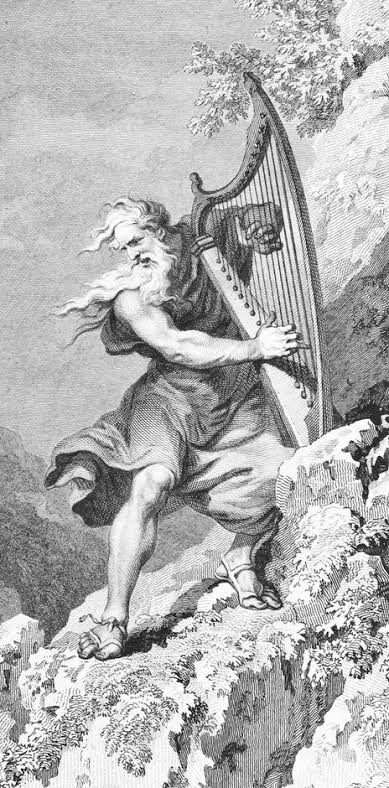
Over six thousand years ago there lived a people in the Eurasian Steppe who spoke a language now known as Proto-Indo-European. This language is the ancestor of the entire Indo-European language family, with members spanning from Sri Lanka to Iceland, and with one of its members that you are currently reading: English. However, language is not the only thing the speakers of Proto-Indo-European left behind; several Indo-European speaking cultures throughout history have had a traditional class of oral storytellers, musicians, and priests. Their stories and storytelling traditions are potentially a mark the steppe dwellers left on societies even millennia after they were all long forgotten in the minds of the living.
You have likely heard the term “bard” before, whether in reference to magical musicians in a tabletop game or as an epithet for Shakespeare. This term in English is a loanword from Insular Celtic languages, which are languages in the Celtic family that originate in the British Isles, e.g.: Welsh, Gaelic, and Cornish. In Celtic cultures of Antiquity and the Middle Ages, Bards were a class of poets and singers in service of a patron, often important leaders such as chieftains and kings. Bards would both compose verse and perform pieces by other bards. These songs and poems were often transmitted orally, even highly notable works such as the medieval Welsh poem “Y Gododdin” being accredited to several hundred years before it was first written down. Bardic songs and poems often consisted of the praise of their leaders and the satires of their foes. Still, bards were not limited to simply praise of the living. They would also perform eulogies to the dead, and often the praise of the both the living and dead was paired with praise of legendary heroes. The practice of singing praises of the dead and their deeds as a form of consolation for the bereaved is also found in Greek tradition, an example of this is seen in “The Iliad” upon the return of Hector’s body to Troy, as several women begin to eulogise him in the form of song as his corpse lays on a wooden bed. The praise of the living by comparing them to heroes of legend is also seen in the Old English poem “Beowulf”; after the monster Grendel is slain by the titular protagonist, a man composes a new verse about the victory and pairs it to an earlier tale of the dragon slayer Sigemund. These orally transmitted songs and poems focused on praise of both the living and dead involving references and reverence of mythological figures aren’t all that these historical cultures had in common. They also all spoke a language (or languages) in the Indo-European Language family. This brings forth the possibility that the similarities in these practices are more than just coincidence, but in fact a connection going back several thousand years to the Indo-European steppe nomads.
The bards were not alone in their practice of orally transmitting stories through the generations in Celtic society. In fact, they were one of three learned classes of Celtic society described by Greek geographer Strabo, alongside the Druids and Vates. Druids played the role of a priestly class who served as the holders and teachers of both religious and legal tradition, and much like bards, they did not put their knowledge into writing. This role offers a parallel to the Brahmins of India, a social class of priests and teachers of religion and philosophy whom much like druids of Celtic Europe had a strong history of oral tradition over writing. The Vedas, which are the oldest texts of Hinduism, are thought to have been composed between BC 1500–1200 in the north of the Indian subcontinent yet lack written manuscripts until the Middle Ages. Both cultures were separated by a massive geographic distance, with little to no contact or connection. Despite this distance, both contained similar cultural practices, which could be seen as nothing more than a mere coincidence, if it were not for the connection of language. Both the Celtic languages of Europe and Indo-Aryan languages of the Indian subcontinent are related members of the Indo-European language family. The distance and difference between these languages means this connection is incredibly ancient, perhaps dating back to the time when Proto-Indo-European was spoken. Overall, both these priests and poets appear to relate to an idea of a societal class or classes of oral keepers of knowledge, stories, and religion across Indo-European speaking cultures. So, it is not impossible that in the society of those who spoke Proto-Indo-European there was a societal grouping of those learned in arts, philosophy, and mythology. This article will refer to this hypothetical social grouping as Storytellers.
The idea of a social class of those learned in oral tradition being spread across Indo-European speaking societies isn’t enough to prove that the concept stretches all the way back to the speakers of Proto-Indo-European. In fact, oral tradition being kept among specific member’s societies has emerged independently several times, including but not limited to the Griots of West Africa. However, this connection has more evidence than simply the existence of societal groups, but in the main narratives and themes included throughout the stories told. An important theme seen throughout the traditions of Indo-European speaking cultures is that of the importance of warriors and the battles they partake in. A specific common theme in works about these warriors is that of the cattle raid, which is referenced in a hymn from the Hindu Rigveda, specifically Hymn 38 from Book 10. The capture of cattle is also one of the Labours of Heracles in Greek legend, in which the hero stole the cattle of Geryon. In various Indo-European speaking groups, there is also importance placed on war bands of unmarried men who would spend their time on various raiding and looting expeditions. Evidence of this importance is also found linguistically. Linguists have reconstructed the Proto-Indo-European word *koryos, referring to the previously mentioned war band. Decedents of this word include Middle Irish cuire, Lithuanian kãrias, and the reconstructed Proto-Germanic term *harjaz (which is a cognate with Swedish härja). This has led scholars to propose the idea hypothesis that a warrior class played an important role in the society of those who spoke Proto-Indo-European. As the activities and practices of these warriors were important enough to be remembered in the tales of Storytellers, and the very concept of a war band was important enough to have its own term.
The importance of war is not the only thematic and narrative feature that features throughout Indo-European speaking oral traditions. The very gods and heroes that feature so often in the mythologies of Indo-European speaking cultures and their indigenous religions have evidence of a common origin among the steppe nomads who spoke the ancestor to their tongues. A common theme seen throughout Indo-European religions is the idea of the gods meeting and debating in some form of assembly or council of the divine. This is attested to in Hinduism, along with pre-Christian Germanic, Irish, and Greek faiths. Found in both Greek and Indian tradition is the idea of this divine council meeting on a mountain, with Mount Olympus and Mount Meru respectively being stated as the place gods meet to discuss their affairs. This links to a general theme of reverence focused the sky. This idea of the sky being greatly holy can further be attested to by the reconstructed deity name *Dyēus Ph₂tḗr, literally translating to “sky” or “daylight father”. This name was reconstructed from several attested to deities. Including Zeus, Germanic Tyr, Hindu Dyaus, and Latin Jupiter. All these deities carry an authoritative and fatherly role, often seen as the chief or father god of their respective religions. Thus, it can be inferred that a great reverence for the sky and daylight must have been prevalent to the speakers of Proto-Indo-European, including their Storytellers who carried this reverence throughout great distance and lengths of time.
It is more than just reconstructed words that allow us to glimpse into the potential culture of the speakers of Proto-Indo-European practice. The stories carried by a long tradition of oral storytellers paint a much clearer picture of the kind of society these people lived in, and perhaps more importantly how their legacy survived through the harsh and inevitable progress of time. Even as individuals are long forgotten, how they loved, laughed, and eventually died endures; a part of them may live on in the beloved cultural tales of many.
Bibliography
Aldhouse-Green, Miranda (2010). Caesar’s Druids: An Ancient Priesthood. New Haven: Yale University Press.
Bremmer, Jan N. (2010). Bremmer, Jan N.; Erskine, Andrew (eds.). Gods of Ancient Greece: Identities and Transformations: Identities and Transformations. Edinburgh University Press.
De Witt Griswold, Hervey (1923). The Religion of the Rigveda. H. Milford, Oxford University Press.
Griffith, R. T. H. (Trans.). (1896). The hymns of the Rigveda. E. J. Lazarus. (Original work published ca. 1500–1000 B.C.E.).
Heaney, S. (Trans.). (2000). Beowulf: A new verse translation. Faber & Faber. (Original work published ca. 8th–11th century)
Homer. (1951). The Iliad (R. Lattimore, Trans.). University of Chicago Press.
Watkins, Calvert (1995). How to Kill a Dragon: Aspects of Indo-European Poetics. New York: Oxford University Press.
West, Martin L. (2007). Indo-European Poetry and Myth – Oxford University Press.
Image Credits
Image: “Welsh Druid playing harp”, engraving from Thomas Pennant’s ‘A Tour in Wales’ (1781).

