
Written by Alexander Stroem
Between 1967 and 1974, the Greek Military Junta (led by a military committee, notably Brigadier General Stylianos Pattakos, and Colonels Georgios Papadopoulos and Nikolaos Makarezos), following the Coup of April 21, 1967, introduced various changes to the Greek State that were deemed dictatorial. Such changes were not merely limited to the reversal of the democratic process but also to the reconstruction of religious morality and authority within the Greek Orthodox Church and its social environments. The control of religious institutions by authoritarian regimes is no novel political paradigm and was seen in contemporary authoritarian regimes, such as Francoist Spain under Nacionalcatolicismo, Portugal, Brazil, Chile, and Argentina, to name a few. This was not merely due to the church’s power as an institution with immense social responsibility and influence, even legitimising, but also as a contrasting root of dissidence and opposition. Therefore, the church becomes an ‘ideological necessity’, resulting in what the magazine Time remarked in 1973 as ‘Greece’s Other Coup’.
The Greek state, itself a relatively new territory with a developing national church, autocephalous and effectively independent from the Ecumenical Patriarch since June 1850, and territory (nonetheless with a pious population), was especially prone to such religious control during its various twentieth-century dictatorial regimes. Under the brief rule of Theodοros Pangalos as ‘constitutional dictator’ (δικτάτορας) between 1925 and 1926 during the Second Republic (1924-1935), or that of Ioannis Metaxas between 1936 and 1941 under his so-called ‘New State’ (Νέον Κράτος), the church was subdued to various political ends, notably against liberalism, communism and secularism and other such sources of ‘national decline’. Indeed, key junta figures such as Makarezos were described as ‘above all, very devout’ by foreign contemporary intelligence. Such means of control, particularly using the church hierarchy and canon law, were fundamental in establishing and maintaining authority under a regime whose motto became ‘Greece of the Christian Greeks’ (Ελλάς Ελλήνων Χριστιανών).
The law remains a fundamental part of the administration and order of the church, Greek Orthodox or not, and therefore, an effective means of controlling the church by authorities. Because of how religion is judicially controlled and formatted, dictatorial regimes, both military and civilian, have often employed its use by one means or another in consolidating, legitimising and regulating their regimes and, at lower social levels, entire communities. Weber mainly employs such political and sociological paradigms of religion, notably in the presence of contesting powers and threats to the community. To the colonels, the seeming threat of communism imagined or not, seemed very real, even among the church. Consequently, they saw themselves as ‘the nation-saving revolution’ (Εθνοσωτήριος Επανάστασις). The American Central Intelligence Agency’s material at the time, declassified as recently as 2019, reveals much information on the Junta’s initial plans. Minister of Coordination, Colonel Nikolaos Makarezos (himself ‘concerned with… ‘cleansing’ and the reorganisation of the government bureaucracy’) remarked that ‘we will never permit Greece to become a second Vietnam’ and that parliamentary rule would only return when ‘social and political conditions in Greece and healthy and sound’. Because of such fears, the Junta pursued ‘modernising and improving the image of the Orthodox Churchy by appointing clerical dignitaries sympathetic to the new government and setting an official example of moralistic behaviour in public life’.
Control of the church becomes key to such religious-moral intervention based on legitimising the regime’s authority through popular belief and the pastoral ‘quotidien’ (everydayness) of a remarkably pious population in the form of Gramscian-like hegemony and consent by faith. This relationship between popular religion and politics in Greece has been investigated by Nikos Kokosalakis (1987). In exploring particularly on the everyday importance of the Greek church as the ‘sole cultural and political agent of the nation’ between the reformation and nineteenth century, Kokosalakis remarks on the difficulty in separating Church and State, not simply in forming Greek nationalism but also Canon law via popular belief and economy (οἰκονομία) and legal-popular compromise. Indeed, Metaxas, while himself not immensely pious, had understood the value of the church as a pillar of Greek unity and harmony in support and dissidence. He even noted this idea with reference to continued religious unity under the Byzantines and resultantly involved himself in the election of a Primate ‘due simply to his feeling that the whole issue had become a challenge to his authority’. The fact that the Colonel similarly followed Metaxas is not surprising; it may be remarked that the colonels had begun their military careers under the Metaxas regime, becoming influenced by his ideas, loosely defined as Metaxism (Μεταξισμός) in their authoritarian and right-wing ideology. Following the Second World War and Civil War (1946-1949), many became members of IDEA/ΙΔΕΑ (Ιερός Δεσμός Ελλήνων Αξιωματικών, Sacred Bond of Greek Officers), an ultraconservative clandestine group that even attempted a coup in 1952 based on such right-wing Greco-Christian principals. As a result, Canon law and the church, itself formed by the interaction between popular piety and politics, remained a fundamental form of controlling population and morality alike, particularly concerning legitimacy and authority.
In establishing authority, the Coup’s primary ideologues made particular use of clerical allies in subverting Canon law and the church hierarchy to their needs, particularly Archbishop Ieronymos I (Kotsonis) of Athens, installed as Archbishop of Athens (rejected twice before in 1962 and 1965 for the same position based on scepticism of his credentials) and all Greece following Chrysostomos II’s refusal to adhere strictly to the regime and subsequent removal. Ieronymos, himself a strong anti-communist and conservative, became a staunch defender of the regime, eventually resulting in his resignation and exile to the Cycladic Island of Tinos in 1973 with the Junta’s initial decline. Indeed, in July 1968, Ieronymos refused to partake in the fourth World Council of Churches (WCC) conference in Uppsala, Sweden, despite being a central member. The refusal was seemingly due to criticism over human rights violations in Greece under the Junta, which he deemed excessive involvement in Greek ecclesiastical affairs.
With the Emergency Law (αναγκαστικός νόμος) 3/1967, issued on May 10, 1967, the church suspended the Permanent Holy Synod (Διαρκῆς Ἰερά Σύνοδος), and replaced it with a smaller synod of eight Bishops chosen by merit (Ἰερὰ Σύνοος ἀριστίνδην), namely by the Junta themselves or loyalists. The title of the law itself, ‘Concerning the modification and completion of the provisions of Law No. 671/1943 on the Charter of Greece’, further implies such shifts of control, with Law No. 671/1943 itself having been enacted in the post-dictatorial/Metaxas years under Nazi occupation to prevent such presidential control of the Holy Synod, traditionally under the Holy Synod of the Hierarchy. This is further noted later in the subsequent section, with Synod members being chosen ‘on the proposal of the Minister for National Education and Religious Affairs’, much like the proposal itself. This was followed later in 1967 with a further charter of law 291/1967 concerning the Synodal assemblies in accordance with sections 1 and 3 of law 3/1967, granting the Synod the right to appoint Greek regional Archbishops and Metropolitans (including the seats of Patras, Trikala/Trikki, Stagi, Naupaktos, Evritania, Kythera, Kasandreia, and Nikopolis among others), enforced by the Minister of National Education and Religious Affairs. Effectively speaking, the Junta, which had now established itself within the synodal council, was at the forefront of the religious hierarchy and the apogee of its theological control despite its military-civilian status.
In maintaining the church hierarchy as organised above, the Junta preserved a set of bishops loyal to the regime. This hierarchy was kept strictly in check by the regime, resulting in many clerics and Metropolitans even losing their seats, similar to judges. These particularly followed Emergency Law (214/1967) from December 12th, 1967, effectively empowering the now government-run Greek Synodal Courts (Holy Courts / Ἰερά Δικαστήρια) through a new Ecclesiastical Synodal Tribunal composed (and entrusted decision-wise to) the Archbishop of Athens and All Greece and other ‘chosen’ members of the clergy with authority to remove such dissident clerics from their seats. One such dissent removal was Metropolitan Panteleimon (Papageorgiou) of Thessaloniki, formerly Metropolitan of Edessa and Pelli. Following his disapproval of the regime and seeming uncooperating attitude, notably that he had ‘refused to officiate at ceremonies attended by junta officials’, Bishop Panteleimon was deposed at a synod of 1968 led by Archbishop Ieronymos. Subsequently, according to a letter from Deputy Chief of Mission in Greece Roswell McClelland to the Country Director for Greek Affairs Daniel Brewste, he was ‘disciplined by the government-controlled Holy Synod of the Greek Orthodox Church’, namely exiled to Patmos and later living in Athens, restricted of his position. Panteleimon was no lone case during the period. Seemingly, Ieronymos himself had remarked that the fate of an accused cleric was hardly dependent on the verity of the charges at hand but on ‘the effect that these charges have on a reputation’. Two bishops were forced to resign by trial, while seven others resigned by the mere intimidation of prosecution. As noted by Time, ‘He went after not only bishops reputed to be immoral but also those who criticised him and his policies’, replacing them in the Synod with younger clerics loyal to his policies.
Various other periodicals similarly remarked on such developments, including The New York Times, labelling the acts an unlawful ‘purge’ of bishops, notably Archbishop Chrysostomos, and that the government effectively ‘rule[d the] Church’. The article even features a quote by Patakos, stating that ‘There were very many things wrong in the church… They were all fighting with each other’. Another casualty, albeit perhaps lesser in severity, was Bishop Ambrosios, Metropolitan of Eleutheroupolis, who, upon calling Archbishop Ieronymos a ‘despot’, was suspended for three days. Ambrosios responded to his charge by noting, ‘You are violating canon law, Your Beatitude!… You are afraid of the light, Your Beatitude!’ in reaction to Ieronymos’ subversion of the Synod (Ironically, Ieronymos was a prominent professor of Canon Law at the Aristotle University of Thessaloniki working in the Faculty of Theology). As such, the Junta established itself within the church hierarchy, aided by loyalists such as Archbishop Ieronymos I, who protested little to the above ecclesiastical subversion to the state.
Dictatorships come in many forms, not merely restricted to the traditional images of near-monarchical autocrats with power based on repression. Coercion remains equally, perhaps even more so, important as a means of manipulation and hegemonic acceptance. In such coercion, whether by law or belief alone, the church, often through its subversion, remains fundamental in inculcating a common moral belief of ‘religion and our history’. Ultimately, with the coercion of the church and through clerical such as Archbishop Ieronymos I, the regime maintained the clerical sectors of society, removing any opposition, regardless of form, to their authority. Indeed, as remarked by The New York Times, the Junta had ‘purged’ the church and Synod (although, to no surprise, it was declared illegal) to its authority, later even stating that they ‘demanded adherence to ‘Hellenic‐Christian traditions’ to preserve not Greece but their glory’ until their fall in 1974 by their incompetence and nationalism.
Bibliography
Primary Sources:
Central Intelligence Agency. Memorandum: The Greek Junta, 24 May 1967/No. 1113/67/ F-2018-01318.
Εφημερίς της Κυβερνήσεως: τοῦ Βασιλείου τῆς Ελλάδος, Ἐν Αθήναις τῆ 11 Μαϊου 1967, αριθμός Φύλλου 68, No.291.
Εφημερίς της Κυβερνήσεως: τοῦ Βασιλείου τῆς Ελλάδος, Ἐν Αθήναις τῆ 12 Δεκεμβρίου 1967, αριθμός Φύλλου 220, No.214.
“Greek Press ‘Traditions’” in The New York Times, August 7, 1971. p.22.
”Letter From the Deputy Chief of Mission in Greece (McClelland) to the Country Director for Greek Affairs (Brewster) from the Department of State, Greek Desk Files: Lot 71 D 509, Correspondence to and From Athens.” in Foreign Relations of the United States, 1969-1976, Volume XXIX, Eastern Europe; Eastern Mediterranean, 1969-1972. ED. James E. Miller, Douglas E. Selvage, Laurie Van Hook; Edward C. Keefer. Washington. D.C. United States Government Printing Office. 2007.
“Religion: Greece’s Other Coup”, in Time, July 2, 1973.
Richard Eder. “Greek Junta acts to purge Bishops and rule Church: New Law Will Oust Primate – Treason Plot Charged to Andreas Papandreou” in New York Times, May 11, 1967. p.1c3/16c1.
Secondary Sources:
Andreopoulos, Charalampos Μ. “The Greek Orthodox Church during the Dictatorship of the Colonels Relations of Church and State in Greece at the seven – year period of military Junta (1967-1974)” in Eusebius Lab International Working Paper 2020/07. Thessaloniki. Aristotle University of Thessaloniki. 2020.
Borras, Alphonse. “Rôle et signification du droit canonique dans la pastorale”. Revue Théologique de Louvain Vol.40. (2009): pp.360-381.
Charalampos, Andreopoulos; Athanasios Grammenos. “Religion Enchained: The Church of Greece under the Military Junta” in The Greek Military Dictatorship: Revisiting a Troubled Past, 1967–1974. Ed.Othon Anastasakis och Katerina Lagos. pp.198-214. New York/Oxford. Berghahn Books. 2021.
Clogg, Richard. “The Ideology of the ‘Revolution of 21 April 1967” in Greece under Military Rule. Eds. Richard Clogg; George Yannopoulos. pp.36-58. New York. Basic Books. 1972.
Clogg, Richard; Yannopoulos, George. “Editors’ Introduction” in Greece under Military Rule. Eds. Richard Clogg; George Yannopoulos. pp.vii-xxii. New York. Basic Books. 1972.
Dépret, Isabelle. « Ioannis Metaxas et le religieux (1936-1941) : expérience historique et débats actuels en Grèce ». (Cahiers balkaniques: Grèce-Roumanie : héritages communs, regards croisés. Vol.42. 2014. http://journals.openedition.org/ceb/5120.
Johnston, Hank; Figa, Jozef. ”The Church and Political Opposition: Comparative Perspectives on Mobilization against Authoritarian Regimes”. Journal for the Scientific Study of Religion (Journal for the Scientific Study of Religion. Vol.27. No.1. (1988). pp.32-47.
Koesel, Karrie J. Religion and Authoritarianism: Cooperation, Conflict, and the Consequences. Cambridge. Cambridge University Press. 2014.
Kokosalakis, Nikos. “The Political Significance of Popular Religion in Greece”. Archives de Sciences Sociales des Religions. Vol.64. No.1. (1987). pp.37-52.
Vavouskos, Constantine Anastasios. “Church and State in Modern Greece: A Review Article: a propos of Varnavas D. Tzortzatos, the statutory legislation of the Church of Greece from the time of the establishment of the Greek Kingdom”. Balkan Studies Vol.9. No.1 (pp.209-226). 1968.
Weber, Max. The Sociology of Religion. Ed. Talcott Parsons. Trans. Ephraim Fischoff. London. Methuen & Co Ltd. 1922/1965.
Woodhouse, Christopher Montague. The Rise and Fall of the Greek Colonels. London/New York. Granada. 1985.
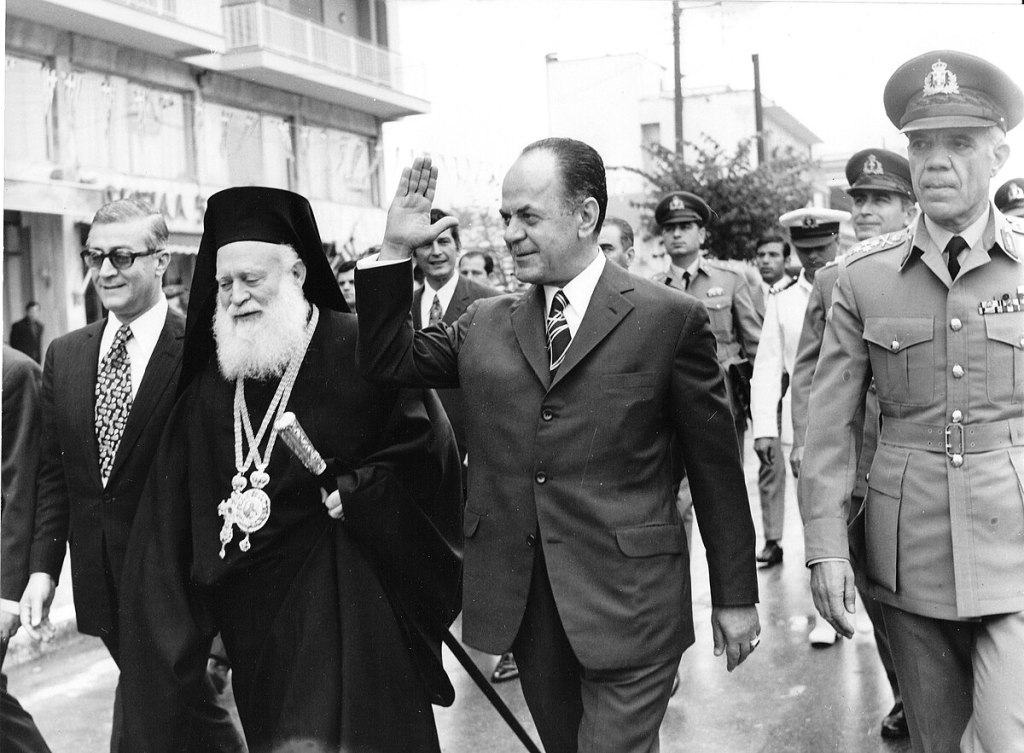
Featured image credit: Commander in Chief of the Greek Armed Forces Gen. Odysseas Aggelis (aka Angelis) accompanies PM G. Papadopoulos visiting Alexandroupolis. Accessed via Wikicommons: https://commons.wikimedia.org/wiki/File:Odysseas_Aggelis_Al1972_02.jpg


