
Written by Harry Fry
Performing a ‘Statistical Profile of Adolescent Saints’ in 1982, Donald Weinstein and Rudolph Bell argue that ‘social’, ‘economic’, and even regional differences existed ‘only in the fifteenth century’. Scholars such as Weinstein and Bell acknowledge variation in the construction of saintly adolescence yet largely prioritise elite examples. Questioning the reality of a presupposed elite-centricity, this investigation makes an urban-rural comparison from the eleventh century. Using four case studies, urban saints Francis of Assisi and Clare of Assisi, and rural saints Alpais of Cudot and Godric of Finchale, I will consider their different socio-cultural upbringings but also locate similarities within their hagiographers’ creation of them as unique. This will move from the historiographical tradition of confining saintly adolescents to a class-based experience, demonstrating greater fluidity which exemplifies their phenomenon-based invention.
This essay will incorporate scholarship on what I will term the phenomenon of medieval sainthood; amplifying medieval perceptions of saintly adolescence yet equally probing the limitations of their hagiographies. Patricia Wasyliw insists that an awareness of ‘hagiology’ equal to the ‘history of childhood’ is vital to comprehending this topic. Hagiographies, written retrospectively to a saint’s life, carry limitations as a biographical source. This essay considers how subsequent and scholarly interest in young saints prioritises the typically fuller narratives of elites and boys. The ability to form tangible comparisons between rural non-elite as well as young and female sainthood is presented, establishing the more specific phenomenon-based, rather than elite, existence of saintly adolescence.
To facilitate this argument, the different scholarly constructions of young saints as a unique social phenomenon must be understood. Wasyliw reflects on ‘childhood’ and ‘sanctity’ as disconnected themes in scholarship until the formation of studies concerning adolescence from the 1970s. Acknowledging the existence of young saints and their difference from adult sainthood, Michael Goodich notes their ‘allegedly pious behaviour which became the paragon against which all human action was measured […] presented to the young as an ideal worthy of emulation’. This viewpoint defines child sainthood as a construct with a wider social purpose, modelled for adolescents. However, their hagiographical-based narratives written by adults widened their influence and perception to the entire society, not merely other adolescents. Moreover, Weinstein and Bell reframe child sanctity through greater consideration of their quantity and social significance, terming them as a rarer entity. It is this perception of young sainthood as more rigidly constructed, a ’social type’ that accomplished ‘spiritual perfection’, which necessitates their characterisation as a phenomenon for medieval society.
Within an Italian Catholic city, adolescents Francis of Assisi and Clare of Assisi embraced sanctity through their remarkability. In scripture, “It is not good for Francis to be alone […] and in this way Clare was created”. Their sainthoods are partly integrated but predominantly have a deeply religious causation story. Such a narrative on Francis is offered by his hagiographer, Thomas of Celano, who also likely wrote Clare’s hagiography. Francis created The Lesser Brothers, and Clare subsequently founded The Order of Poor Ladies, both after converting to the vita apostolica as adolescents, which included a life of sustained poverty. As specified by Regis Armstrong, their fixation on poverty was created from their support for the Eucharist, a Christian rite which views bread and wine as the body and blood of Christ. Francis and Clare’s decision to take on a basic diet, such as bread, meant they were sustained by Christ alone. Centralising their unwavering determination to uphold Christian values and the strict demands they placed on themselves for the rest of their lives, Francis and Clare’s hagiographies conveyed their sanctity as worthy of prestige but difficult to mimic.
The hagiographical construction of saintly adolescence as perhaps challenging to embody is solidified in Clare’s unique, revelatory experience. Clare is spoken to through a ciborium, a cup which holds the Eucharist, promising, “I will always protect you”. Uplifting a theological context as noted by Armstrong, the Eucharist ‘is a living person’. Therefore, this voice from inside the ciborium is akin to God directly speaking to her in human form; a transformative occurrence. While Goodich underlines that medieval hagiography was a quasi-fictional narrative, Clare’s biography was produced for thirteenth-century medievaldom as reality. This unique phenomenon associated with Clare herself is pivotal for scholarly understanding, as historical tradition named her Francis’ la pianticella. This long presupposition of Clare’s sainthood as dependent or due to Francis, given her training under him, suggests a wrongful male confinement of youthful sanctity. Catherine Mooney considers how Clare’s monastic order was largely papacy-controlled, but that Clare’s revelation into sainthood exists outside of Francis’ journey. A revision of women as central figures in medieval Europe as offered by Mooney relates to the necessity of better appreciating the variation of saintly adolescence. Weinstein and Bell’s depiction of elite boys dominating sainthood until the fifteenth-century forces uniformity against a more nuanced reality. Contrasts can be made to this rigid narrative through the use of girl saints and rural, non-elite, examples.
The notion of adolescents experiencing a greater calling towards Christianity and sainthood diverges but exists in the rural examples of Alpais of Cudot and Godric of Finchale. Raised in rural twelfth-century France, Alpais suffered paternal loss, extreme neglect from her family and physical suffering. Her hagiography, written by a monk also from Cudot named Peter, presents Alpais’ Life as unsustainable and helpless before she ‘[devoted] herself exclusively to God’. The extreme struggle Alpais is almost required to experience for a later saintly experience is consequential. However, Godric’s hagiographer, Reginald of Durham, depicts Godric’s movement around non-elite as well as wealthier environments, explicitly complicating the requirements of saintly adolescence. Becoming a successful merchant who partly owned a ship and served an elite home as a steward, Godric entered a new financial status away from his more humble upbringing in rural Norfolk. However, he suddenly transitioned to an opposing lifestyle as a hermit in Finchale, which led to him becoming a saint. As Margaret Coombe suggests, greater usage of Godric’s unparalleled journey can facilitate novel scholarship on young saints. Godric left a wealthier path to become a saint, yet only through his career – where he visited Jerusalem twice and Santiago Compostela – did he decide on his unique calling to God. Consequently, while Godric’s financial context related to his journey, he was never elite and nonetheless made an unconventional decision to pursue sanctity.
Saintly adolescence can be seen more widely than through only elite perspectives and classed as a phenomenon. Returning to a discussion of Alpais, scholars aiming to solidify an inclusion of rural, non-elite adolescents have highlighted Alpais’ upbringing in parallel to her eventual sainthood. Her neglect and involuntary separation from her family and society are rightly viewed as instrumental in why she sought defence from God. Additionally, however, to present her sanctity, Irina Metzler pays closer attention to the reason for Alpais’ neglect, incorporating a study of medieval disability. While Alpais might have been born with physical or mental disadvantages, her long lack of nourishment at home and possible depression from the death of her father could similarly explain her ‘tender small body’ and ‘mind of an old woman’. While attributing Alpais with a genuine disability requires delicate unpacking, her childhood could suggest that rural, non-elite saints must have experienced hardship to gain a necessary, revelatory experience. Weinstein and Bell seek to identify why Alpais is personified through a sense of suffering and consider the representation of parents. However, they still confine rural, non-elite child saints under the thematic boundary of struggle, even though Godric’s life before sainthood does not contain such a narrative. Therefore, inasmuch as scholars attempt to break away from more simplistic evaluations, they remain present in the historical tradition and only partially scrutinise the real variation of sanctity in medieval youths.
Tying in these case studies can help us identify the unique world of saintly adolescence, constructed within tough requirements. Alpais’ sudden attachment to God and a supposed response from him can, to an extent, be perceived as inexplicable. Similarly, Francis and Clare’s sustained decision to embrace the Eucharist and poverty, which gave rise to their sanctity, can appear convoluted. Francis became renowned for founding three influential Orders, and in The Miracle of the Multiplication of Bread, Clare instructed groups of women. Yet, their teachings, which led followers to take on an identical lifestyle, did not weaken their hagiographical portrayals as saints. Their unique position and status, untampered by others embracing a similar path, could be explained by the interplaying of Godric’s sainthood. Godric’s eventual rejection of financial prosperity, away from normative social desires, relates to Francis and Clare’s transformation from an elite upbringing to a simple lifestyle. This move to unconventionality, playing a vital role in their hagiographical representation, could explain how the phenomenon of sanctity was attributed to an individual. However, Alpais is a diverging example since she did not voluntarily choose an unconventional life but was forced into one. To fully ground the argument for a phenomenon-based construction of saintly adolescence, robust navigation around their respective hagiographies and the use of new interpretations of hagiology are required.
With a focus on hagiographies, Wasyliw offers context to historians such as Goodich, who define young saints as a unique, religious ‘paragon’. Wasyliw posits that the intricate conception of child saints differs from that of adult saints in how they are perceived by others: ‘The legends of the saints are not historical documents in any strict sense; their purpose was spiritual edification’. While Goodich contends that saintly adolescence inspired young peers, Wasyliw shifts attention to the intention of hagiographers and the lacking agency of their subject matter. Adolescents, being a vulnerable social category and fundamental to Alpais’ sanctity, could be characterised by a singular meaning and a wider message separate from them. Weinstein and Bell themselves apply substantial uniformity to child saints yet imply such hagiographies could possess different communications to parents, not adolescents. Urban-raised Francis and Clare reject their family’s wealth, whereas Alpais’ rural childhood highlights neglect, even abuse, from her family. Weinstein and Bell argue that Francis and Clare’s decision appeared unconventional and worthy of discussion in their hagiography because it contrasted their successful upbringing by their parents. Given that Alpais’ suffering was narrated under a lack of parental support, hagiographies could possess the didactic nature located by Weinstein and Bell. Through comprehending the agency of hagiographers and the inclusion of urban-rural comparisons, we can discern why and how child saints were invented akin more to a social construct or phenomenon.
Further contextualisation of hagiographies as a historical and literary genre in medieval Europe can aid the understanding of saintly adolescents as a unique entity. Goodich centralises these ‘standard hagiographical legend[s]’ as importantly written retrospectively to a saint’s life. Sainthood, being a title or canonisation applied after their death, explains their role as noteworthy characters whom hagiographers and society reflect upon. This relates to their depicted actions in hagiographies, which can be viewed as unsubstantiated and inexplicable. Godric is characterised with miraculous power as a healer to 243 people, and Alpais’ mother, Ortolana, is depicted as receiving signs which envision her daughter’s destiny when pregnant. These rural perspectives represent young sainthood as incomprehensible to others and predestined to an extent. This connects with Weinstein and Bell’s definition of more urban-facing saints as a ‘religious metaphor, invocation of the supernatural, hagiographical convention, and the requirements of heroic biography’. Young saints exist substantially under a literary-based illusion. It is easy to become stuck within scholarly assumptions and the standard difficulty of rationalising how any adolescent became a saint. However, as Weinstein and Bell here conclude, these opaque elements of spiritual transformation and agency are vital in the construction of a uniquely saintly adolescence.
Against their wealthy urban origins, Francis and Clare’s movement down all social echelons into poverty could confirm the insignificance of an elite background. However, Alpais’ rural and non-elite upbringing diminishes notions of saintly adolescence as confined to elites. To equate young sainthood as restricted in the context of a phenomenon, Godric’s eventual rejection of financial prosperity shows a refusal of conventional social desires. These four case studies each present a unique calling or necessity for God, as even before sainthood, they transcend normative human experiences. Read through the context of hagiographical agency, it is this narration of their deeper alignment to God and retrospective construction of such gravity which materialised their rarity as a phenomenon. Weinstein and Bell appreciate such readings, yet scholarship must fully notice female and non-elite examples to present such a conclusion and progress historical tradition.
Bibliography
Primary Sources:
Gen 2:18 (OT), as cited in Thomas of Celano, Legend of Saint Claire, ed. and trans., Armstrong, Regis J. (New York: New City Press, 2005).
Reginald of Durham, The Life and Miracles of Saint Godric, Hermit of Finchale, ed. and trans., Coombe, Margaret. (Oxford: Oxford University Press, 2022).
Thomas of Celano, First and Second Life of Saint Francis, (New York: Fordham University, 1996).
Thomas of Celano (Authorship Disputed), Legend of Saint Claire, ed. and trans., Armstrong, Regis J. (New York: New City Press, 2005).
Secondary Sources:
Goodich, Michael. ‘Childhood and Adolescence Among the Thirteenth-Century Saints’, History of Childhood Quarterly 1, no. 2 (1973), pp. 285-309.
Metzler, Irina. Disability in Medieval Europe: Thinking about Physical Impairment in the High Middle Ages, c. 1100-c.1400 (London: Routledge, 2005).
Mooney, Catherine M. ‘Religious Women in the Thirteenth-Century Church’, in Clare of Assisi and the Thirteenth-Century Church (Philadelphia: University of Philadelphia Press, 2016).
Mueller, Joan. A Companion to Clare of Assisi (Leiden: Brill, 2010).
Robson, Michael J. P. (ed). The Cambridge Companion to Francis of Assisi, (Cambridge: Cambridge University Press, 2011).
Skinner, Patricia. and van Houts, Elisabeth. Medieval Writings on Secular Women (London: Penguin Classics, 2011).
Wasyliw, Patricia Healy. Martyrdom, Murder, and Magic: Child Saints and Their Cults in Medieval Europe (New York: Peter Lang Publishing, 2008).
Weinstein, Donald. and Bell, Rudolph M. Saints and Society: the Two Worlds of Western Christendom, 1000-1700 (Chicago: the University of Chicago Press, 1982).
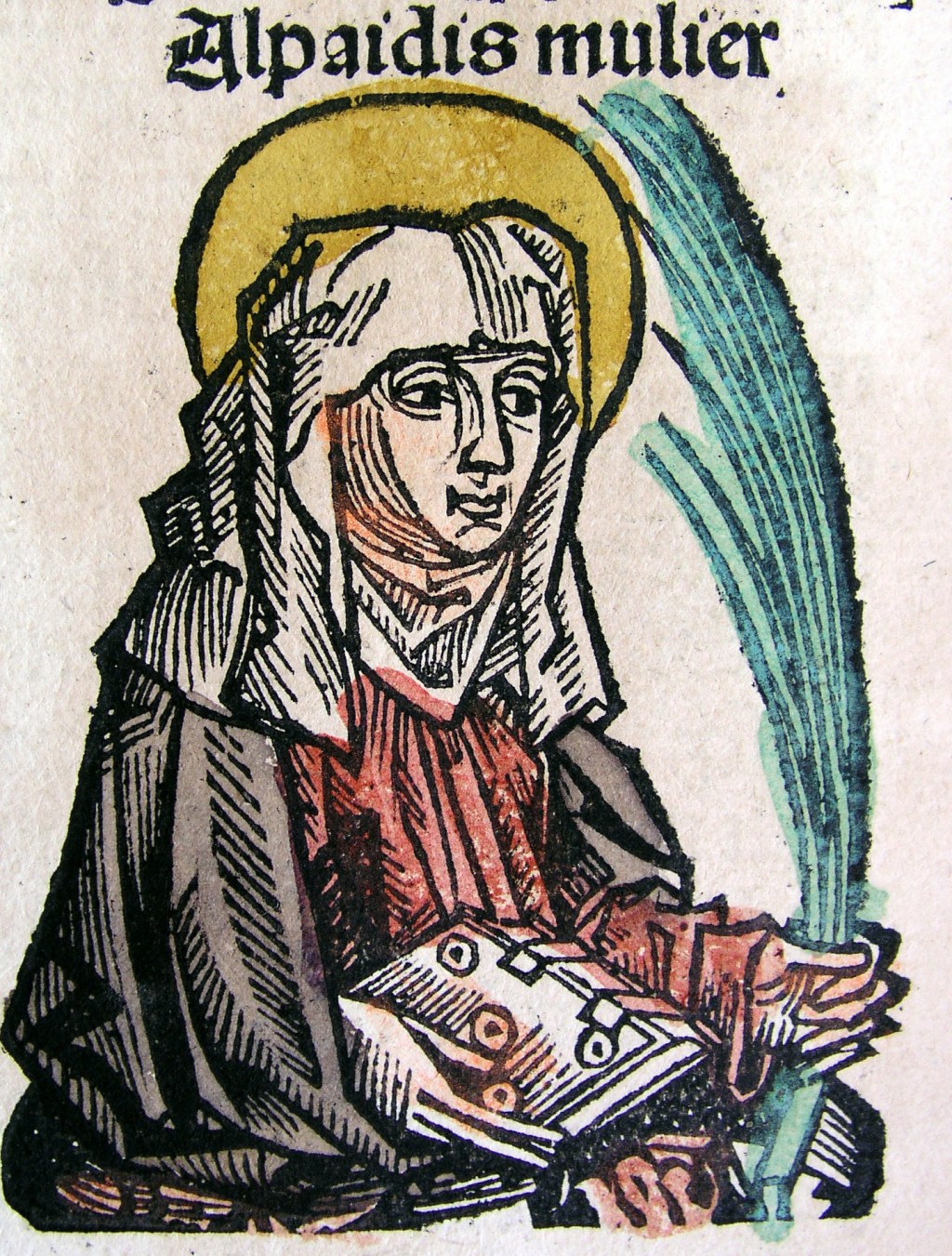
Featured image credit: Alpais of Cudot, from the Nuremberg Chronicle, by Hartmann Schedel (1440-1514). Accessed via WikiCommons: https://commons.wikimedia.org/wiki/File:Nuremberg_chronicles_-_Alpaidis,_Holy_Woman_and_Seer_from_Cudota_(CCVv).jpg


.jpg)