
Written by Arianna North Castell
When we think of Andromeda, most of us will simply think of a damsel in distress. Bearing the burden of her mother’s hubris, she is saved by the very thing she is condemned for: her beauty. Perseus, struck by her appearance, fights the sea monster Cetus and rescues her, marrying her and founding an impressive dynasty. She’s been the subject of countless paintings and famously features in the Clash of Titans movies – beautiful, slender, and white. Recently, the debate surrounding Andromeda’s race has surfaced. The classical materials are united in one fact, that she was a Princess of Ethiopia. It is important to note that the ancient world did not have the same concepts of race as we do, and that ancient Ethiopia does not correspond to what we know as Ethiopia today. However, it is evident from the ancient sources that Andromeda was a black woman.
Ethiopia in the ancient sense was a ‘legend that has both Asiatic and African settings.’ The etymology of the name ‘Ethiopia’ comes from the Greek for ‘scorched faces’, something which indicates that, even if there are discrepancies regarding the exact geography, we can say with certainty that ancient Ethiopians were not white. The Greek sources vary on a physical description of her beauty, only agreeing that her beauty was overwhelming to all. A clear picture of her appearance is solidified by Ovid, who describes her as having dark skin and still as overwhelmingly beautiful. In the Heroides, she is described as ‘fusca’, meaning black or brown, and in the Ars Amatoria, he goes into more detail. He states that Andromeda was brought by Perseus from ‘Black Indians’, and when he is advising women on what to wear, he advises that women with dark skin should wear white clothes, as Andromeda did. So, if Andromeda was not only exceedingly beautiful, but very clearly a black woman, why is she not celebrated as such?
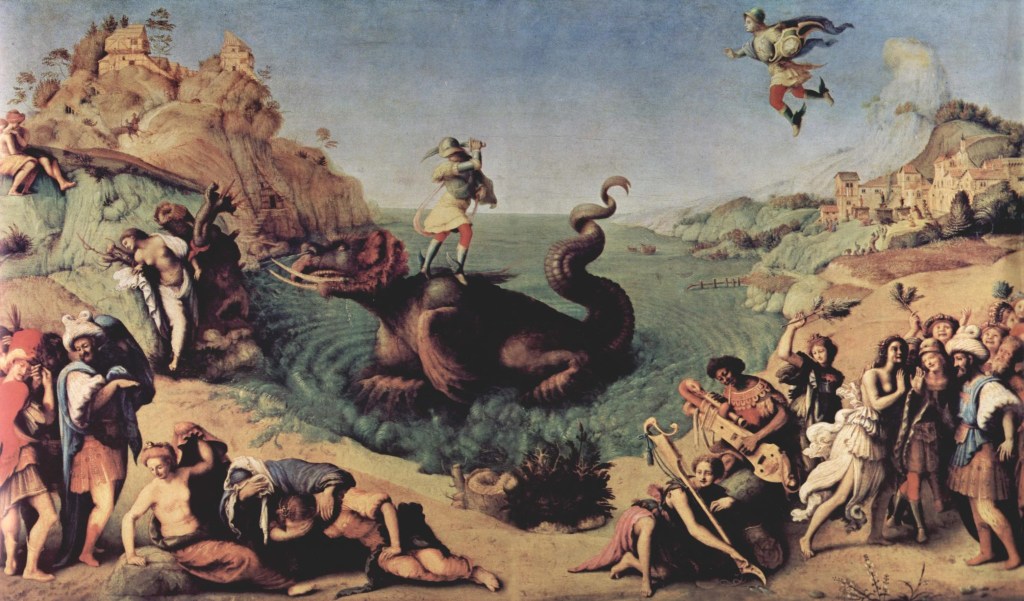
The racism that shapes both modern and historical beauty standards is no secret, and we see Andromeda undergo whitewashing as her story is received. She is not alone in this, as we see the same happen to the Queen of Sheba. In the Old Testament she states, ‘I am black and beautiful’. This is changed in later Latin translations to ‘I am black but beautiful’. Here we can see the changing attitudes – black was becoming dichotomous with beauty. The reception of Andromeda undergoes the same fate. In commentaries of Petrarch’s Andromeda, described as a ‘dark virgin with beautiful eyes and hair’, one wrote that she was ‘entirely ugly and black’. With a wealth of classical materials at their disposal, Renaissance poets and painters were well aware that Andromeda was black, choosing to portray her as a white woman to align with their own standards of beauty. Even those who chose to paint Andromeda with dark skin, never fully committed to celebrating black beauty. Diepenbeek’s Andromeda features dark skin, but has entirely European features, still reinforcing Eurocentric beauty standards. He was even scolded by his editor, who was outraged that he would paint the most beautiful woman in the world as having dark skin. Piero di Cosimo is often lauded for painting an authentic Andromeda, but when the paintings are examined, this is dubious – she’s only subtly darker, almost grey, still evidently white and with complete European features. Other artworks that depict Andromeda have no debate surrounding them – she is painted as a white European woman.
In recent years, Andromeda has been recognised as what she was – a beautiful black woman. But merely recognising this is not enough. Her importance prevails beyond her whitewashing, to the impact this act has had on our society today. The erasure of her beauty as a black woman, alongside many others, has impacted our Western beauty standards to the modern day, where Eurocentrism forms the foundation of what is seen as beautiful. A pioneer of Pan Africanism, W.E.B Du Bois, dedicated his final chapter of The World and Africa: An Inquiry Into the Part Which Africa Has Played in World History to Andromeda. He stated, ‘We owe it to Africa and ourselves to release Andromeda and place her free and beautiful among the stars of the sky,’ looking to the wishfully ancient world as a society, ‘where there was no color bar or name for race’. By denying her not only her African heritage, but her identity as a black woman, we allow classics to be something it is not – the story of white people, for white people. This false narrative has been used to dangerous lengths, infamously as a justification for slavery and segregation in the USA. In Du Bois’ The Souls of Black Folk, he draws from the classical sources, highlighting the importance of black Africans to ancient societies, in an effort to compel his fellow African Americans to not see themselves as outsiders, but as active agents in the civilisation that has been manipulated to oppress them. The whitewashing of Andromeda has made her a deeply significant character, an emblem of the impacts of racism.
The importance of celebrating black beauty is crucial in a society where one looks outwards to feel beautiful. As Eurocentric beauty standards prevail, it’s important to begin to undo the prevailing racism that surrounds the way we think about beauty in all facets of life – Classics included. As classicists, our work isn’t done by recognising racism within the reception of the contemporary sources – a recognition of the prevailing effects on our modern society is crucial. It is not enough to simply state that black beauty is beauty and ending the sentiment there. It’s about stating why society needs to promote and celebrate black beauty as strongly as European beauty. Eurocentrism has not only occurred in the past but prevails, the roots of which have grown deep in our society, making it our job to dig them up and discard.
Bibliography
Gates Jr.,H.,L. (2014), Was Andromeda Black? <https://www.theroot.com/was-andromeda-black-1790874592> [accessed 13 February 2024]
McGrath, E., (1992,) ‘The Black Andromeda’, Journal of the Warburg and Courtauld Institutes 55, 1-18.
Sekayi, D., (2003), Commercialism in the Lives of Children and Youth of Color: Education and Other Socialization Contexts, The Journal of Negro Education 72, 467-477
Smith Galer, S. (2019), How black women were whitewashed by art < https://www.bbc.com/culture/article/20190114-how-black-women-were-whitewashed-by-art#:~:text=Yet%20Renaissance%20art%20repeatedly%20depicts,darker%20and%20in%20exotic%20costume.> [accessed 13 February 2024]

