
Written by Ellie Whitehead
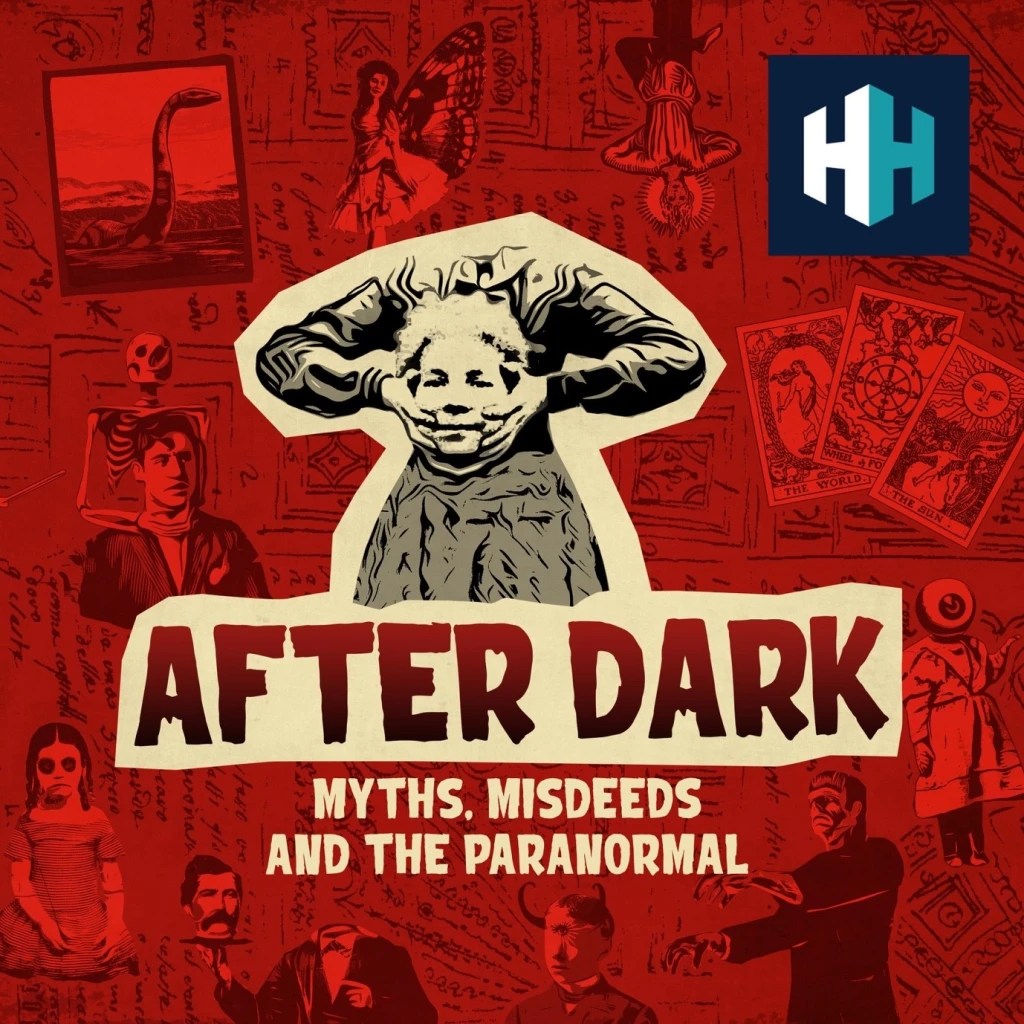
“This is After Dark: Myths, Misdeeds and the Paranormal. The podcast that takes you to the shadiest corners of the past, unpicking history’s spookiest, strangest, and most sinister stories. Join historians Anthony Delaney and Maddy Pelling, every Monday and Thursday to take a look at the darker side of history…”
Every Monday and Friday, this introduction welcomes your ears to a new episode of After Dark – the newest podcast on the block produced by award-winning history media giant, History Hit. Premiering just under four months ago, on the 16th of October 2023, it already has around 37 episodes for you to enjoy. Actor, writer, and historian Dr. Anthony Delaney is joined by writer, historian, and broadcaster Dr. Maddy Pelling investigating the often ignored and typically snubbed aspects of popular history. Bringing the discussion closer to home, Maddy was actually a postdoctoral fellow at The Institute for Advanced Studies in the Humanities (IASH) at the University of Edinburgh in 2020, working on her project Women and History: Female Antiquarianism and Historiographical Strategies, c. 1750‐1830.
After Dark episodes are about a range of spooky topics, spanning from the Origins of Halloween, the Ghost of Anne Boleyn and Victorian Baby Farm Killers to the Loch Ness Monster, the Last Witch of Scotland and Medieval Werewolves, Ghosts & Zombies (to name a few!). Episodes range from 25 minutes to just over an hour, meaning they can fit into the space of a nice hot bath, your daily commute or a run around the meadows.
Some podcasts have guests on to help bring the topic to life, such as the one about Myths of King Arthur with Dr. Eleanor Janega or Bodmin Jail with the manager of the attraction Jess Marlton. These guests help to illuminate the subject in question, opening up a discussion between the hosts and guests. This historical expertise is useful for the listener and the podcast follows a similar interview layout to its History Hit counterpart Not Just the Tudors with Professor Suzannah Lipscombe. The hosts come at these discussions with a varying degree of expertise and let the guest lead the conversation which makes for a refreshing discussion. In episodes without guests, this feeling is replicated with a student-teacher like approach. One host will lead the conversation, taking both the listener and their colleague through the main timeline, context, and fun facts.
One of the most recent episodes, ‘The Mythical Origins of Britain’, highlights why I think this new podcast is just so good. It uses casual, humorous and investigative conversation to introduce me to topics that I would have, admittedly, not previously looked twice at. In this episode, hosts Maddy and Anthony welcome Dr. Amy Jeffs, the author of the amazing and illustrative Storyland: A New Mythology of Britain, to discuss the myths and ancient folklore surrounding the origins of the British Isles. Dr. Jeffs takes our hosts through the mythical belief of the early origins of Britain, discussing chronicles such as Geoffrey of Monmouth’s The History of the Kings of Britain and the Scotichronicon. They explore the belief that survivors of the Trojan War washed up on Britain’s shores and vowed to lead the kingdom to greatness. At a particularly interesting point in the podcast, Maddy asks Amy to expand upon the thought that Britain was a product of inherited thought from other classical empires. Amy concurs and tells us of the story of the evil giant Gogmagog who was thrown off of a cliff in Portsmouth by warrior Corineus at the request of Brutus of Troy!
Bringing in their own vast wealth of historical knowledge, the hosts set out questions in an accessible, educational and entertaining manner. I am a victim of commonly pigeonholing myself into my specific early modern period of interest, but this podcast has allowed me to engage with and understand aspects of history of which I had little to no prior knowledge of. The fun, spooky atmosphere pulls me in further with each episode. It really is an innovative podcast, discussing and exploring aspects of history which historically have been ignored and are increasingly moving towards the forefront.
Featured Image Credit: Accessed via History Hit on X (formerly known as Twitter), @HistoryHit
 Retrospect Journal