
Tag: Political History
-
Between Utopia and Tyranny: What Plato and Marx Tell Us About Power

Lydia Collier-Wood compares and contrasts two renowned thinkers of our ancient and modern history. Plato’s Republic envisions an ideal society focused on justice and collective good, contrasting with Marxist theory’s historical view on class and oppression, revealing tensions in political idealism.
-
Neoliberalism Not-so Dead and Buried: Chilean Neoliberalism and Its Continuity in Post-Dictatorial Concertación-era Chile (1990-2005)

Alexander Stroem details the development of Neoliberal politics in post-dictatorial Chile.
-
Whipping up a Frenzy: President Truman and Cold War Hysteria
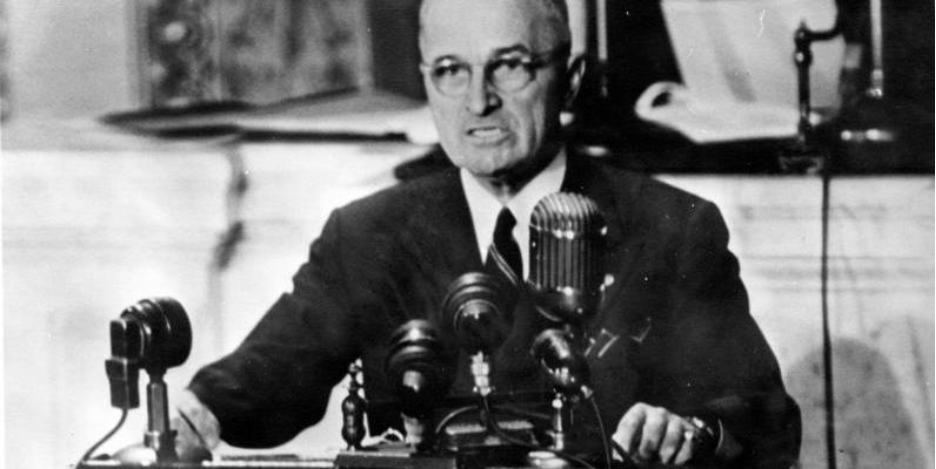
Eve Beere looks at the aftermath of FDR’s presidency and Truman’s adoption of an aggressive anti-Soviet approach to mark a shift from collaboration to confrontation.
-
The Lebanese-Armenian Community: Diasporic Nationalism, Positive Neutrality, and Post-War Decline

Connie Greatrix explores the policy of ‘positive neutrality’ adopted by Lebanese-Armenian political parties, discussing how this was motivated by aspirations of community survival.
-
The Importance of Archives: Partido Comunista de España (PCE) Archive Madrid
Isabelle Shaw discusses the importance of the Partido Comunista de España Archive in Madrid for understanding how the Spanish Communist Party operated.
-
The Biafran Crisis: How Famine Redefined Humanitarianism

The Nigerian Civil War, 1967-1970, arose from tensions between different and diverse ethnic groups following a forced union by British colonial powers. These struggles continued post Nigerian independence, and Louisa Steijger explores international responses to the Civil War which prompted a form of neo-humanitarianism.
-
The role of Khomeini in the 1979 Iranian Revolution

The 1979 Iranian Revolution resulted in the toppling of the Pahlavi dynasty and the creation of the Islamic Republic. Olivia Norbury acknowledges Khomeini’s role in unifying the Iranian people and cementing the ideology of political Islam. However, Norbury also seeks to explore other reasons for revolution, such as Shari’ati’s ideology and secular beliefs.
-
The Court of King Henry VIII and the Importance of Dynastic Portraiture

The Tudor dynasty leveraged portraiture to assert their legitimacy and power, with images emphasizing ancestry and wealth. Emily Jones considers portraits of Henry VIII and his heirs as not only symbolising dynastic continuity but also reinforcing monarchical authority and stability throughout turbulent political times.
 Retrospect Journal