
Written by Kat Jivkova
On 18 December 1912, amateur palaeontologist Charles Dawson revealed a remarkable discovery to the Geological Society of London. At the society’s meeting, fragments of skull believed to belong to the earliest Englishman “the Piltdown Man” were presented to the attendees, one of whom remarked that the findings constituted “the most important discovery in England.” Meanwhile, newspaper headlines around the world optimistically claimed that the Piltdown Man confirmed Darwin’s theory of evolution: “Missing Link Found!” Forty years later, esteemed geologist Dr Kenneth Oakley provided evidence to suggest that the Piltdown Man was fraudulent: “… it is now clear that the distinguished palaeontologists and archaeologists who took part in the excavations at Piltdown were the victims of a most elaborate and carefully prepared hoax.” While the perpetrator remains unknown, most scholarship name Dawson as the main suspect. The Piltdown forgery remains one of the most significant instances of scientific fraud, having triggered a paleoanthropological debate spanning a period of over one hundred years and finally concluding in 2016. But what made the claims of Dawson so alluring, yet so controversial during this period? In what ways did the hoax unite Britain’s scientific community, and what are its implications for the future of anthropology? I aim to answer these questions in my brief analysis of the rise and fall of the Piltdown Man, with special focus on Oakley’s work.
According to the official account of Dawson’s discovery, published in the Geological Society’s Quarterly Journal, he had first come across the fragments of skull in the autumn of 1912 at the Piltdown gravel pit, in Sussex. Subsequently, he contacted the Keeper of Geology at the British Museum, Arthur Smith Woodward, to make sense of his findings. Woodward “was immediately impressed,” with the discovery according to Dawson, and the men spent a significant portion of the following year in search of further skull pieces. Frank Spencer’s impressive work on the Piltdown papers reveals the extensive epistolary-based communication of Dawson and Woodward during this period. Dawson often wrote to Woodward of his progress in the recovery of various cranial fragments and referred to him as his “geologist friend” in letter correspondences to his parents and friends. Various scholars of science, in an effort to uncover the motivations behind the hoax, argue that Dawson used Woodward as a channel through which he could acquire scientific recognition. On the contrary, I argue that the friendly correspondence between the men suggests that Dawson held genuine respect for his “colleague” and valued their friendship. Immediately, Dawson’s account of the discovery raises issues of inconsistency. For one, in a speech to the Geological Society he recounts coming across a fragment of human cranium at the site four years prior to 1912, which had been discarded by workmen for looking like a “coconut”. While the inconsistency in his chronology of events was not questioned at the time, in light of the hoax’s unveiling it is suspicious; the vagueness of the report reinforces Dawson’s role as a prime suspect in the fraud.
At the onset of the unveiling of the Piltdown Man, Dawson and Woodward were met with praise from Britain’s scientific community. Professor of Dental Surgery, Arthur Swayne Underwood, noted his enjoyment of “the historic occasion”; geologist George Barrow “was greatly interested in the deposit and especially the flints [of the skull]; biologist Edwin Ray Lankester praised the “great evening last Wednesday at the Geological”, wishing to be the first to examine the pieces of jaw presented earlier in the month. Archaeologists placed the age of the skull at five hundred thousand years old at the time. Meanwhile, the Piltdown case dominated newspaper headlines: for instance, The Graphic published an article under the following title: “A Hard Nut to Crack for Christmas: Have we really found the missing link at last?” Woodward’s publication, Eoanthropus dawsoni (the scientific term for the Piltdown Man), generated further excitement among the British public. Aside from supporting Darwinism, Piltdown specifically introduced Britain as a protagonist in the mapping of human evolution: the enthusiasm surrounding its discovery was nationalistic as much as it was scientific. Other opinions, namely those of anatomists and zoologists, were sceptical of the Piltdown Man. Woodward’s reconstruction of the skull of a human ancestor was most famously criticised by Arthur Keith, Conservator at the Royal College of Surgeons, who proposed his own reconstruction. Even still, anatomists considered the various reconstructions inaccurate, arguing that the cranium was too human-like, and the jaw too ape-like, to belong to the same skull structure. These scepticisms were initially undermined by the “Smith-Woodward” narrative in the earlier years but exacerbated after the Second World War.
The most discernible hit to the credibility of the Piltdown Man came from Oakley’s paper titled “The Solution of the Piltdown Problem.” Oakley used fluorine tests to disprove the claim that the Piltdown remains were five hundred thousand years old – in reality, they were only approximately fifty thousand years old, at which humans were already in their Homo sapiens form. Therefore, the skull could not have possible been “a missing link” between ape and man. In his collaborative work with Wilfrid Le Gros Clark and Dr Joseph Weiner, Oakley further discovered that the skull and jaw fragments did not belong to the same individual, probably coming from a human and ape, respectively. Further, Oakley dedicates an entire section of his research to evidence “of the artificial abrasion of the Piltdown teeth,” in which he deduces that, upon inspection with a binocular microscope, the teeth of the skull had been artificially filed down – this was probably the work of Dawson. Finally, the paper revealed that most of the fragments found at the Piltdown site were not actually found at an English deposit: “it is probable that they [the molar fragments] were obtained from some foreign source and artificially stained to match the Piltdown cranial bones and mandible.” The technology of the 1950s enabled more sophisticated processes of anthropological testing, based on fluorine analysis, which not only disproved the Piltdown Man’s legacy, but also shed light on the scientific misconduct that surrounded the case. Indeed, the skull pieces found on the site were fraudulently modified and placed there. Oakley affirmed that the ten which were analysed by his team were “unquestionably frauds,” with there being “strong grounds for believing that this is also true of the remainder.”
In 2016, a research paper published in the Royal Society Open Science journal substantiated Oakley’s earlier study, utilising modern scientific methods centred around DNA and morphometric (quantitative) analyses. The motivation behind this study was to demonstrate that modern scientific techniques could provide new insights into twentieth-century paleoanthropological debates. Aside from its scientific findings, the study also offers interesting suggestions into the motives of Dawson’s forgery (assuming that it was indeed Dawson that orchestrated the hoax, which remains unconfirmed). In a 1909 letter to Woodward, he wrote the following: “I have been waiting for the big find which never seems to come along”. It seems likely that Dawson wanted to further his reputation as an archaeologist, and his knowledge and connections certainly would have made the forgery of specimens easy enough. What is striking about this hoax, and explains why it remains so popular, is that these specimens were so convincing that they fooled the entire country. The Piltdown Man was able to unite Britain’s scientific community, just as quickly as it was able to divide them as its controversy grew. It has taught scientists two critical lessons: firstly, that they should approach new findings with a critical eye in order to not be deceived; and secondly, that they must not be led to accepting a discovery based on preconceived scientific ideas; in this case being the theory of evolution and the prospect of Britain being a key part in its mapping. Thus, the Piltdown Man serves as an example of what anthropologists should not do in their research. The main question that remains is whether we will ever know for certain who the Piltdown Man’s forger was.
Bibliography
Bartlett, Kate. “Piltdown Man: Britain’s Greatest Hoax.” BBC History, 2017. [Online]. [Accessed on 20 October 2023]. https://www.bbc.co.uk/history/ancient/archaeology/piltdown_man_01.shtml
De Groote, Isabelle, Linus Girdland Flink, Rizwaan Abbas, Silvia M. Bello, Lucia Burgia, Laura Tabitha Buck, Christopher Dean, et al. “New Genetic and Morphological Evidence Suggests a Single Hoaxer Created ‘Piltdown Man.’” Royal Society open science 3, no. 8 (2016): 160328–160328.
Natural History Museum. “Piltdown Man.” [Online]. [Accessed on 20 October 2023]. https://www.nhm.ac.uk/our-science/departments-and-staff/library-and-archives/collections/piltdown-man.html
Natural History Museum. “Piltdown Man hoax findings: Charles Dawson the likely fraudster.” [Online]. [Accessed on 20 October 2023]. https://www.nhm.ac.uk/discover/news/2016/august/piltdown-man-charles-dawson-likely-fraudster.html
Spencer, Frank. The Piltdown Papers, 1908-1955. London: Natural History Museum Publications, 1990.
Subramaniam, Nandini. “The Problem of Piltdown Man.” Science History Institute: Museum & Library. [Online]. [Accessed on 20 October 2023]. https://www.sciencehistory.org/stories/magazine/the-problem-of-piltdown-man/
Weiner, J. S., Kenneth Page Oakley, and Wilfrid E. Le Gros Clark. Further Contributions to the Solution of the Piltdown Problem. London: British Museum Natural History, 1953.
Weiner, J. S., Kenneth Page Oakley, and Wilfrid E. Le Gros Clark. The Solution of the Piltdown Problem. London: British Museum Natural History, 1953.
Woodward, A. Smith. “Note on the Piltdown Man (Eoanthropus Dawsoni).” Geological magazine 10, no. 10 (1913): 433–434.
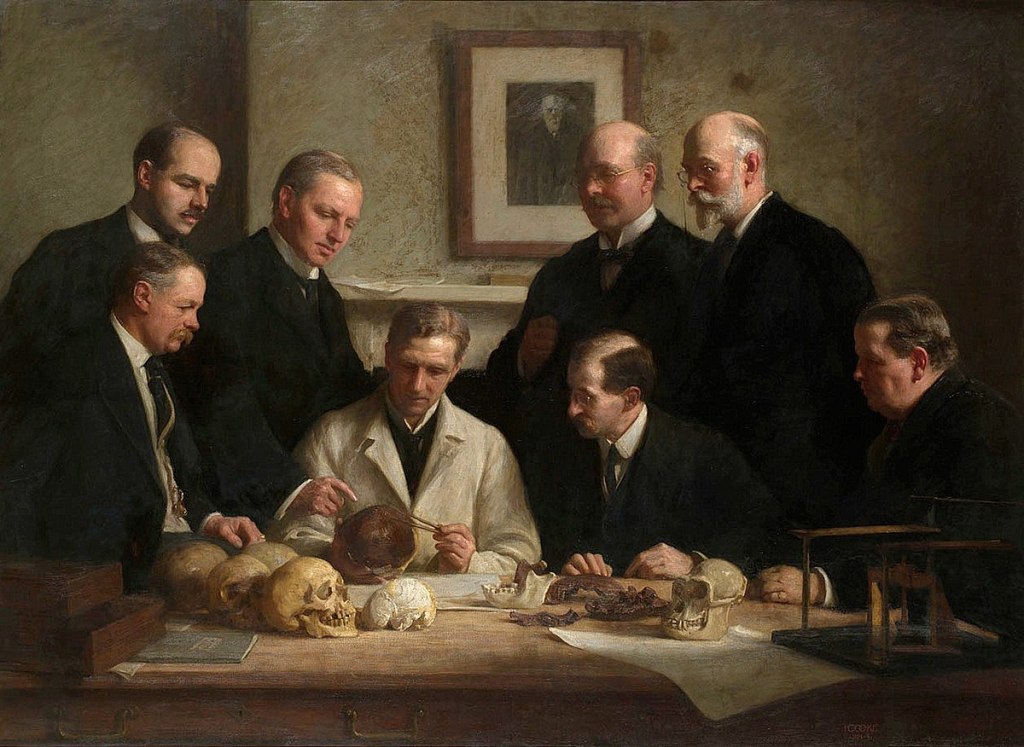
Featured image credit: Piltdown Gang by John Cooke, 1915. https://commons.wikimedia.org/wiki/File:Piltdown_gang_(dark).jpg


.jpg)