
Written by Edie Christian
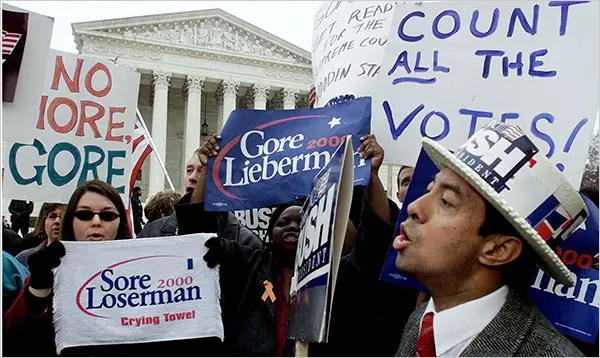
The organisation and outcome of the 2000 presidential election has long since cast aspersions on the Supreme Court of the United States (SCOTUS). Many consider the resulting decision, Bush v. Gore (2000), to be a watershed moment of distrust in American elections and institutions, and it is easy to see why. In the United States government, the separation of power between its three branches – executive, legislative, and judicial – allows for checks and balances between each branch in order to restrict absolute power. So what happens when Supreme Court justices intervene and, instead of allowing the electorate to vote on the President of the United States, appoint him themselves?
The Supreme Court decision Bush v. Gore arose from a few contested counties in Florida during the election. Several hundred votes were invalid due to ‘hanging chads’, meaning voting slips weren’t entirely punched through and therefore not counted. Despite the votes evidently being made for Al Gore – the Democratic candidate – SCOTUS overruled the Florida Supreme Court’s order for a manual recount, with George W. Bush therefore winning the presidency. Bush had actually lost the national popular vote, but the historic electoral college system means that he still could have legitimately won. The Electoral College has 538 electors, with a majority of 270 required to win a presidential election. The number of electors per state is dependent on population size – whilst Maine and Nebraska employ a type of proportional representation, the other states use a ‘winner-takes-all’ system, where all the electoral votes will be cast towards the candidate who won the state popular vote.
A deep division resulted in America between those who believed Al Gore had attempted to steal a national election, and those that believed Bush had done so using five justices that – while not Republican in name – espoused constitutional originalism and conservative principles. Interestingly, the typically conservative concept of federalism – in which the states’ power should supersede that of the federal government’s – was practically destroyed in the court’s decision. This created another dimension to criticism; federalism is enshrined in both the ninth – the ‘elastic clause’ – and tenth amendment to the Constitution, thereby inviting many to view the justices’ actions as unconstitutional. This period in American political history has led some to believe that the justices are merely politicians in disguise; the use of judicial philosophies in Supreme Court decisions is arguably a thin veil for justices’ political opinions.
It could be argued that Bush v. Gore has fatally undermined the American peoples’ faith in their electoral system, with the political actions of a supposedly neutral Supreme Court threatening the core of the system of government and its separation of powers. As the judiciary is an unelected body in a democratic society, it relies heavily on the public perception of its legitimacy. In 2010, it was found that the number of lawsuits related to electoral issues had more than doubled since Bush v. Gore, whereas before the electorate and political parties had been quick to accept official election data. There is an evident partisan dimension to this distrust, with Republicans accused of voter suppression and Democrats of election fraud.
This is most clearly manifested in the 2020 presidential election, with Donald Trump making more than 800 inaccurate claims about the election from when the polls began closing in November 2020 to the end of his presidency. Countless accusations were levied against Democrats, particularly surrounding the legitimacy of mail-in ballots, which Trump denounced as a ‘corrupt system’. The argument that voting by mail is highly susceptible to fraud has been disseminated by conservatives for years, although studies have found it to be exceedingly rare; Judd Choate, the director of elections in the Colorado Department of State, declared there to be ‘very little evidence that there is more than a handful of fraudulent (vote-by-mail) cases…in a given election cycle’. This public anger at the electoral system culminated in the January 6th attack on the United States Capitol in the attempt to overturn the election result; whilst the rioters had been fed months of dangerous rhetoric and falsehoods, it is important to consider the years of distrust in American elections, at least partly derived from the legacy of Bush v. Gore.
However, disputed elections are by no means a modern phenomenon – the Supreme Court has historically intervened in several presidential elections in a similar way to that of 2000. The 1876 election saw a stalemate between Republican candidate Rutherford B Hayes and Democratic candidate Samuel Tilden – the results of several states remained unclear, despite both candidates claiming them. There were several facets to why this election was disputed. Republican-controlled ‘returning’ boards – an official body who declare the results of state elections – threw out enough Democratic votes for Hayes to win in certain states. As well as this, an election official had to be disqualified and reappointed, and Congress received two sets of conflicting electoral votes. Although these issues were to be resolved with a non-partisan commission of senators, representatives, and Supreme Court justices, a third Republican justice was appointed, therefore outnumbering the Democrats. The commission unsurprisingly voted 8-7 to legitimise the victory of the Republican candidate – it is therefore clear that while the judicial intervention into an electoral process in Bush v. Gore is an anomaly, it is certainly not unprecedented.
Indeed, anxieties surrounding the dilution of individual votes are certainly not unfounded, and arguably epitomised by the process of gerrymandering. This practice allows for the boundaries of electoral districts to be manipulated in order to favour a particular political party, and is a systemic problem in America. The Voting Rights Act of 1965 addressed the particular problem of racial gerrymandering, where districts are intentionally drawn to dilute the minority vote; the difficulty in proving intention means the issue is not completely eradicated. Whilst there is no ‘correct’ way to draw a congressional district, it is evident that the process of gerrymandering is having an adverse effect on democratic elections, as districts are becoming less competitive – following the 1996 election, there was 164 districts with a partisan lean, compared to 72 following the 2016 election.
The Supreme Court arguably has precedent for ruling that extreme partisan gerrymandering is unconstitutional. Baker v. Carr (1962), in which the Tennessee legislature failed to reapportion based on its growing population, was ruled by SCOTUS to violate the equal protection clause of the fourteenth amendment. This was consolidated by Shaw v. Reno (1993), in which it was ruled that electoral boundaries that cannot be proven not to be racial gerrymandering can be challenged as potential violations of that same clause. This previous protection has seemingly been eroded in subsequent decades, with the conservative majority of the Court ruling in the 2019 case Rucho v. Common Cause that ‘partisan gerrymandering claims present political questions beyond the reach of the federal courts’. If the federal judiciary and wider government are unwilling to protect democratic elections by targeting extreme partisan gerrymandering, they ultimately go largely undefended.
Overall, Bush v. Gore – whilst not unprecedented in American judicial and political history – was a defining moment for loss of public faith in national elections. This trend has ultimately proven dangerous, epitomised by the January 6th riots and the rise of demagogues such as Trump as people have become disillusioned with the political system. The evidently politicised decision begs the crucial question – do we really have control over who we elect to our high offices?
Bibliography
Blackford, Sheila. “Disputed Election of 1876 | Miller Center.” millercenter.org, September 30, 2020. https://millercenter.org/the-presidency/educational-resources/disputed-election-1876.
Cole, David. “The Liberal Legacy of Bush v. Gore the Liberal Legacy of Bush v. Gore Part of the Courts Commons, and the Judges Commons,” 2006. https://scholarship.law.georgetown.edu/cgi/viewcontent.cgi?article=1417&context=facpub.
Hasen, Richard L. “Election Hangover.” Slate, December 3, 2010. https://slate.com/news-and-politics/2010/12/the-real-legacy-of-bush-v-gore.html.
MacDougall, Ian. “Why Bush v. Gore Still Matters in 2020.” ProPublica, November 1, 2020. https://www.propublica.org/article/why-bush-v-gore-still-matters.
Mackinnon, Amy. “Why Trump’s Elections Challenges Are Nothing like Bush v. Gore.” Foreign Policy, November 6, 2020. https://foreignpolicy.com/2020/11/06/election-2020-trump-legal-challenges-bush-gore/.
Page, Susan. “It’s Not 2000 Anymore: President Trump’s Rejection of Election Sets Rocky Landscape for President-Elect Biden.” USA TODAY, 2020. https://eu.usatoday.com/story/news/politics/elections/2020/12/12/trumps-rejection-election-diverges-bush-v-gore-path-2000/6521328002/.
Qiu, Linda. “Fact-Checking the Breadth of Trump’s Election Lies.” The New York Times, August 17, 2023, sec. U.S. https://www.nytimes.com/2023/08/17/us/politics/trump-election-lies-fact-check.html.
Saul, Stephanie, and Reid J. Epstein. “Trump Is Pushing a False Argument on Vote-By-Mail Fraud. Here Are the Facts.” The New York Times, April 11, 2020, sec. U.S. https://www.nytimes.com/article/mail-in-voting-explained.html.
Featured Image Credit: Adam Liptak, “Bush v. Gore Set to Outlast Its Beneficiary,” The New York Times, December 22, 2008, sec. U.S., https://www.nytimes.com/2008/12/23/us/23bar.html.

