
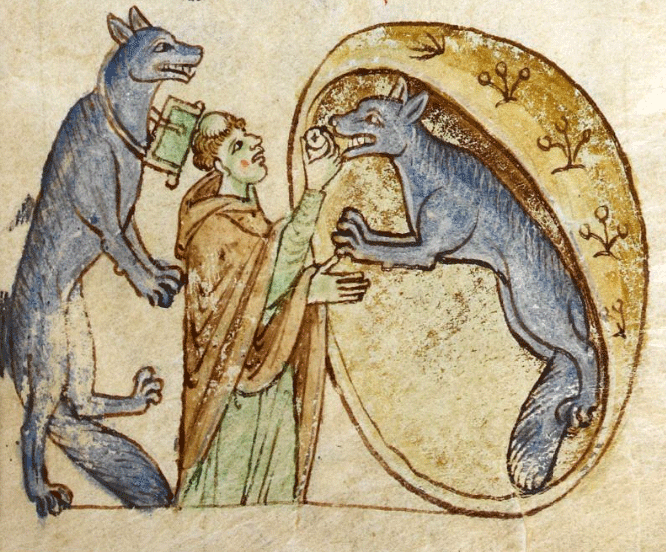
Written by Fiona Macrae
In modern fiction, the werewolf is a staple of fantasy and thriller books, with many familiar features which define it. Most readers will be familiar with the concept of a werewolf transforming on a full moon, transmitting the condition through biting, and being killed only by a silver bullet, but there are lycanthropic tales from the ancient world which show that the werewolf is not merely a current fad. In particular, I will be comparing stories of human-wolf transformations from two ancient novels: the werewolf story of Niceros at Trimalchio’s dinner in Petronius’ Satyricon, and Dorcon’s wolf disguise in Longus’ Daphnis and Chloe.
Although written in the 1st century CE, Petronius’ werewolf tale contains elements familiar to the modern reader. The tale is told by Niceros, a freedman, when the dinner party host asks him to entertain the group (Satyricon 61-2). It reads like a campfire ghost story: set in a graveyard outside of the city at night, the companion unexpectedly transforms himself into a wolf, kills a number of sheep, and is proven to be the same creature because of injuries he sustained in his wolf form. In Daphnis and Chloe, the wolf is the cowherd Dorcon in disguise, intent on sexually assaulting the young girl Chloe (Longus.1.20-1). Rather than undergoing a magical transformation, he dons a wolfskin and hides in the bushes like a wolf and is revealed when attacking dogs pull the skin off his back.
One qualifying feature of ancient werewolves, as identified by Ogden in his 2020 book The Werewolf in the Ancient World, is that the werewolves are either wolves inside with a human exterior (usually clothes, not skin) or humans inside with a wolf exterior (a wolf skin). By divesting the outer layer, transformation occurs: the wolf would put his clothes back on to become human again, and vice versa. This is seen in Sat.62 when Niceros’ companion strips off his clothes and transforms into a wolf. In order to maintain his wolf form, the man urinates in a circle around his clothes transforming them into rock. This allows him to find his clothes and transform himself back into a man. The inverse is seen in Daphnis and Chloe, as Dorcon does not shed his human clothes, but instead dons a wolf-skin, revealing his inner wolf. He returns to his human nature when the dogs pull the wolfskin from his back, and he finally calls for help. In this way, clothing facilitates both a symbolic and physical transformation for werewolves in the novels.
Different degrees of transformation occur in the two novels. Dorcon’s transformation is simultaneously real and only symbolic, as his appearance as a wolf reveals his predatory nature and acts as a lesson in the sexual development of the naïve Chloe. The text maintains a clear difference between human Dorcon and his wolfish disguise, whereas there is no doubt in Niceros’ story that he saw anything but a real werewolf. Dorcon dons the wolfskin carefully, with each wolf part placed with the corresponding human part, showing a duality in the transformation, thus he is not entirely transformed. Instead, he makes himself “look as much like a wolf as he could.” His chosen hiding place is described as “the perfect place for a real wolf to lurk in ambush,” (Longus.1.20) and the dogs attack “what they took for a wolf,” (Longus.1.21) in each case demonstrating that Dorcon is merely in disguise and not fully transformed. Thus, there is still a distance between Dorcon’s appearance as a wolf, and him actually being one.
The degrees of transformation are also dictated by the genres of the novels. The Satyricon, as its name suggests, is a collection of rude and bawdy tales, thus the tale of the werewolf is allowed to use comic and rude images such as urination. However, it can also be read on another level: the cena Trimalchionis scene is a satirisation of Plato’s Symposium, thus a thread of philosophical thought can be detected throughout. Therefore, the story of the werewolf can also be read as Niceros contributing a philosophical view on the nature of man through the uneducated means of a freedman. The werewolf is allowed to fully transform in Niceros’ tale because we are supposed to find it ridiculous as educated readers. Daphnis and Chloe, on the other hand, is a bucolic tale of the maturation of a young couple. There is an underlying theme of sexuality which prompts Dorcon’s actions, but the innocence of Daphnis and Chloe quashes the sexual aggression before it can begin. Dorcon’s wolf form represents his position as a sexual predator rather than being a wolf for the sake of being one as is the case in the Satyricon. In this way, Dorcon and Niceros’ companion each demonstrate the genre of their novels through the nature of their lycanthropy.
Further differences between the two transformations lie in the injuries the wolves sustain during their transformations. Niceros uses the neck injury the wolf receives to confirm that his companion was also the wolf who attacked the sheep on the farm, as his girlfriend Melissa tells him “one of our slaves shoved a spear through its neck.” This is the exact injury the doctor is treating the man for when Niceros returns home. Dorcon, on the other hand, is protected from injury by the wolfskin and is only wounded once it is pulled from his back and the dogs can sink their teeth into his flesh (Longus.1.21). The injuries of the wolf do not transfer to Dorcon once he becomes human again, as he is disguised, not truly transformed, whereas the man and wolf of Niceros’ story are one and the same.
Admittedly, there are very few similarities between the features of the modern werewolf outlined in the introduction and the werewolves seen in Satyricon and Daphnis and Chloe, with the only real connection being human-wolf transformation. Neither of the werewolves of the novels discussed are killed, nor do they try to transform others into wolves. Their transformations are not limited to full moons, and instead happen at will with the wearing or discarding of clothing. However, the settings seem somewhat in keeping with modern expectations: a graveyard is standard for a spooky tale, and so are the dark woods. Nevertheless, these human-wolf transformations are still recognisable to us today as early iterations of the werewolf.
Bibliography
Epstein, S. (1995) ‘Longus’ Werewolves’, Classical Philology, 90(1), pp. 58–73.
Hoffman, H. (2014) ‘Petronius’ Satyrica’, in E.P. Cueva and S.N. Byrne (eds) A Companion to the Ancient Novel. John Wiley & Sons, Incorporated, pp. 130–155.
Longus (2002) Daphnis and Chloe: A New Translation by Ronald McCail. Translated by R. McCail. Oxford University Press.
Ogden, D. (2020) The Werewolf in the Ancient World. Oxford University Press.
Petronius (1997) The Satyricon: A New Translation by P. G. Walsh. Translated by P.G. Walsh.
Plaza, M. (2001) ‘Derision and Conflict in Niceros’ Story (Petronius, Sat. 61,3 – 62, 14)’, Latomus, 60(1), pp. 81–86.
Featured image credit: Werewolves of Ossory. https://commons.wikimedia.org/wiki/File:Werewolves_of_Ossory.png


