
Written by Kat Jivkova
Ever since graphene was isolated from graphite and characterised in 2004, academic interest in its real-world applications has remained consistently substantial. For instance, in 2011, former Chancellor of the Exchequer, George Osborne, announced plans to invest £50 million into graphene-related research at the University of Manchester. Between 2004 and 2012, academic publications on the uses of graphene increased from less than five hundred to almost twelve thousand per year; by 2013, graphene-related publications averaged forty per-day. A decade later, however, graphene’s title of “wonder material” has started to be questioned. With the challenges posed by its synthesis on an industrial scale, and the expenses associated with bulk production, graphene has not been as successful in the commercial sector as initially hoped. In 2021, the UK manager of Haydale Graphene Industries, Mark Seymour, acknowledged the “graphene disillusionment” phenomenon: “It’s had the hype. It has been hurt. Now it’s picking up.” At present, however, there is still hope that graphene commercialisation will expand, with global industries racing to discover its further applications.
Graphene is defined as a sheet of one atomic layer of carbon atoms; therefore, it can technically be considered a two-dimensional material. At present, it is the thinnest known material, with a height of 0.33 nanometres. It is also the strongest, something which can be attributed to the covalent bonds between its carbon atoms arranged in hexagons. Traditionally, the history of graphene begins in 2004, with its “discovery” by a research group at the University of Manchester, led by Professor Andre Geim and Professor Kostya Novoselov. These researchers successfully isolated graphene using the “Scotch Tape method”, which involved the simple process of removing single layers of graphene from a slab of graphite using adhesive tape. In 2010, Geim and Novoselov were awarded the Nobel Prize in Physics “for groundbreaking experiments regarding two-dimensional material graphene”. Awarding the Nobel Prize only six years after graphene’s discovery seems surprising; however, once a more comprehensive version of graphene’s history is considered, the Nobel Committee’s decision can be better understood.
Before the history of graphene can be traced, it is useful to also acknowledge its predecessor: the carbon allotrope known as graphite. It is thought that graphite was first discovered in sixteenth-century England by miners, although there is evidence of its existence as far back as six thousand years ago. Graphite was originally assumed to be made of lead rather than carbon, but this belief was subverted by Swedish chemist Carl William Scheele in 1779. In modern times, graphite is used in the pencil, nuclear, and motor industries, to name a few. The development of graphene, on the other hand, spans a shorter history of around 170 years, beginning in the nineteenth century. It is important to note that developments in the study of graphene, even in the earlier years, were not restricted to one singular scientist or institution – the structure of graphite oxide, revealed to be a group of thin sheets or “lamella”, was observed by numerous scientists between 1840 and 1958, including British chemist Benjamin Brodie and German scientist Carl Schafhaeutl. The collective work of these scientists centred around numerous oxidation experiments and proved that graphene could be divided, or “delaminated”, into separate layers.
Understandings of graphene from the later-twentieth century onward can be categorised into three phases: theoretical, experimental, and physical. We have already covered the latter through the findings of Geim and Novoselov. The former two phases are discussed henceforth. Philip Wallace was the first to explore graphene within a theoretical framework with his publication, “The Band Theory of Graphite” (1947). His idea was developed further through the use of Transmission Electron Microscopy (TEM) imaging a few years later, which visually displayed layers of graphene – these experimental studies were led by scientists G. Ruess and F. Vogt. The most significant milestone in the study of graphene was the work of Hanns-Peter Boehm and his co-workers, who used TEM to identify single graphene sheets in 1961 and ultimately coined the term “graphene” over twenty years later. Geim argued as part of their Nobel Lecture that the observations of Boehm’s team may have “received little attention until 2009-2010” but should still “stand as the first observation of graphene”. The Nobel laureates have stressed, on multiple occasions, that the physical discovery of graphene could not have been possible without the exceptional work of Boehm, and rightly so. Between 1990 and 2004, there were efforts to produce single layers of graphite, though none could reach the thinness observed in 2004.
Indeed, 2004 was the “golden year” for graphene and marked the beginning of the age of the graphene hype. As mentioned, the progress of graphene has experienced a downward trajectory in recent years in spite of the many academic works centred around its uses, with the main reason being its lack of “out of lab applications”. Unfortunately, the Scotch tape method for obtaining graphene seems to be one of the only methods that maintains the quality of the graphene produced. One of the most common methods for the large-scale synthesis of graphene, for instance, is the “reduction of exfoliated graphene oxide”. This approach produces defective graphene, which can be several layers thick and with impurities, thus not as useful to industries. Another common production method of graphene, known as vapour deposition, produces good-quality graphene but at a prolonged rate. Therefore, the manufacture of graphene is the largest setback to its development within material science research and is the main reason it has not experienced a significant breakthrough at a commercial level; however, several companies, including Tesla, are currently investing in graphene-related research. Notably, the Nuclear Decommissioning Authority has also attributed the limitations of graphene’s commercial use to environmental concerns and “lack of standardisation;” both valid concerns which are not raised as frequently as they should be within existent graphene discourse.
It is my view that the graphene gold rush came too fast; it takes decades for a new material to be developed and for its potential to be realised. This is not to say that Geim’s and Novoselov’s jointly-awarded Nobel Prize was undeserved – their achievements can certainly be viewed as a culmination of graphene’s impressive development from the 1840s onward. It was the immediate reaction to their discovery that I would categorise as part of the gold rush rather than their achievements alone. In the period between 2004 and 2011, especially, headlines surfaced on the news virtually every month declaring the many amazing breakthroughs graphene could lead to – “graphene can solve the world water crisis;” “graphene will make batteries charge five times faster;” “graphene can detect diseases”. Perhaps the initial excitement surrounding graphene was a little hasty. However, the main question to ask now is: Is there a future for graphene? Given the relative recency of its discovery and the impressive number of developments that have followed in the current decade, the answer is: certainly. The initial graphene gold rush may have come and gone, but the newfound, more realistic excitement surrounding graphene in present years is a step in the right direction for the future of its development.
Bibliography
Dreyer, Daniel R., Rodney S. Ruoff, and Christopher W. Bielawski. “From Conception to Realization: An Historial Account of Graphene and Some Perspectives for Its Future.” Angewandte Chemie (International ed.) 49, no. 49 (2010): 9336–9344.
GOV.UK. “Graphene, one for the future”. [Online] [Accessed on 27/09/2023].
https://www.gov.uk/government/case-studies/graphene-one-for-the-future
Jolly, Jasper. “How ‘wonder material’ graphene became a national security concern.” The Guardian, 2021: [Online] [Accessed on 27/09/2023].
https://www.theguardian.com/business/2021/sep/27/graphene-wonder-material-national-security-china-uk
Randviir, Edward P., Dale A.C. Brownson, and Craig E. Banks. “A Decade of Graphene Research: Production, Applications and Outlook.” Materials today (Kidlington, England) 17, no. 9 (2014): 426–432.
Sharon, Madhuri, Maheshwar Sharon, and Hisanori Shinohara. “The History of Graphene.” In Graphene, 1–15. United States: Wiley, 2015.
The Nobel Prize. “Andre Geim: Nobel Lecture”. [Online] [Accessed on 27/09/2023].
https://www.nobelprize.org/prizes/physics/2010/geim/lecture/
UK Parliament. “Evidence on Graphene”. [Online] [Accessed on 27/09/2023].
https://committees.parliament.uk/writtenevidence/67180/pdf/
Wallace, P.R. “The Band Theory of Graphite.” Physical review 71, no. 9 (1947): 622–634.
Wyss, Kevin. “Graphene is a proven supermaterial”. The Conversation, 2022: [Online] [Accessed on 27/09/2023].
Featured Image Credit:
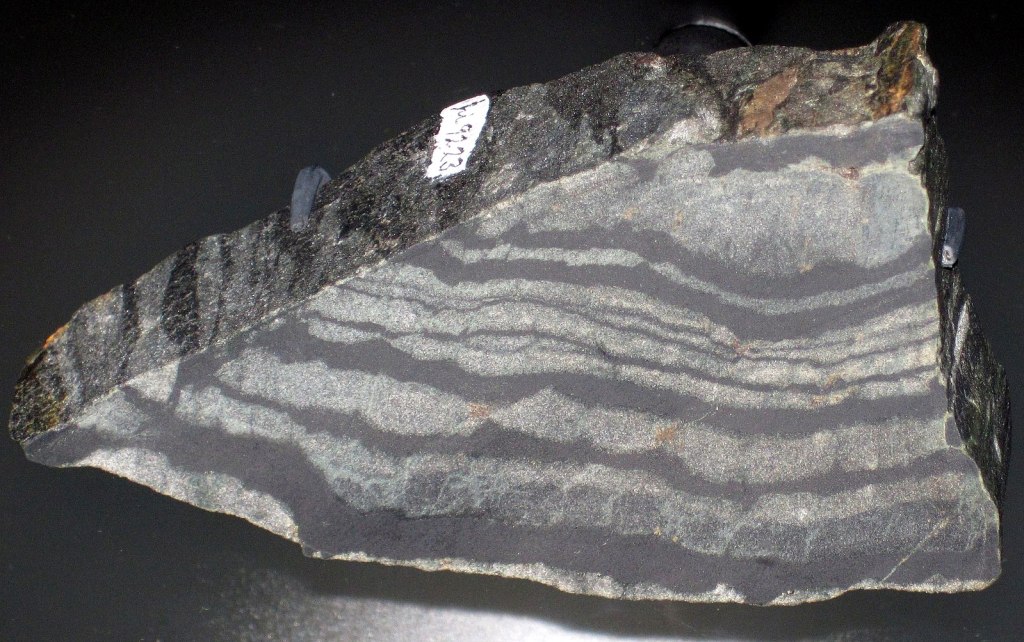
John, James St. Graphitic Banded Iron-Formation (Meta-BIF) from the Precambrian of Greenland (FMNH Li 9223, Field Museum of Natural History, Chicago, Illinois, USA). August 21, 2010. Graphitic BIF (meta-BIF) (Eoarchean, 3.8 Ga; Isua Supracrustal Belt, southwestern Greenland). https://commons.wikimedia.org/wiki/File:Graphitic_BIF_(meta-BIF)_(Eoarchean,_3.8_Ga;_Isua_Supracrustal_Belt,_southwestern_Greenland)_(15056531391).jpg.


_(Eoarchean,_3.8_Ga;_Isua_Supracrustal_Belt,_southwestern_Greenland)_(15056531391).jpg)