
Written by Darcy Gresham
When one thinks of happy, good-natured countries, Denmark and Canada would likely rank pretty high on the list; however, for just over half a century these two nations fought over competing claims to the desolate Arctic rock, Hans Island. The Island is positioned in the Nares Strait between Greenland, an autonomous kingdom of Denmark, and the Canadian Ellesmere Island. It wasn’t until 2022 that the pseudo-conflict (both bloodless and relatively under the radar) was concluded with the signing of a treaty.
Hans Island was named for Hans Hendrik, an Inuit known in Greenlandic as Suersaq, who assisted both American and British expeditions to the Arctic during the 19th century. To honour his assistance and knowledge, the island was posthumously given his name. First references to the island as “Hans” are seen in accounts of polar expeditions dating from 1853, and in 1876 it first appeared in cartography, seen in maps accompanying the narratives of Polar navigator Charles Francis Hall. The island is known in Inuit as Tartupaluk, meaning “kidney,” based on its shape and is used to hunt primarily polar bears, as well as other animals. Beyond that, one may question its usefulness to Denmark and Canada, but it has become an area to which they are attached and, amid increasing sovereignty claims in the Arctic, could prove strategically helpful.
Due to its geographical location, both Denmark and Canada believed that Hans Island was part of their sphere of influence. Efforts to draw boundaries through the Nares Strait provoked the question of ownership of the island, which lies roughly 18km from both countries, thereby giving them both credible claims to the territory. If you fancied running a half marathon in the Arctic, then you could visit the rock outcrop from either Europe or North America, with a couple of kilometres to spare. Despite closer proximity to the Canadian capital, the Danes emphasised the presence of indigenous Greenlandic peoples on and around Hans Island to strengthen their claim.
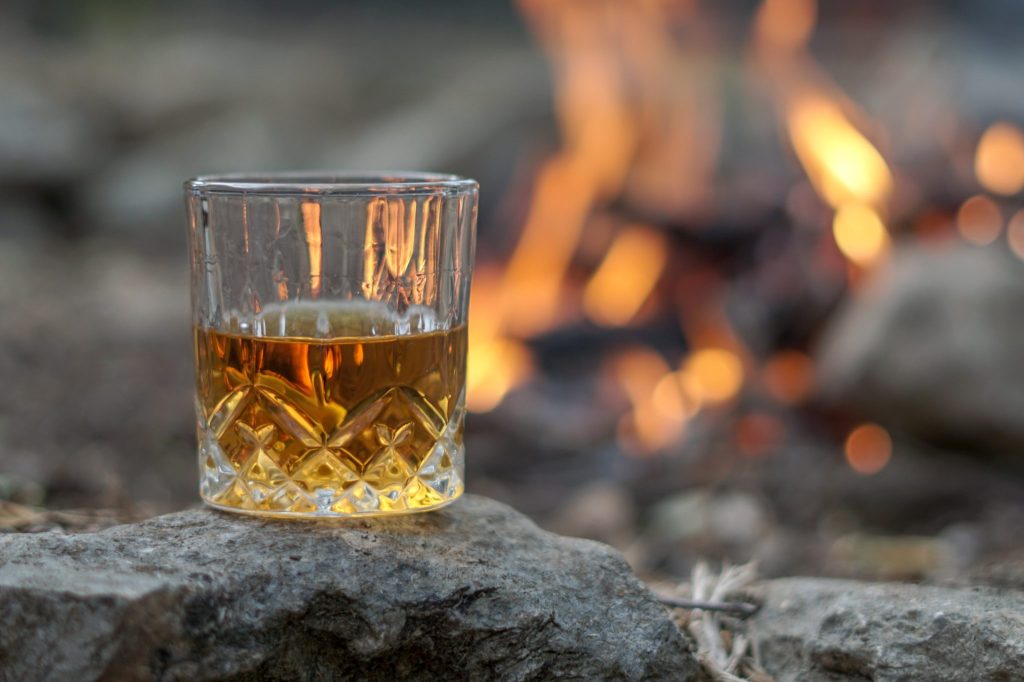
In 1984, Canada landed a small group of troops on the rock who planted a flag and, at its base, buried a bottle of Canadian whisky. In response, a Danish delegation led by the Minister of Greenland affairs visited the Island and hoisted the Danneborg (the Danish national flag) and replaced the whisky with the finest Copenhagen schnapps. From then onwards, each delegation would arrive at the island, take down the flag, hoist their own up the mast, and leave a bottle of whisky as a gift to the other nation. Supposedly, this alcoholic gift celebrates the friendship between the nations, despite the territorial dispute that provided the backdrop to events. It is seen in international diplomacy circles as a reflection of the good nature of, and between, Denmark and Canada and as a prime example of peaceful territorial dispute. Alcohol is also potentially a perfect item to be greeted with after travelling through the icy Arctic conditions. There is no estimate of the number of bottles that were ever left or collected, nor is there scholarship on the fate of these liquors, leaving historical imagination to muse upon the fates of alcohol in the hands of freezing delegates in the middle of the Arctic.
As time went on, comical notes also started to accompany the bottles of whisky and schnapps that had been left. There are even stories that tell of Canadians posting the Dannebrog back to Denmark after replacing it with their own flag. There have been a few minor instances of outcry against the Whisky Wars, with diplomatic protests and online campaigns – one of which amusingly urged Canadians to boycott Danish pastries. While this may not significantly affect the Danes (due to their ample pastry exports), Canadians would likely miss a good cinnamon roll. These tales stem from the so-called “Google fights”, where Google promoted either Canadian or Danish ownership of Hans Island in 2005 through advertisements. However, this was seen as harmless and treated as entertainment by the media in both nations. Nevertheless, the Canadian Foreign Affairs Ministry did publish a statement reporting that they would allow Danish pastries to continue to be sold within Canada, which illustrates their stance towards the matter.
In 2018, they settled these competing claims by dividing the rocky outlet in half. Using the geographical features of the island, the territory has been split, resolving this long-standing dispute. The deal was signed in 2022 — arguably a predictable end to what had been a very good-tempered and polite series of confrontations. In keeping with tradition, at the signing of the treaty in Ottawa, Greenland’s Prime Minister, the Canadian foreign minister, and the Danish foreign minister all exchanged bottles of alcohol one final time.
Nowadays, Hans Island represents a land border between Denmark and Canada as well as an example of a friendly border dispute — an adjective not usually associated with such an event. It also established the world’s longest maritime border of 3,882km between the nations. Both foreign ministers involved in negotiations praise the way diplomacy prevailed on Hans Island for showing how rulings of law can be successful without the need for violent action.
The cooperation between peoples that it represents has also been applauded. Importantly, Inuit from both countries are allowed free passage around the island and its surrounding ice waters, continuing hunting traditions and journeys that date from the 14th century. Those living between Greenland and Canada utilised the island over centuries and were therefore keen for its purpose to remain the same. Inuit representatives were involved and consulted about the treaty, and were pleased with the successful outcomes, especially where the internationality of Arctic peoples was protected.
The Whisky Wars encompass ideas beyond the pure necessity of creating borders between nations: they show the promotion of diplomacy and friendship within international relations, and the possibilities of peaceful negotiation. The gifts of whisky make the tales that bit more enchanting and evoke the feelings of the real people involved within the expeditions. It feels as though it would be rare for a ‘war’ to be carried out like this in today’s world, but the only recent end to the liquor exchanges shows us we aren’t all that removed from our neighbours and gives us hope for the continuation of friendly cooperation.
Bibliography
Rozina Sabur. Canada and Denmark end 50-year ‘whisky’ war over tiny Arctic Island. The Telegraph Online, 15 June 2022 https://telegraph.co.uk/world-news/2022/06/15/canada-denmark-end-50-year-whiskey-war-tiny-arctic-island/
The Local. What does the resolution of Denmark-Canada ‘whisky war’ tell us about international relations? The Local, Denmark, 15 June 2022 https://www.thelocal.dk/20220615/what-does-resolution-of-denmark-canada-whisky-war-tell-us-about-international-relations
Alexandra Pope. Canada and Denmark end 50 year ‘Whisky War’ over Hans Island. Canadian Geographic, 14 June 2022 https://canadiangeographic.ca/articles/canada-denmark-end-50-year-whiskey-war-over-hans-island/
Erin Blakemore. The barren Arctic Island that sparked Canada and Denmark’s Whisky War. National Geographic, 14 June 2022 https://www.nationalgeographic.com/history/article/how-hans-island-sparked-whisky-war-between-canada-denmark
Matt Murphy. Whisky Wars: Denmark and Canada strike deal to end 50-year row over Arctic Island. BBC News Online, 14 June 2022 https://www.bbc.com/news/world-europe-61801682

