
Written by Ambrose Brown
Content warning: Racial discrimination.
Isaiah Turner stood trembling, heart clobbering against his chest with the force of a jackhammer. Droplets of perspiration trickled down his temples like a sudden storm. The voices of the mob exploded into a cacophony of white noise; their turbulence was almost tangible. Isaiah’s gaze was fixed on the Little Rock Nine as they marched forward, each step an act of defiance cultivating Isaiah’s courage and yet immobilizing him in equal measure. He saw himself among them, bravely shouldering the burdens ahead side-by-side. Yet, when the moment of truth arrived, his feet were rooted to the ground in fear. He could feel the eyes of the mob boring into him, their jeers piercing deeper. Every aspect of his life was on the line with no room for error, as each step forward brought him closer to an abyss. Every beat of his heart surged with the pressure of history building to a better future until it shattered. Its pieces reverberated with regret until he had no choice but to turn around. He ran.
Time has an innate symmetry and within every moment of remorse is a plethora of events, not occurring, but inherent because of their proximity and influence. Each morning, Isaiah wakes in safety, and each night he dreams of solidarity and choices unmade. Each trigger thrusts him back to the blinding Arkansas sun, an air of suffocation, where screams of a divided nation are all that pierce that atmosphere. The shadow of his failure– a constant companion– didn’t haunt him quite like Elizabeth Eckford’s recollection:
“They moved closer and closer. […] Somebody started yelling. […] I tried to see a friendly face somewhere in the crowd—someone who maybe could help. I looked into the face of an old woman, and it seemed a kind face, but when I looked at her again, she spat on me.”
Each time Isaiah replayed those words in his mind, he’d wonder: could he have been that friendly face? Could he have shielded her from spit and condemnation, or at least offered a look of compassion amidst the sea of hostility? But he knew, he’d known too many, the depth of his pain widened by the memories of many who’d stood firm in the face of hate.
Those who knew Isaiah had seen the torment in his eyes on that fateful September day. Daisy Bates, having been in the thick of the integration efforts, understood the weight of Isaiah’s guilt.
“Isaiah,” she began, her voice firm, yet understanding, “inaction can consume anyone. But it’s never too late to act. Be part of the change, even if it’s in the smallest of ways.”
She was the one who originally encouraged him to attend. Yet, today as he stood among fellow NAACP members in their church of progress, history echoed in that hallowed hall. The warmth of the gathering, one that intended to promote unity and hope, was suddenly interrupted. A young Black man, with papers in hand – likely an appeal or a speech for the evening – was cornered by a group of white police officers who’d stormed in the church. Their trespass came accompanied by harsh whispers and loud accusations, fingers pointing menacingly. Vitriol dripped like venom from their tongues while their slurs sliced the air. The attendees held their breath in anticipation as a torrent of fear and recognition bludgeoned them. Isaiah’s heart pounded with dread as memories came flooding back – the oppressive atmosphere of Little Rock Central, his crippling hesitance, and ultimate surrender to injustice.
The crowd hushed – their place of hope desecrated by hate – eyes darting, each person calculating their own risk if they intervened. The looming threat was evident: the menacing stance of the officers, the tightening grip on their batons, the unspoken warning in their eyes. His compatriots froze, paralyzed by fear. Isaiah’s jaw twitched as he clamped down his teeth. His fists were tightly clenched, and his black knuckles subtly paled from the pressure. Rage and regret coursed through his veins.
“Not again,” he murmured, taking a deep breath.
Isaiah parted the sea of people with his hands that met the shoulders of each he passed, he carried a look of defiance. Their faces were twisted in obstinacy and rage, a change from the fear and uncertainty that gripped them. He threw himself in between the police and their prey, arms extended. The police went silent as Isaiah’s eyes met theirs and he spoke with resolution and solidarity in his throat.
“Enough! No justice. No peace.”
The sound of the crowd’s chants bounced off the high ceilings and stained-glass windows of the church, their belligerence came alive like a profound harmony. “No justice! No peace!” Ushering the retreat of scared uniformed white men.
As their assembly’s fervor began to subside, Isaiah spotted a familiar face emerging from the periphery. Elizabeth Eckford. The recognition was immediate; their eyes locked in deep, wordless conversation. Her nod was subtle yet burned with an unspoken understanding. She’d been there, iced in that horrible moment like the rest. As they embraced, past and present merged, and years of unspoken emotions flowed between them. All their moments of doubt and courage and the weight of color.
The past is etched in stone, but if redemption is a surgery, then Isaiah, like all the others, would endure many scars. The legacy of those who came before Isaiah filled his mind with inspiration, but now he knows that spark could come from within as well. The only distinction, a moment of strength or weakness – our humanity – shaped by a thousand cuts from oppression’s cruel sword. Isaiah sees himself for what he truly is – a being of both great vulnerability and indomitable courage, alive in all who surround him.
Author’s Note:
While set against the real events of the Little Rock Nine, the fictional narrative and characters including Isaiah Turner, are crafted to explore themes of redemption, justice, and internal struggle.
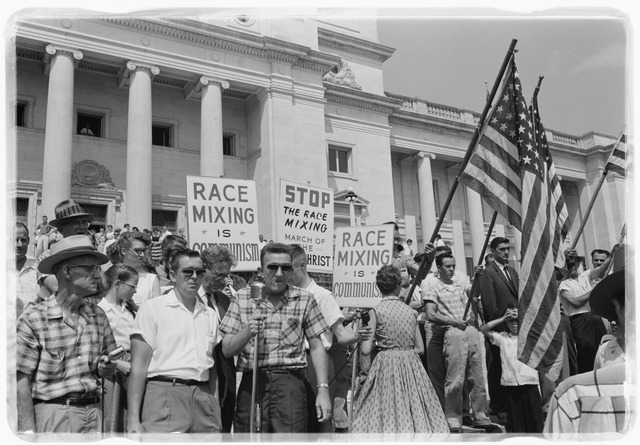
Featured image credit: Little Rock Integration Protest 1959, accessed via Wikimedia Commons.

