
Written by Alisha Allen
What does the end of the world look like to you? Do you imagine the coming of four horsemen, hail and fire, the earth and seas sapped of life? Or rather, nuclear bombs, wildfire and extinctions, or even a zombie apocalypse? Imaginings of the end of the world are imbued throughout history, from the writings of saints during the time of the Romans to current doomsday preppers. Clearly the question of the apocalypse is one that has ever intrigued humans, leaving us pondering, obsessing and worrying in some manner or other about our own extinction.
First, it is important to establish some terms. While phrases such as doomsday and apocalypse are thrown around in current media, they actually denote specific aspects of the end times. ‘Apocalypse’ stems from the Greek word for ‘revelation’ (ἀποκάλυψις), which came to mean divine revelations of hidden matters. Apocalyptic literature, therefore, revealed a number of divine secrets including, but not limited to, world destruction. For ease of understanding, I will only use this term to reference the period leading up to the end of days. ‘Doomsday’ refers to the day of judgement, the term found in old English texts as ‘domes dæg’, made up of the words for statute or sentence (particularly a condemnatory one) and day. Now the terms have been clarified, we can move onto when, how and why such ideas emerged.
The template for apocalyptic texts originated in ancient Jewish and Christian literature. However, speculations of the apocalypse first appear as far back as the sixth century BC, within the ancient Iranian religion, Zoroastrian Dualism. For Christianity, ideas of apocalypse revolved around the duality of God as figure inspiring both awe and terror. The story of Noah’s ark would have taught early Christians that while God promised to never flood the world again, He had not ruled out alternate forms of destruction. Essentially, if the world were deemed full of wickedness and sin, a second instance of divine wrath could be impending. The rise of later Christian works, such as the Book of Revelation by John the Apostle, offered some ambiguous, but nevertheless vivid additions to the apocalyptic genre. His descriptions of a red moon, falling star, pestilence and more horrors leaves the reader with an incomprehensible yet still very much unpleasant image of the end which, according to him, was nigh. When Doomsday didn’t arrive, however, commenters on the Revelation interpreted the text as more allegorical than prophetic.
Variations in belief surrounding the lead up to doomsday can be attributed to their respective economic, social and political setting. Counterintuitively, when the current age was, as Paul Hanson described, precariously “situated on the edge of the abyss”, thought of apocalypse provided comfort. Apocalyptic texts were a method for spreading a consoling message that was attuned to the fears of those receiving it. They offered truth and explanation within a haze of chaos and uncertainty. Perhaps it was better to have an end to suffering in sight, no matter how cataclysmic such an end would be. This was particularly seen throughout periods of religious persecution. Contemporary texts promised punishment for the prospering wicked and reward for the suffering righteous. When things were bleak, the promise of retribution encouraged faith and perseverance. This was not only employed at times of opposing countercultures, but also when there loomed external threats. The Anglo-Saxon period also faced violent raids from Vikings. The brutalities of the time are reflected in the amassing of apocalyptic themes within their literature, particularly those shared with the wider populace.
In contrast to the earlier Christian texts, which encourage optimism, Anglo-Saxon texts are permeated with guilt and self-blame. Wulfstan, a monk and later bishop who wrote during this time, perceives Vikings as a manifestation of God’s wrath, a direct result of humanity’s sinfulness.
And the English now for long have been defeated and too greatly humiliated through the wrath of God. And the Vikings are too strong through the permission of God that often in battle one drives away ten, sometime less, sometimes more – all because of our sins! […] We pay them [tribute] continuously, and they daily humiliate us. They raid and burn, rob, and plunder and lead us to their ships! And lo, what else are all these events but the wrath of God over this nation, clear and evident?
This text offers a great example of how apocalyptic texts were a product of the society within which they were written. The focus on sins and atonement within texts from this period are likely connected to the popular and embedded system of confession and penitence at the time. Additionally, the Anglo-Saxon’s practice of Christianity still held traces of its predecessor, Germanic Paganism. The two faiths shared their belief of a cosmic clash at the end of the world (Armageddon and Ragnarok); however a crucial difference is that within the Germanic myth, the Gods who fight for good will lose. In this way, Germanic paganism could be characterised as inherently pessimistic, thus affecting their later beliefs within Christianity.
While apocalyptic ideas did emerge amongst confusion and upheaval, this was not the sole context within which these cries of apocalypse exist. Rather, a better term coined by scholars to describe such periods is one of ‘perceived crisis’. Though some texts quell fear during rampant Viking raids or subjugation, others attempt to draw attention to a matter, amplifying it to a divine scale. Thus, this term serves to reflect the vast range that encompasses the genre of apocalyptic literature. A prime example of this is the famous Revelation by John the Apostle. While Christians would face mass executions and torment within Rome, notably under the reigns of Nero and Diocletian to name a few, persecution during the time of Emperor Domitian (under whom John the Apostle was writing) was rare. In fact, apart from being exiled for his Christianity, he lived peacefully within the urban province of Patmos, with no evidence of hostilities from Roman officials or non-Christian neighbours. So why did John the Apostle write of the impending end of days? The Revelation is thought to instead be responding to a striking disparity between Christian expectations and their current experiences. John the Apostle’s text may have intended to rally Christians by creating an impression of crisis; unifying them to a singular cause by framing it within an apocalyptic context would emphasise the magnitude of the situation.
Perception of crisis could also be in response to large technological shifts. This is particularly prevalent within our modern age. When the industrial period arrived, it brought more secular discussion of the world’s end. As society and technology became increasingly advanced, more felt threatened by it. During the Cold War, apocalypse was conceived in the form of nuclear disruption, visualising anxieties surrounding the ‘Arms Race’ and developments of nuclear weapons. Even in the current news we hear of the potential for human extinction from new AI advancements.
What is clear is that commentaries on the idea of apocalypse don’t emerge from nothing. Rather, they are augmented by fear and uncertainty. It is interesting to question why, throughout history, we have spent so much time imagining and re-imagining the end of the world. Perhaps we are drawn to speculating the worst, or we simply can’t stand sitting in uncertainty.
Bibliography
De Winter, P. M. (1983). Visions of the Apocalypse in Medieval England and France. The Bulletin of the Cleveland Museum of Art, 70(10), 396–417.
Huber, L. R., & Mould, T. (2018). On the Edge of Apocalypse: An Introduction. CrossCurrents, 68(2), 207–215.
Jeffery, I. (2026). Art and the Apocalypse. Available at: https://www.liverpoolmuseums.org.uk/stories/art-and-apocalypse (accessed: 23 October 2026).
Lindohf, J. M. (2002). Images of the End: Representations of the Apocalyptic In Contemporary Film. PhD thesis, University of Glasgow.
McFayden, D. (1920). The Occasion of the Domitianic Persecution. The American Journal of Theology, 24(1), 46–66.
Radish, M. (2017). Why do we call the end of the world “doomsday”?. Available at: https://mashedradish.com/2017/01/27/why-do-we-call-the-end-of-the-world-doomsday/ (accessed 26 October 2026)
Ryan, M. A. (Ed.). (2016). A companion to the premodern Apocalypse (1st ed.). Brill.
Thompson, L. L. (1990). The book of Revelation: Apocalypse and empire. Oxford University Press.
Image Credits
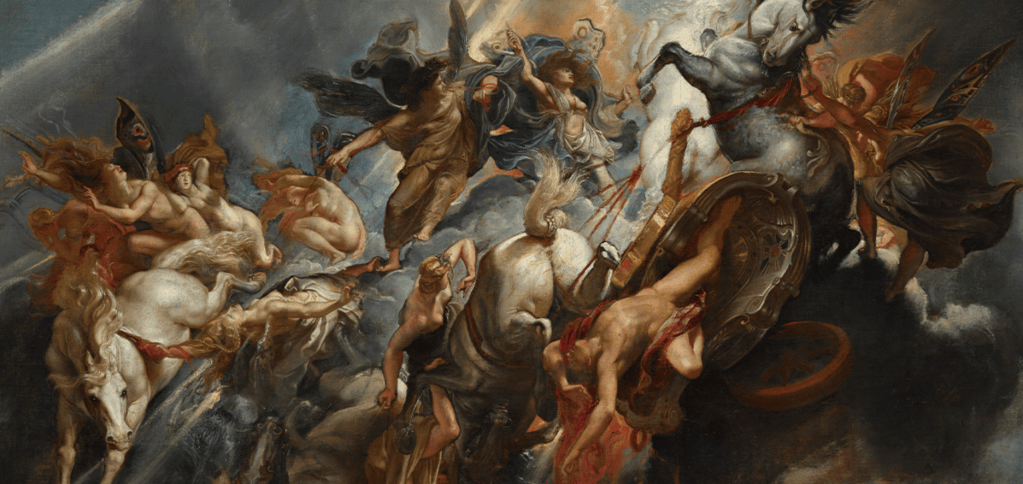
“The Fall of Phaeton” by Peter Paul Rubens (c. 1604/1605, oil), image available at https://yalebooks.yale.edu/2025/03/19/apocalypse-in-greek-and-roman-classics/
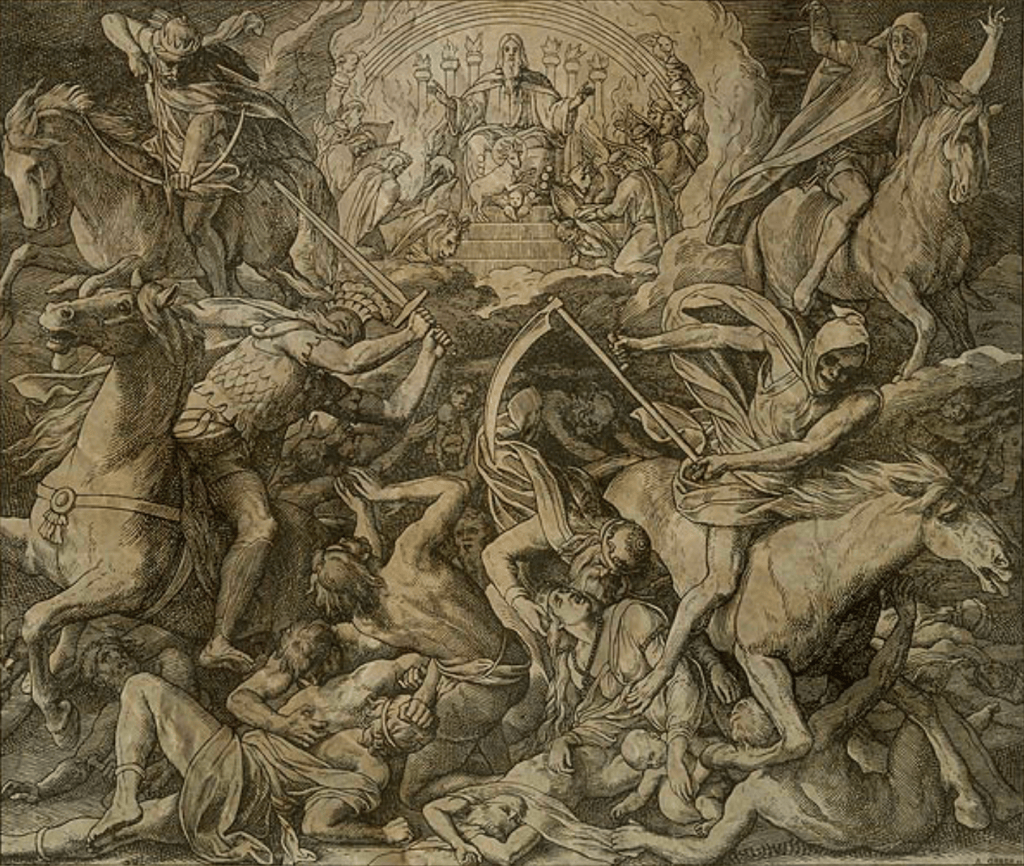
“Four Horsemen” by Julius Schnorr von Carolsfeld (1860), image available at https://en.wikipedia.org/wiki/Four_Horsemen_of_the_Apocalypse

